
BY MARK A. LARSON
Question: “Why did the team let the manager go?”
Answer: “Because you can’t fire 25 players.”
That’s one of the reasons often given when a club is floundering and a managerial change takes place.
In the first two parts of this three-part series, we profiled Twins managers from 1961-80. In this third – and final – installment, we’ll cover the 1980s and ’90s, looking at each Twins manager during the past two decades …
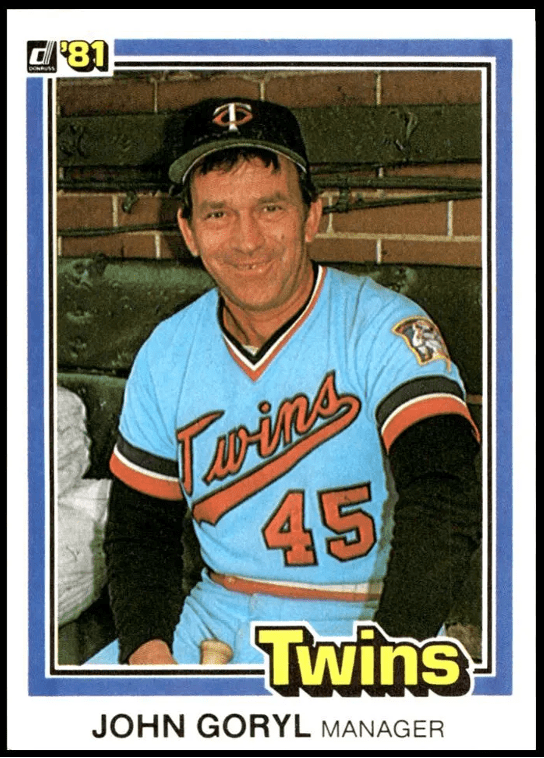
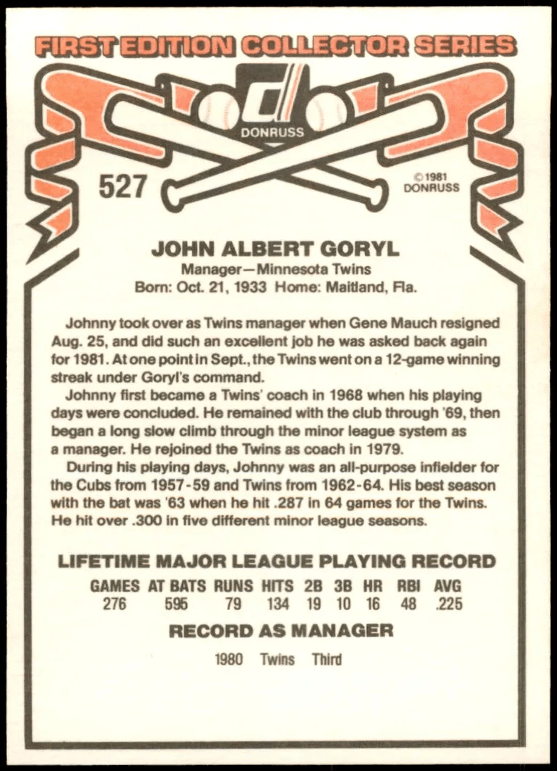
~ 1981 Donruss ~
• JOHN GORYL: When John Goryl took over the reins of the Twins in the latter part of 1980, the team was just a hollow shell of its former self. Minnesota had been devastated by the loss of players through free agency or pathetic trades made because of the threat of free agency.
During Gene Mauch’s four-plus years as manager (1976-80), the Twins seemed close to becoming legitimate contenders. But owner Calvin Griffith’s penny-pinching ways would pull the rug out from under any potential winning teams. No doubt, Griffith was in a financial bind. Yet any smart business owner knows that sometimes you have to spend money to make money. Fans aren’t going to come out to the ballpark year-after-year to watch mediocrity – especially when the owner had basically let star players just slip away.
Goryl became Twins Manager with about six weeks to go in the ’80 season. He inherited a 6th-place team, 17 games under .500. During the final 36 games, the team rallied and went 23-13, finishing in 3rd-place.
As good as the 1980 season ended for Goryl, that’s how bad the ’81 campaign began. The team started the season 11-25 and that was all she wrote for Goryl’s first (and only) major league managerial assignment. Billy Gardner then took command.Goryl, like many of his Twins managerial predecessors, had played in the big leagues for the franchise. During the last half of six years in the majors, the infielder appeared in 159 games for Minnesota. Although a lifetime .225 hitter, he batted .287 in 1962. Goryl’s first baseball card was in the 1958 Topps set. He appeared in a Twins uniform in the 1962-64 Topps sets. Donruss and Topps included him in their 1981 sets as a manager.

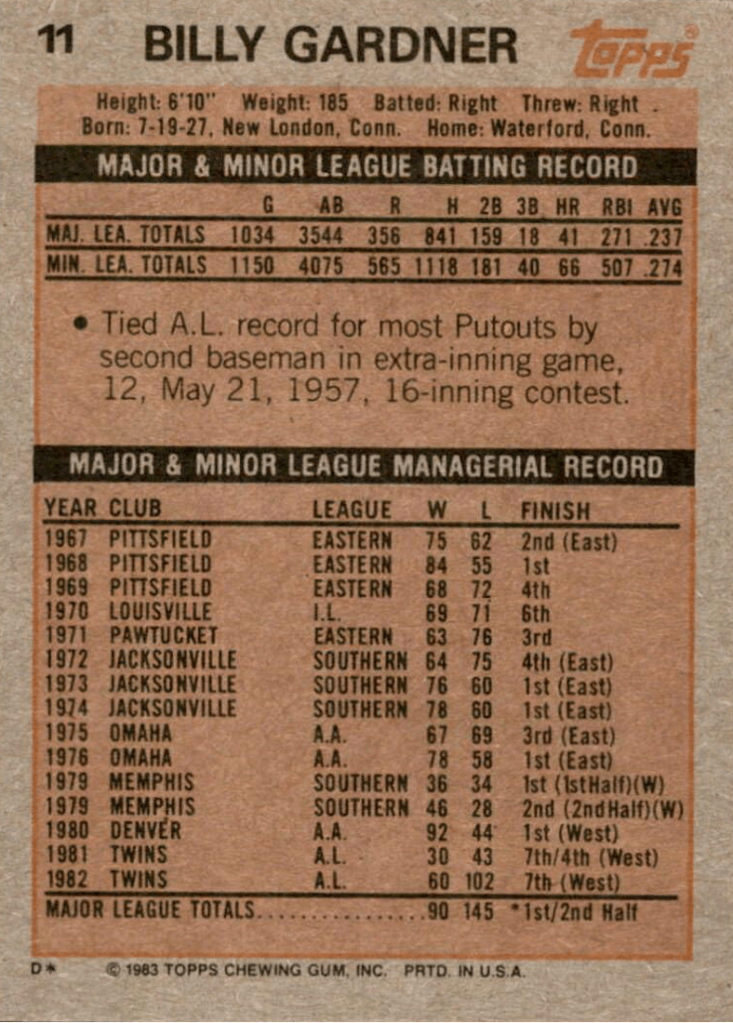
~ 1983 Topps ~
• BILLY GARDNER: Billy “Slick” Gardner’s relationship with the Twins went all the way back to the days when the franchise was still in Washington. The second-baseman spent the 1960 season with the Senators, moved with the team to Minnesota, then was traded to the Yankees in June 1961. Over a 10-year major league career, (1954-63), Gardner hit .237. His best season was with the Orioles in 1957. He led the league in doubles and at-bats that year.
In 1955, Gardner was included in his first major card sets (Topps and Bowman). His ’61 Topps card shows him with the Twins. He appeared as a manager in several 1980s sets.
When Gardner became Twins skipper in 1981, the team was woefully inadequate in almost every respect. Weak hitting combined with lame pitching does not a contender make. Plus, 1981 was wrecked when the players’ strike wiped out over 60 games and led to a split season.
The Twins franchise had only been kept somewhat competitive the previous half-dozen years with the equivalent of bailing wire, staples, scotch tape and paper clips. Now the charade was over. The curtain was pulled back on the Wizard (Griffith) exposing him for what he was: A humbug. Plain and simple, the Twins stunk.
The 1982 season began with the Twins moving to the Metrodome and Griffith unloading more players. Fans couldn’t believe it. Gardner was now faced with fielding basically an all-rookie lineup. But even though the ’82 Twins posted the worst record in the team’s history, there were signs of possible future success. Although Griffith had let nearly every good Twins player from the mid-1970s on get away, he had somehow managed to assemble a decent crop of youngsters.
Gardner led an ’82 team that included: First-baseman Kent Hrbek (23 home runs, 92 RBIs, .301 average), third-baseman Gary Gaetti (25 home runs, 84 RBIs), outfielders Gary Ward (28 home runs, 91 RBIs) and Tom Brunansky (20 home runs), plus catcher Tim Laudner and a young lefthanded pitcher named Frank Viola.
The team improved a bit in 1983 and by 1984 played .500 ball and contended in the weak A.L. West, finishing just three games out. Besides posting their best record in five years, two other important events occurred in ’84. First, in May, a rookie outfielder arrived on the scene by the name of Kirby Puckett. Secondly, Griffith sold the team to Carl Pohlad that summer.
Unfortunately for Gardner, the Twins slipped a bit in early 1985 and he was replaced in June by Ray Miller. Yet, Gardner should receive some credit for molding a young, inexperienced team into what would become a World Championship club.
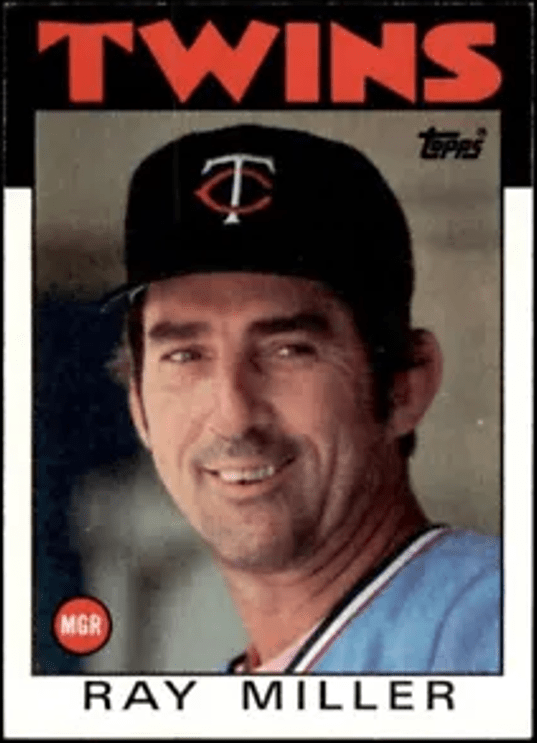

~ 1986 Topps ~
• RAY MILLER: Now it was Miller time. But it was no high life for the Twins. Minnesota was Miller’s first managerial position, having previously been Baltimore’s pitching coach. A decent pitching coach? Yes. A good manager? Far from it. As a leader, Miller was lite.
As evidenced by both his major league stints as a manager (Twins 1985-86 and Orioles 1998-99), Miller has done less with more than almost any other recent field boss. In 100 games with the Twins in ’85, the team went 50-50. In ’86, Minnesota was 59-80 when Miller was canned late in the season. He was replaced by Tom Kelly and the next year the Twins were World Champions.
Miller pitched in the minors for 10 seasons. He first appeared on a baseball card in 1986 as Minnesota’s manager. He has served as a major league pitching coach – both before and after his time with the Twins – for over 18 years.
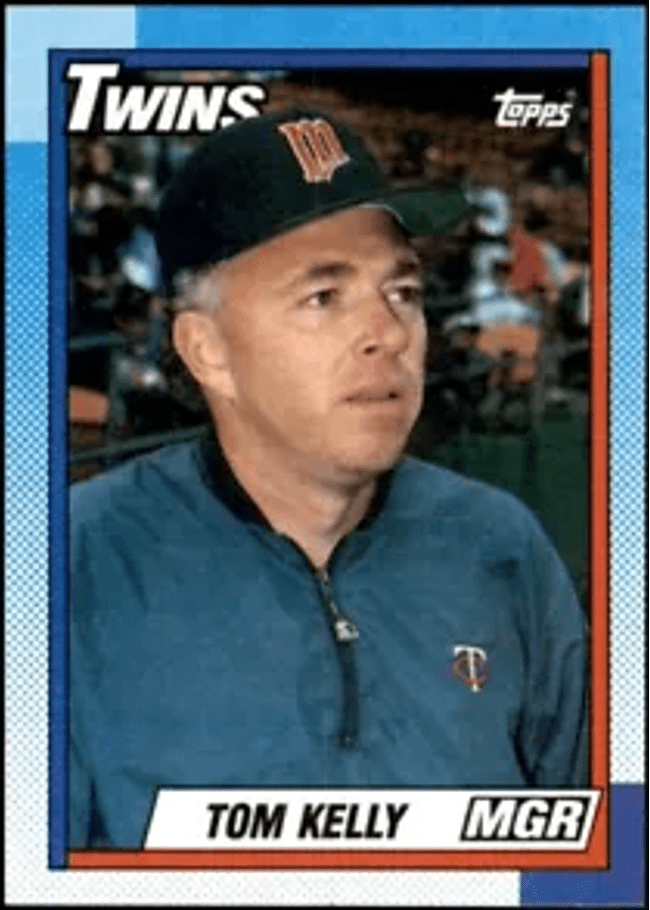
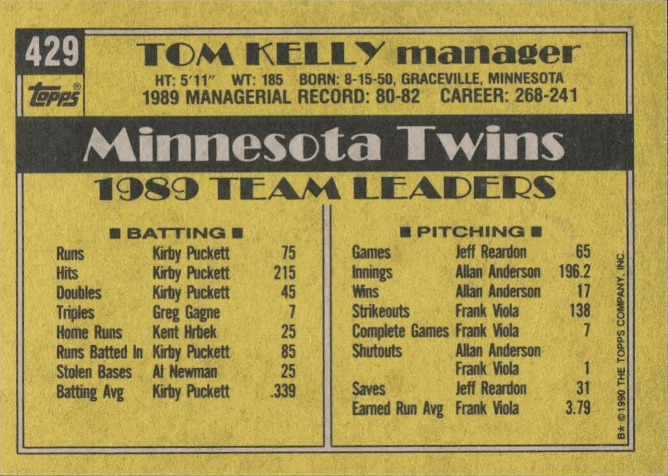
~ 1990 Topps ~
• TOM KELLY: When one thinks of Tom Kelly, naturally the Twins’ two World Series Championships immediately spring to mind. Before managing on the big league level, Kelly was in the Twins organization as a player, minor league manager and major league coach. His major league playing career consisted of 49 games for Minnesota in 1975. Playing first-base, outfield and DH, Kelly batted just .181. He made his major league card debut in the 1987 Topps set as a manager.
When Kelly took over from Ray Miller in late ’86, the team was mired in last place. With 23 games to go, the Twins went 12-11 and managed to avoid the cellar. In Kelly’s first full season, the club went all the way: Winning the A.L. West; defeating the Tigers in the playoffs; and besting St. Louis four games to three in the Fall Classic.
Some key personnel changes helped “T.K.” in 1987. Bert Blyleven returned to Minnesota in mid-1985 and won 15 games in ’87. Shortstop Greg Gagne had become a regular in ’86. And added to the roster for the ’87 campaign were relievers Jeff Reardon and Juan Berenguer, and outfielder Dan Gladden. This, of course, was in addition to Puckett, Hrbek, Gaetti, Brunansky, Laudner and Viola (many of whom Kelly had managed earlier in the minors).
The surprising 1987 season was followed by a 2nd-place showing in ’88, but then 5th in ’89 and 7th (last) in ’90. Next: A sudden resurgence. The Twins went from last to first in one season. Yet, this was a different team from 1987. Gone for various reasons were Viola, Blyleven, Gaetti, Brunansky, Reardon, Laudner, and Berenguer.
Newcomers to the team who made significant contributions in 1991 were: pitchers Scott Erickson (20 wins), Jack Morris (18 wins), Kevin Tapani (16 wins) and Rick Aguilera (42 saves); catcher Brian Harper (.311 average); outfielder Shane Mack (.310 average); DH Chili Davis (29 homers and 93 RBIs); and second-baseman Chuck Knoblauch (Rookie of the Year). Puckett, Hrbek, Gagne, Gladden and a few others remained from the ’87 team. The Twins defeated the Braves in the World Series in an unbelievably exciting seven-game thriller.
As with the ’87 title, the ’91 World Championship team landed in 2nd-place the following season. Within a few years, most of the ’91 team was gone through trades, free agency or retirement. From 1993-on, mediocrity has ruled. The team has never been a serious contender, never even had a winning record. (In fact, the franchise had one of the worst overall records in the majors during the ’90s.)
Truth is, in recent years owner Carl Pohlad decided to become the reincarnation of Calvin Griffith. In other words, an old curmudgeon so cheap and miserly that stars are dumped and very little money is spent on players to improve the team.
In 1999, the Twins went with a nearly all-youth roster and the results were predictable: The team finished with the worst record in the majors, having completely collapsed after Aug. 15th. There were comparisons with the young club of 1982 that went on to form the bulk of the 1987 World Championship team. But at this point, that is just head-in-the-clouds wishful thinking.
In 13 full seasons managing the Twins, Kelly’s teams have had just four winning years. Miracles will be required to put Minnesota back in post-season play. It will be a long and winding road back to the top. The question then becomes: Is Kelly the right man to lead a young, inexperienced team which – because of front-office decisions – may or may not have any realistic chance at competing in the foreseeable future?
• • • • • •
See related articles on BaseballCardFun.com entitled:
“TWIN TIMES — History of Twins Managers, Parts 1” Click Link Here
“TWIN TIMES — History of Twins Managers, Parts 2“ Click Link Here
• Originally Published in Feb. 2000 “Twin Times” •
THIS ARTICLE FROM THE “TWIN TIMES” NEWSLETTER – OFFICIAL PUBLICATION OF THE TWIN CITIES SPORTS COLLECTORS CLUB – IS REPRINTED WITH THE PERMISSION OF THE AUTHOR. IT HAS BEEN RETYPED, BUT NO CONTENT HAS BEEN CHANGED (EXCEPT FOR VERY MINOR ADJUSTMENTS, CORRECTIONS TO ANY TYPOGRAPHICAL ERRORS AND THE ADDITION OF GRAPHICS). COMMENTS OR INFORMATION IN THE ARTICLE MAY BE OUT-OF-DATE.
To keep up-to-date on additions to BaseballCardFun.com, subscribe below*
* Your email address will never be shared and is only used to announce new articles
 BaseballCardFun.com