
BY MARK A. LARSON
In the hot seat. On a tightrope. In a minefield. On the fence.
They’re managers. And like it or not, they’re a necessary part of any organization – including baseball. Without them, there would be chaos. Rightly or wrongly, they get credited with a team’s success or take the brunt of the blame.
In part one of this three-part series, we profiled Twins managers from the time the team moved to Minnesota in 1961 through the end of the decade when Billy Martin led the franchise to the A.L. West title. In this installment, we’ll cover the years from 1970-80, looking at each Twins manager during that period.
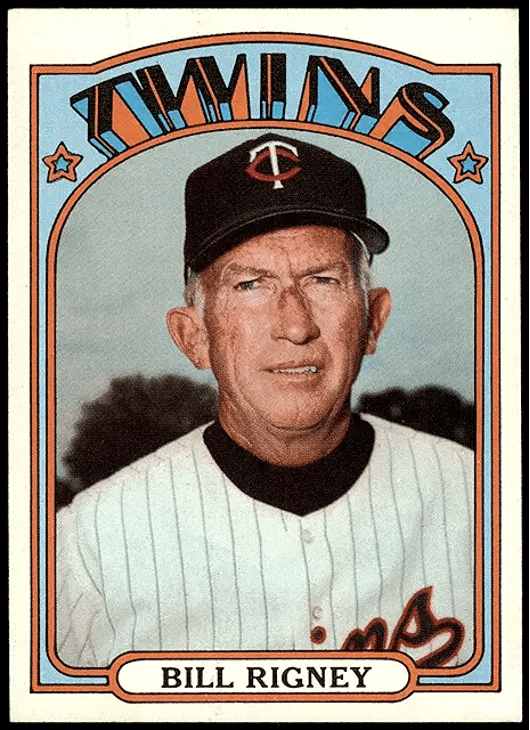
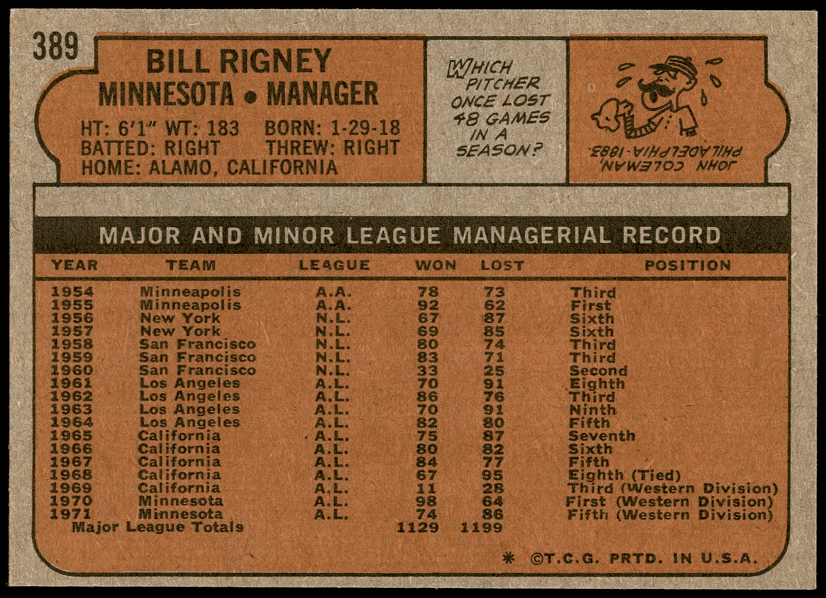
~ 1972 Topps ~
• BILL RIGNEY: Rigney began his Minnesota managerial career in 1970 in both an enviable and unenviable position. He was replacing the extremely popular – but volatile – Billy Martin. Twins owner Calvin Griffith fired Martin after only one season … a season in which the team finished first. Whether justified or not, fans were furious with Griffith. That put Rigney (at least indirectly) on the receiving end of some hostility.
On the other hand, winning can help erase some of the negative feelings. Rigney was extremely lucky be to inheriting a division winner that still had all its pieces intact.
Bill Rigney was the first Twins skipper with previous major league managerial experience to take the job. When the team relocated from Washington in 1961, Cookie Lavagetto was already manager. It had been his first major league assignment. Ditto for Sam Mele, Cal Ermer and Billy Martin.
Rigney had spent eight seasons in the big leagues as an infielder with the New York Giants from 1946-53, hitting .259 lifetime. In 1956, he took over the Giants helm after managing the Minneapolis Millers for two seasons (including a first-place finish in 1955). His success was mixed in his four and a half years with the Giants. In 1961, he began an eight and a half year managerial stint with the Angels. Considering they were an expansion team, they weren’t bad.
The Twins won their second consecutive Western Division title under Rigney in 1970. However, they also lost three straight to the Orioles in the playoffs for the second straight year. It would be the last time the Twins were in post-season play for 17 long years.
In 1971, Rigney’s Twins took a nose-dive. They finished 5th (next to last), winning the fewest games and ending up the most games behind since their inaugural year of 1961. (The Oakland A’s were now the Western Division power, winning the first of five consecutive divisional titles.)
With attendance beginning to decline – and the team only playing .500 ball – midway into the 1972 season, Rigney was fired. He managed one more year in the majors with the Giants in 1976.
Rigney’s first baseball card was in the 1948 Bowman set. He appeared in numeruous other sets as a player and manager, including 1970-72 Topps as Minnesota’s head man.
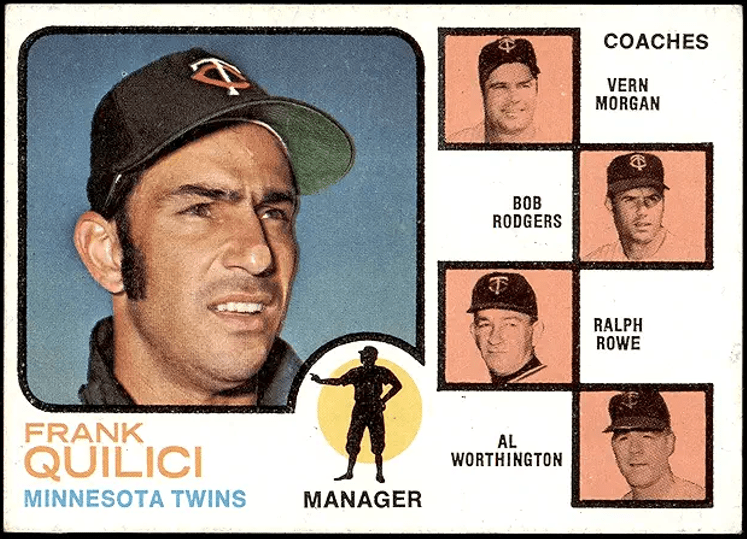
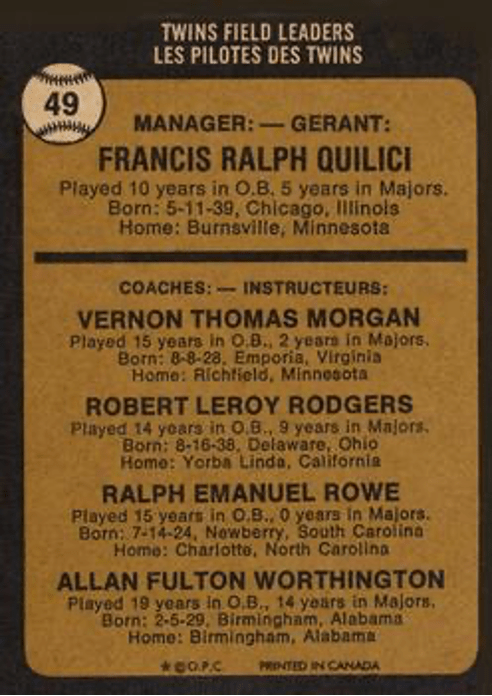
~ 1973 Topps ~
• FRANK QUILICI: When Bill Rigney was let go in mid-1972, the Twins turned to their former utility infielder Frank Quilici. He had played parts of five seasons with Minnesota between 1965 and 1970, splitting his time between second and third base. Although only a .214 lifetime hitter in 405 games, Quilici was a valuable guy to have around.
He played in all seven games of the 1965 World Series, going 4-for-20, including two doubles. Two of his hits helped the Twins win the first game against the Dodgers.
Quilici appeared on eight Topps cards – all in a Twins uniform. He was included in the 1966 and 1968-71 sets as a player and the 1973-75 sets as a manager.
By the time Quilici took over as leader of the Twins in the summer of ’72, some of the team’s stars were beginning to fade. Harmon Killebrew’s numbers dropped significantly to 26 home runs, 74 RBIs and a .231 average. Tony Oliva missed all but 10 games in 1972 due to injuries. Jim Kaat started out the season like a house on fire, going 10-2, with a 2.07 ERA, but then was sidelined. Jim Perry, who posted 20 victories in 1969 and 24 in 1970, won just 13 in 1972.
The glory years were over. Now the Twins would struggle. Yet, there were still some bright lights. Oliva’s career would be extended a bit because of the introduction of the Designated Hitter in 1973. Between 1972-78, Rod Carew would win six batting titles. And a young hurler named Bert Blyleven would become the new anchor of the starting pitching staff, averaging 17 wins per season, with an ERA of 2.72, from 1972-75.
Quilici served as manager from mid-1972 through the 1975 season. Try as he might, the Twins were basically just a .500 ball club. In fact, they finished at .500 in both 1972-73, were two games over in 1974 and seven games under in ’75. The best year for Minnesota under Quilici was 1974, when the Twins finished third, eight games out of first place. Exit Frank Quilici after the ’75 season, enter Gene Mauch in ’76.
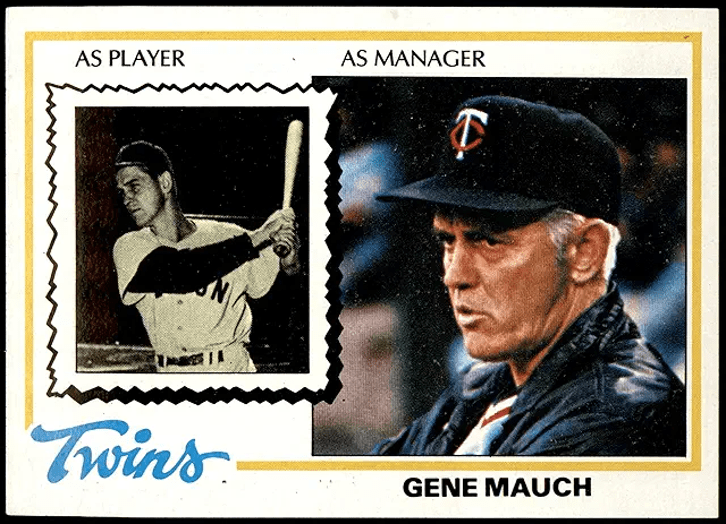
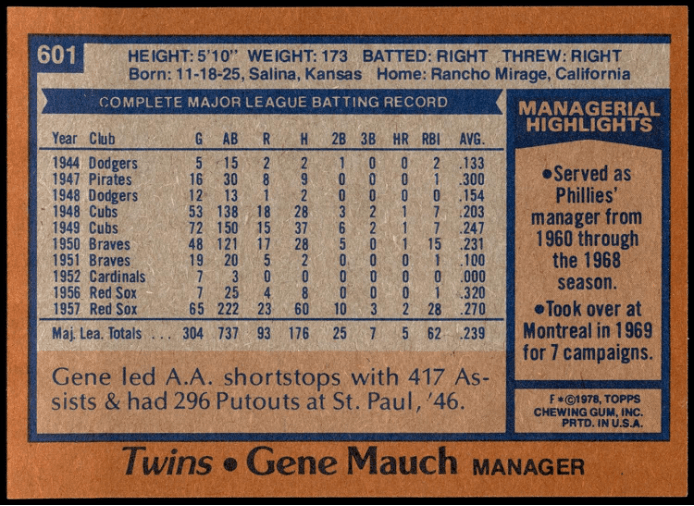
~ 1978 Topps ~
• GENE MAUCH: Under the circumstances, Gene Mauch probably did the best he could with what he had. But his record wasn’t significantly different from Quilici’s. The situation he was in was the advent of free agency and simultaneously Calvin Griffith’s belt-tightening. Many good players were either traded or allowed to slip away because of salary demands.
On the other hand, Mauch was no stranger to challenging situations. Prior to his arrival in Minnesota, he managed the Montreal Expos through their first seven seasons of existence. Before that, Mauch was the Phillies top man from 1960-68. The closest any of his teams came to a pennant was 1964.
A little history … that 1964 season would forever haunt Mauch. On September 20 of that year, with just 12 games to go, the Phils led their opponents by six games. Almost a sure World Series appearance. But it was not to be. Philadelphia managed to drop 10 in a row, while the Cardinals won nine out of 10 … and the pennant.
Mauch played sporadically throughout a nine-year major league career as an infielder. He hit .239 in 304 games. He first appeared in the 1951 Bowman set as a player and on numerous Topps manager cards.
Between 1976-80, Mauch’s Twins teams had a winning percentage of .490. Here’s what he had to deal with: Bert Blyleven was traded in mid-1976; Tony Oliva retired; after going 17-5, with 20 saves in 1976, reliever Bill Campbell left through free agency; outfielder Lyman Bostock hit .336 in 1977, with 36 doubles, 90 RBIs, 199 hits, 104 runs scored and was lost to free agency; fellow outfielder Larry Hisle had 28 homers and 119 RBIs in 1977 and was gone to free agency; Rod Carew won his seventh batting title in 1978 and with free agency looming, was traded; and pitcher Dave Goltz, who averaged 15 wins per season from 1975-79, was a lost victim of free agency after the 1979 season.
Oh, there were a few bright spots … shortstop Roy Smalley, catcher Butch Wynegar, infielder John Castino (1979 A.L. Rookie of the Year), and Minnesota native, pitcher Jerry Koosman. But all-in-all, it was a discouraging time for Twins fans.
Mauch lasted through approximately three-quarters of the 1980 season, when he was replaced by John Goryl.
The Twins started the 1970s decade on top, but spent the rest of it languishing in the middle of the A.L. West. In fact, Minnesota finished 3rd or 4th for nine consecutive years between 1972-80. Not too many fans were optimistic about the approaching 1980s.
• • • • • •
See related articles on BaseballCardFun.com entitled:
“TWIN TIMES — History of Twins Managers, Parts 1″ Click Link Here
“TWIN TIMES — History of Twins Managers, Parts 3” Click Link Here
• Originally Published in Jan. 2000 “Twin Times” •
THIS ARTICLE FROM THE “TWIN TIMES” NEWSLETTER – OFFICIAL PUBLICATION OF THE TWIN CITIES SPORTS COLLECTORS CLUB – IS REPRINTED WITH THE PERMISSION OF THE AUTHOR. IT HAS BEEN RETYPED, BUT NO CONTENT HAS BEEN CHANGED (EXCEPT FOR VERY MINOR ADJUSTMENTS, CORRECTIONS TO ANY TYPOGRAPHICAL ERRORS AND THE ADDITION OF GRAPHICS). COMMENTS OR INFORMATION IN THE ARTICLE MAY BE OUT-OF-DATE.
To keep up-to-date on additions to BaseballCardFun.com, subscribe below*
* Your email address will never be shared and is only used to announce new articles

