
BY MARK A. LARSON
Baseball managers are the Rodney Dangerfields of the card collecting world – they don’t get much respect.
Yet, fans can’t ignore managers. They’re a key ingredient in a team’s success or failure – often the one man fans love to hate, or at least love to second-guess.
This is the first in a three-part series on Twins managers. Eleven men have held the post since 1961 with varying degrees of success. We will look at each of them, beginning with the four who held the position during the 1960s.
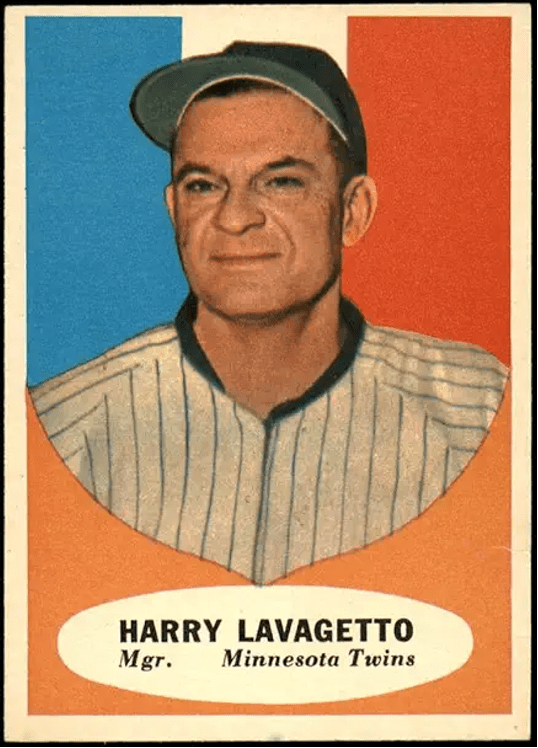
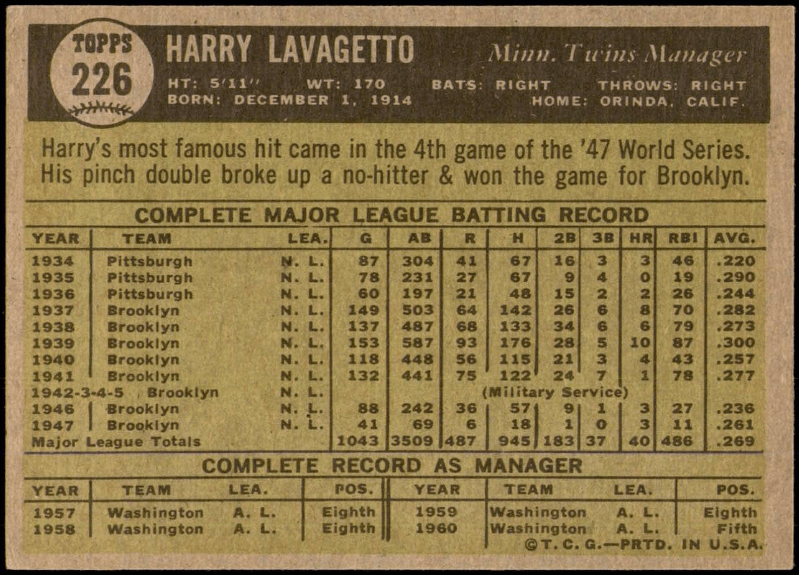
~ 1961 Topps ~
• HARRY “COOKIE” LAVAGETTO: Lavagetto was an infielder in parts of 10 seasons in the majors from 1934-47, including two World Series with the Dodgers. As stated on his 1961 Topps card: “Harry’s most famous hit came in the fourth game of the ’47 World Series. His pinch double broke up a no-hitter and won the game for Brooklyn.” He played in just over 1,000 games, batting .269.
After his playing days ended, Cookie coached and took over as manager of the Washington Senators 20 games into the 1957 season. The situation in Washington was pitiful. He inherited a team in last place and it finished the season in last. In fact, in the five-year period between 1955-59, the Senators finished in last place four times and next-to-last the other year. The standing joke for many years was: “Washington … first in war, first in peace, and last in the American League.”
Things began to look up in 1960. The team finished fifth (out of eight) – its best performance since 1953. Then in the fall of 1960, it was announced the team was moving to Minnesota. The ’61 team featured the nucleus of a future winner: Sluggers Harmon Killebrew and Bob Allison, shortstop Zoilo Versalles, catcher Earl Battey, and pitchers Camilo Pascual and Jim Kaat. Yet, three months into the season, the team was mired in ninth place (next-to-last in the now 10-team league) when Sam Mele took over as Twins manager.
Lavagetto’s first baseball card was in the 1935 Batter Up set. This was followed by appearances in the Play Ball sets of the late ’30s and early ’40s, the 1952 Topps set (as a coach) and the ’61 Topps set as Minnesota’s manager.

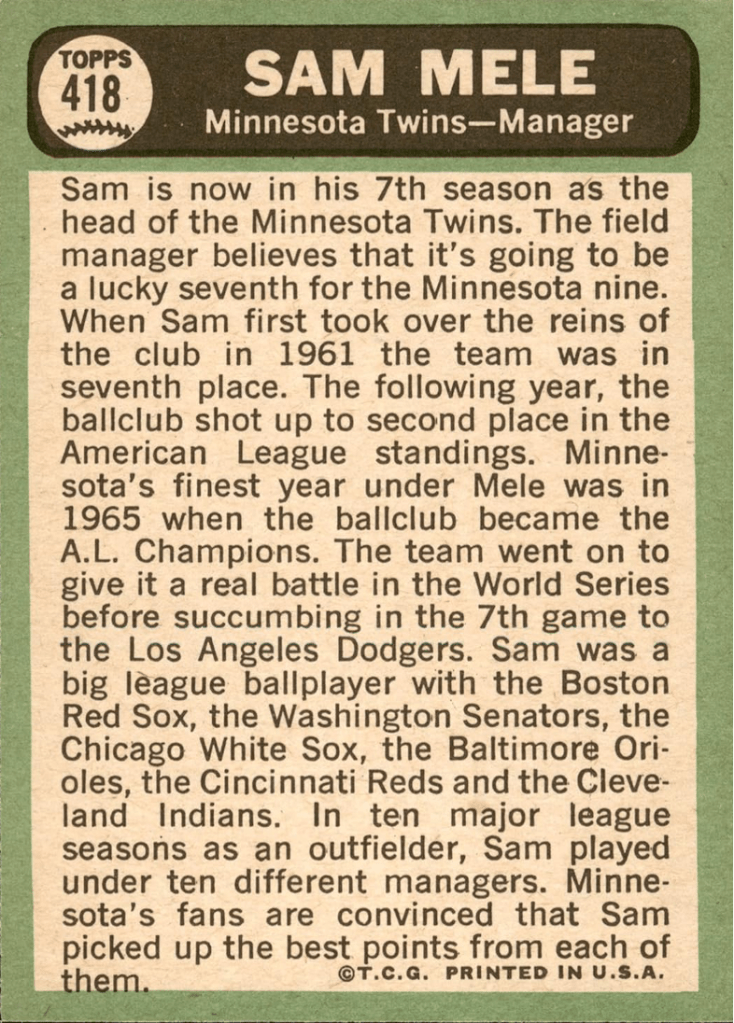
~ 1967 Topps ~
• SAM MELE: From the time Mele took over from Lavagetto in mid-1961 to the end of the first season in Minnesota, the team improved a bit, but still fell short of their fifth-place finish in 1960. However, in 1962, Mele led Minnesota to second place, just five games behind the Yankees. The team finished third in 1963, but fell to sixth in 1964.
On the other hand, things would soon brighten considerably. With the addition of such players as outfielders Tony Oliva and Jimmie Hall, first baseman Don Mincher, and hurlers “Mudcat” Grant, Jim Perry and Al Worthington, the pieces of Minnesota’s winning puzzle began to fit.
Everything came together in 1965 as the Twins won the American League pennant and came within one game of winning the World Series … losing 2-0 to the Dodgers in the seventh game. The team finished second in 1966, but was stuck in sixth place after 50 games of the ’67 season, when Mele was relieved of his duties.
Like Lavagetto before him, Mele had a 10-year major league playing career, appearing in 1,000-plus games. He hit .267 as an outfielder for a half-dozen teams. Mele appeared in his first baseball card set in 1949 (Bowman). Later, he appeared in a Twins uniform in six Topps sets (1962-67).
With Sam Mele, the Twins had relative stability in their managerial ranks for six years. However, beginning with Cal Ermer’s appointment as Minnesota’s head honcho in June 1967, the team would employ no less than four different managers in the next half-dozen seasons.
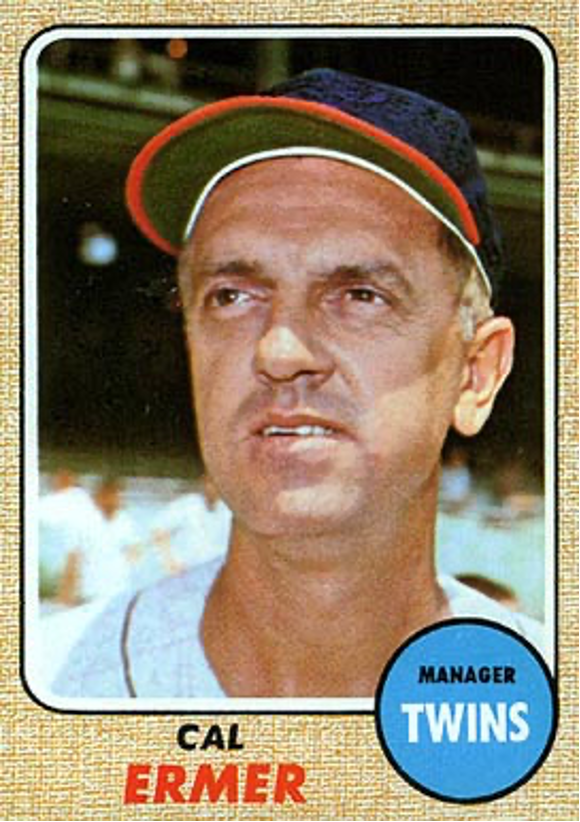
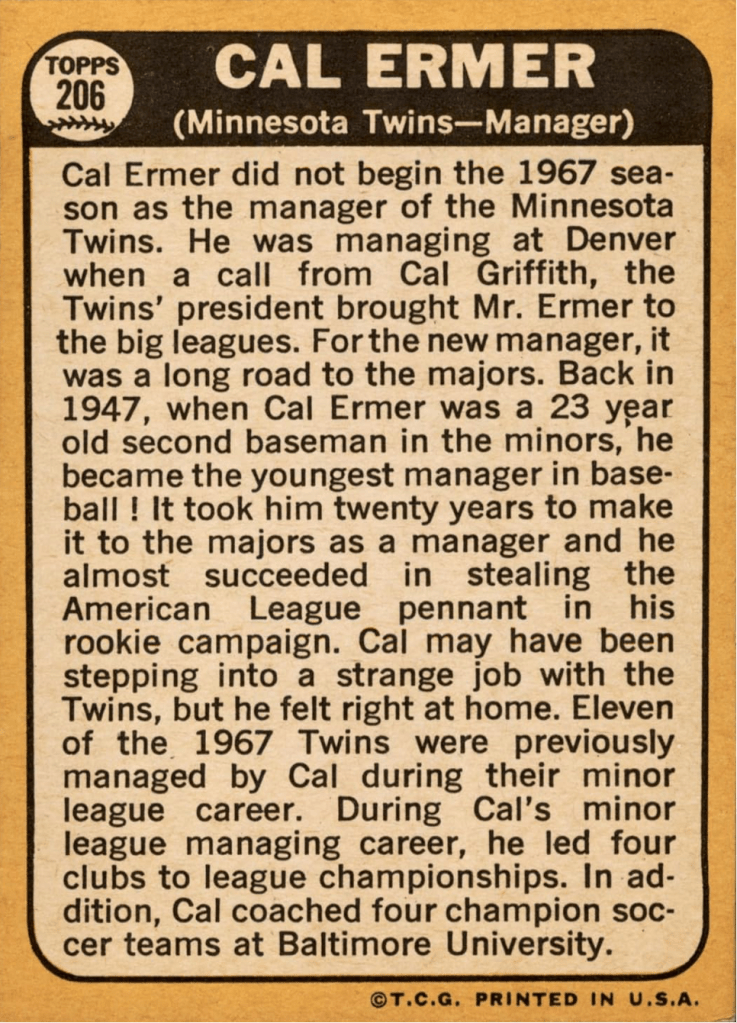
~ 1968 Topps ~
• CAL ERMER: Ermer was an organization man. He had been working in the Washington and Minnesota farm systems for years. According to his only major league baseball card (1968 Topps): “Back in 1947, when Cal Ermer was a 23 year old second baseman in the minors, he became the youngest manager in baseball!” That was also the year he made his only big league appearance, going 0-for-3 in one game for the Senators.
When Ermer took the reins of the Twins, the team was in sixth place. Over the next three months or so, the team played its way to the top, only to lose out to the Red Sox on the last day of the season. It was heart-breaking, but also one of the most memorable pennant races in history. Just three games separated first through fourth place. The additions of infielders Rod Carew and Cesar Tovar, plus pitchers Dean Chance, Dave Boswell and Jim Merritt over the previous couple of years certainly helped the Twins contend in 1967.
Things fell apart for Minnesota – and Ermer – in 1968 when the club dropped to seventh place. Thus ended Cal Ermer’s brief managerial career.
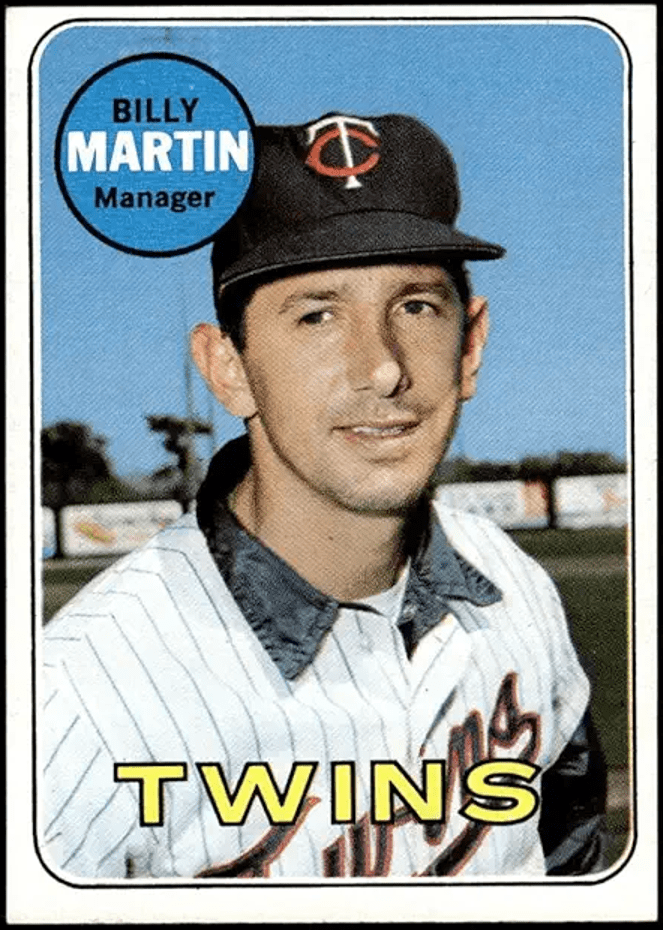

~ 1969 Topps ~
• BILLY MARTIN: With the start of the 1969 season, not only did the Twins have a fiery new manager in Billy Martin, but the structure of Major League Baseball changed significantly. Both leagues expanded from 10 to 12 teams and split into two divisions each. Within the leagues, the winner of each six-team division would face off in a best-of-five game playoff series to determine the pennant winner.
It was to their luck the Twins landed in the American League’s Western Division, as it was generally considered the weaker of the two. With their powerhouse team, Minnesota won the West by nine games over Oakland.
This arguably could have been the best Twins team ever. Harmon Killebrew was the A.L.’s MVP, leading the league in home runs (49), RBIs (140) and walks (145). Rod Carew won the batting title, hitting .332. Tony Oliva was right behind Carew, hitting .309 and leading the league with 197 hits and 39 doubles. A new addition to the team, shortstop Leo “Chico” Cardenas was the best at that position since Zoilo Versalles’s MVP year of 1965. The pitching staff was led by Jim Perry and Dave Boswell – both 20-game winners – and reliever Ron Perranoski, who led the A.L. with 31 saves.
Martin, with his temperamental personality and aggressive style of play, led the team to its second highest number of wins (97) up to that time. Unfortunately, the Twins dropped three straight games to the Baltimore Orioles in the playoffs and were quickly eliminated.
Despite the team’s success, Billy Martin’s off-field antics of drinking and fighting didn’t set well with Twins owner Calvin Griffith, who fired him after the ’69 season. To this day, it still ranks as one of the most unpopular decisions ever made on the major league sports level in Minnesota history.
Of course, Martin’s reputation went way back to his 11-year major league playing career, spent mostly as a second baseman with the Yankees. He only hit .257 lifetime, but .333 in 28 World Series contests. Martin ended his playing career in Minnesota when he appeared in 108 games for the Twins in 1961.
He was included in three minor baseball card sets in the late 1940s, including the 1949 Remar Bread issue. Starting in 1952, Martin appeared in several Topps and Bowman sets, including the 1962 Topps set as a Twin. He was also part of the 1969 Topps set as Minnesota’s manager.
Martin’s managerial career had only just begun when he was given the heave-ho by Griffith. He would also serve as skipper for the Tigers, Rangers, A’s and, of course, Yankees (five different times). He was usually successful, but he was also his own worst enemy, ultimately self-destructing almost every time. Fittingly, he was the only manager with an “In-Action” card in the 1972 Topps set. It showed him arguing with an umpire.
Thus ended the 1960s for the Twins. The decade included two first-place and three second-place finishes. Not bad for a team that left Washington as the laughingstock of the league in 1960.
• • • • • •
See related articles on BaseballCardFun.com entitled:
“TWIN TIMES — History of Twins Managers, Parts 2“ Click Link Here
“TWIN TIMES — History of Twins Managers, Parts 3” Click Link Here
• Originally Published in Dec. 1999 “Twin Times” •
THIS ARTICLE FROM THE “TWIN TIMES” NEWSLETTER – OFFICIAL PUBLICATION OF THE TWIN CITIES SPORTS COLLECTORS CLUB – IS REPRINTED WITH THE PERMISSION OF THE AUTHOR. IT HAS BEEN RETYPED, BUT NO CONTENT HAS BEEN CHANGED (EXCEPT FOR VERY MINOR ADJUSTMENTS, CORRECTIONS TO ANY TYPOGRAPHICAL ERRORS AND THE ADDITION OF GRAPHICS). COMMENTS OR INFORMATION IN THE ARTICLE MAY BE OUT-OF-DATE.
To keep up-to-date on additions to BaseballCardFun.com, subscribe below*
* Your email address will never be shared and is only used to announce new articles
 BaseballCardFun.com