
BY MARK A. LARSON
Changing of the guard.
Not only did the country elect a new president from a different political party in 1976 – Jimmy Carter – five prominent veteran ballplayers had their final regular Topps card that year.
As the United States celebrated its bicentennial and entered its third century as a nation, collectors had their last chance to obtain Topps cards of Hank Aaron, Billy Williams, Tony Oliva, Vada Pinson and Dick Allen.
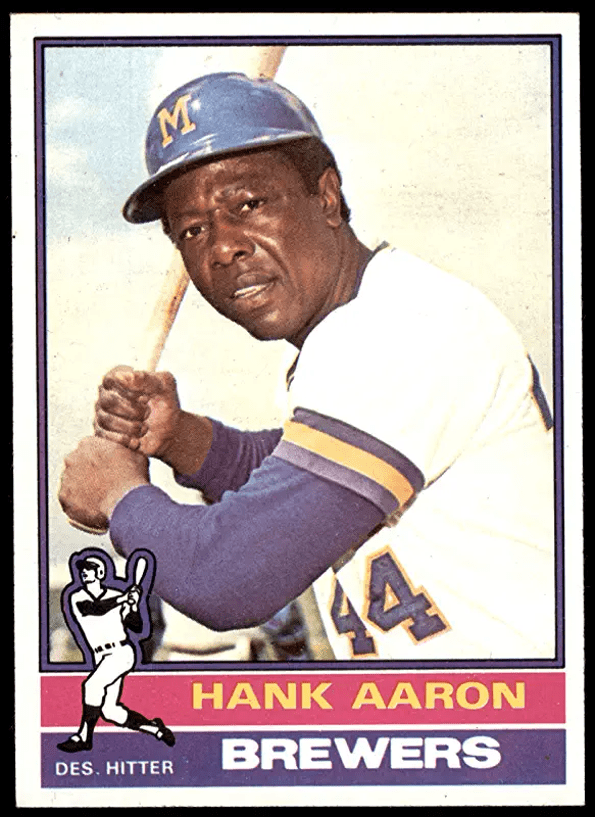
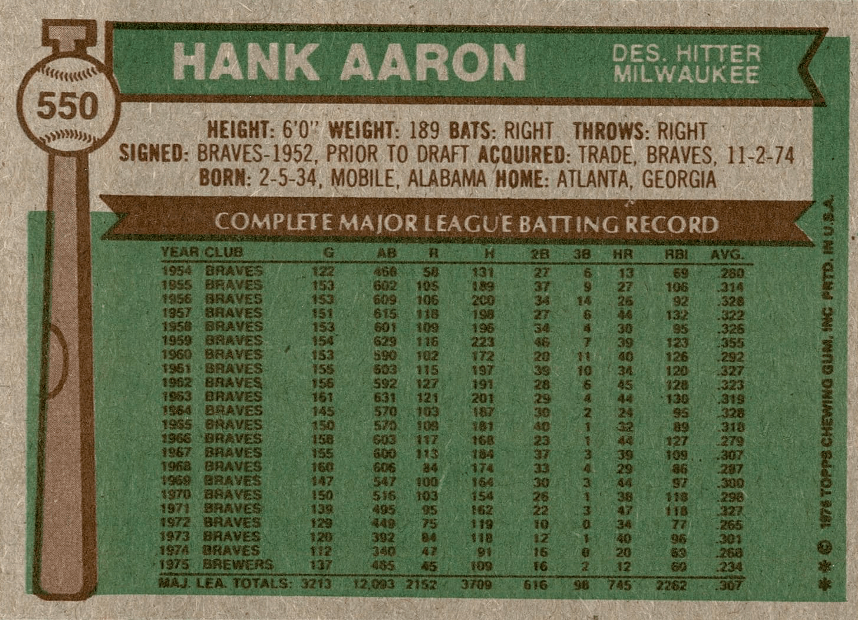
“Hammerin” Hank Aaron is best known as baseball’s all-time home run leader with 755 blasts. His 2,297 RBIs are also tops. Aaron is second on the all-time list in runs scored (2,174) and third in hits (3,771). Plus, he compiled a .305 lifetime average.
Aaron had 90 or more RBIs 16 times, including 11 seasons of 100-plus. He scored 100 or more runs 15 times, including 13 seasons in a row. “The Hammer” hit .300 or better 14 times and won two batting titles, in 1956 and 1959. He also won three consecutive Gold Gloves for fielding excellence in the outfield (1958-60). Aaron hit .362 in 17 post-season games, with six homers and 16 RBls.
The Hall-of-Famer made his first appearance on a Topps card in 1954 (#128). From 1954-74, he played for the Braves. He finished up his career with the Brewers in 1975-76. His ’76 Topps card (#550) is the only one in which he appears in a Brewers uniform. (In 1975, Topps disguised his Atlanta uniform through airbrushing.)
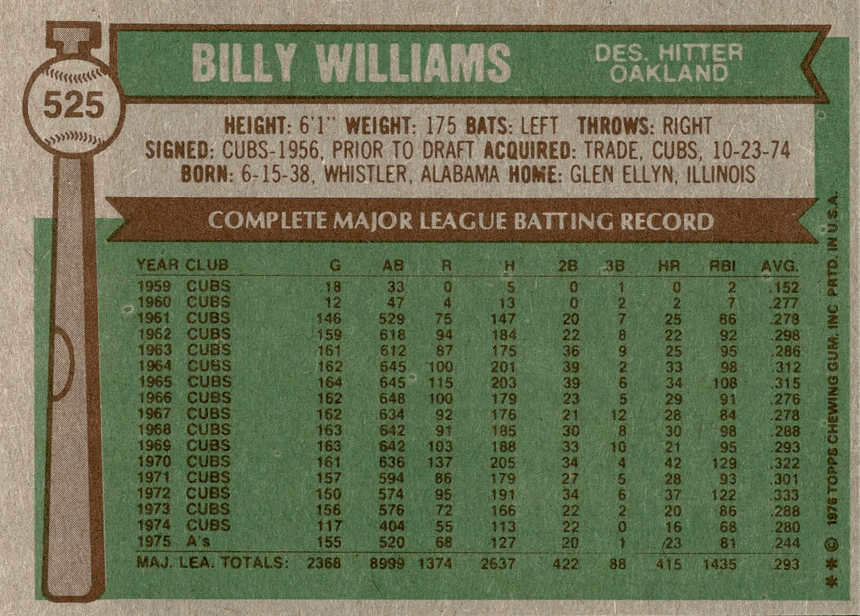

Billy Williams is also a member of the Cooperstown elite. He finished his career with a .290 lifetime average and 426 homers. In addition, Williams had 2,711 hits and 1,475 RBls. He owns the fifth-longest consecutive game streak in history with 1,117.
Williams’ first Topps card was issued in 1961 (#141) – the same year he was named N.L. Rookie of the Year. Between 1961-73, Williams averaged 98 RBIs per season. Over the same period, he averaged 29 homers and 96 runs per season.
By far, his best season was 1970. That year, Williams hit .322, with 205 hits, 34 doubles, 42 home runs, 137 runs and 129 RBls. He spent the first 16 years of his career with the Cubs (1959-74). In 1975-76, he played the final two seasons of his career with the Oakland A’s. He appears on 1976 Topps card #525.

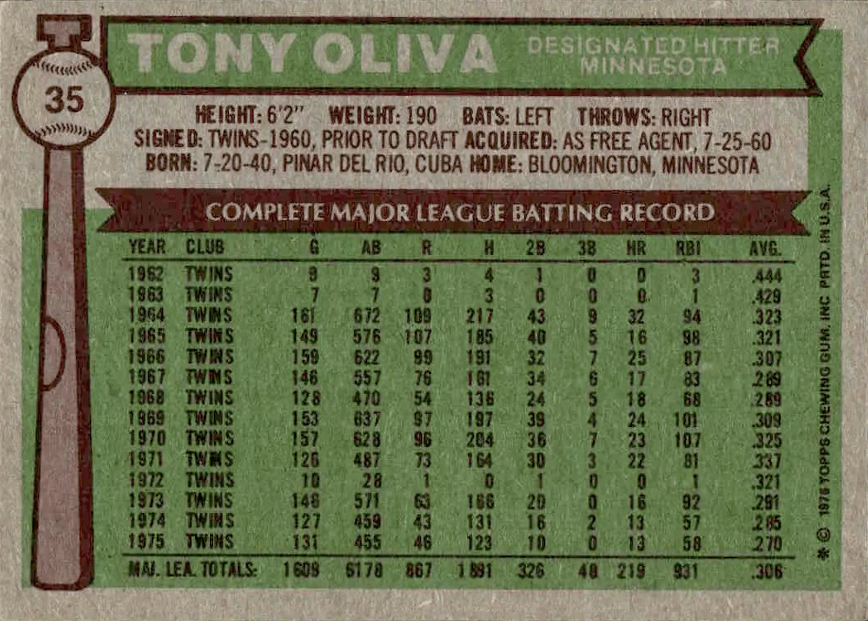
The Minnesota Twins’ Tony Oliva was beset by knee injuries that limited him to just 11 full seasons. Yet, he won three American League batting championships, led the league in hits five times and doubles four times.
His first Topps card was in the 1963 set (#228). The following year he won A.L. Rookie of the Year honors, leading the league in hitting (.323), hits (217), doubles (43) and runs (109). That same year he also belted 32 home runs and had 94 RBls. In 1965, he won his second batting title in a row with a .321 average and added a third in 1971, hitting .337.
In his first eight full big league seasons, “Tony O.” compiled a .313 average. He batted .314 in 13 post-season games, with three home runs. He has just over 1,900 career hits to go along with a .304 lifetime average. His final card in the 1976 set is #35.

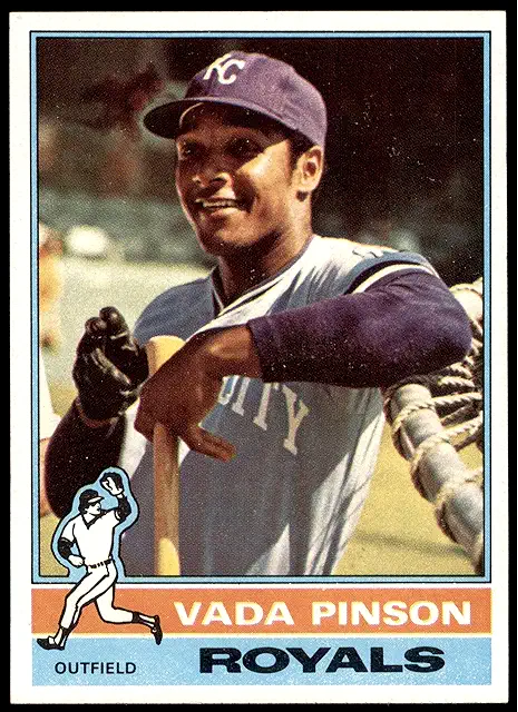
Vada Pinson flashed both speed and power throughout 17 full seasons. He hit safely 2,757 times to go along with 305 stolen bases and 256 home runs during his career with the Reds, Cardinals, Indians, Angels and Royals. He has one of the highest hit totals for a non-Hall-of-Famer who is eligible for election to Cooperstown. Plus, his lifetime average of .286 is quite good.
Pinson had 200 or more hits in four seasons. Between 1959-67, he averaged 100 runs per year. His final Topps card is #415 in the ’76 set. His first Topps card was issued 18 years earlier in 1958 (#420).
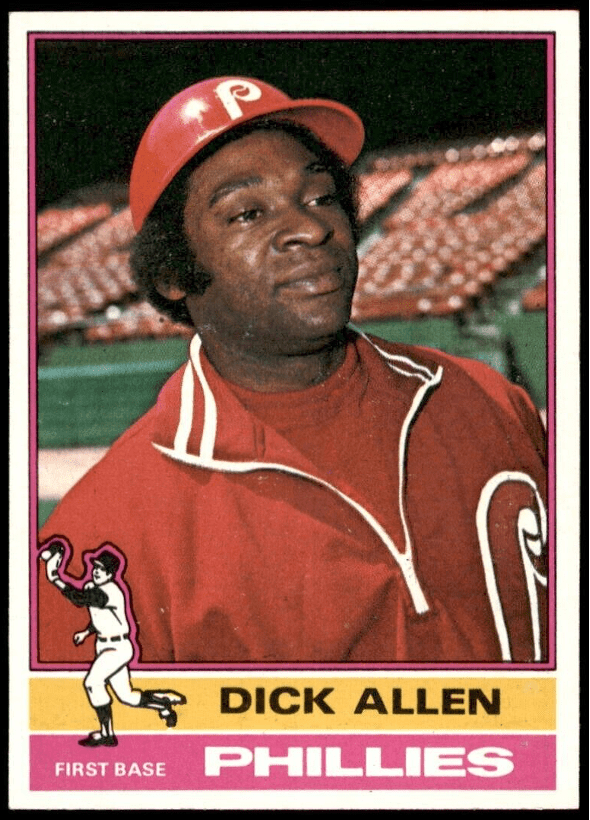

Dick “Richie” Allen had a solid 14-year major league career. He appears on card #455 in the 1976 Topps set, while his rookie card is in the ’64 set (#243).
At times, Allen was a premier power hitter. He blasted 351 lifetime home runs, including six seasons of 30 or more. Between 1964-72, he averaged 30 homers, 94 RBIs and 94 runs per season. Allen toiled for the Phillies, Cardinals, Dodgers, White Sox and A’s during his career. He led the American League in home runs twice while with Chicago … with 37 in 1972 and 32 in 1974.
He was named N.L. Rookie of the Year in 1964 and A.L. Most Valuable Player in 1972. His lifetime average of .292 is among the best of his era.
As Aaron, Williams, Oliva, Pinson and Allen left baseball’s center stage (along with Harmon Killebrew and Frank Robinson the year before), they were being replaced by new upcoming stars with names like Schmidt, Winfield, Yount and Brett. Stars of the 1950s and ’60s were leaving the game, while a new generation of 1970s and ’80s baseball heroes was emerging. Like a changing of the guard.
• • • • • •
See related article on BaseballCardFun.com entitled:
“BASEBALL HOBBY NEWS — Clean Design Sparks Spirited 1976 Set”
Click Link Here
• Originally Published in Jan. 1993 “Baseball Hobby News” •
THIS ARTICLE FROM “BASEBALL HOBBY NEWS” MAGAZINE IS REPRINTED WITH THE PERMISSION OF BOTH THE EDITOR/PUBLISHER AND THE AUTHOR. IT HAS BEEN RETYPED, BUT NO CONTENT HAS BEEN CHANGED (EXCEPT FOR VERY MINOR ADJUSTMENTS, CORRECTIONS TO TYPOGRAPHICAL ERRORS AND CHANGES TO GRAPHICS). COMMENTS OR INFORMATION IN THE ARTICLE MAY BE OUT-OF-DATE.
To keep up-to-date on additions to BaseballCardFun.com, subscribe below*
* Your email address will never be shared and is only used to announce new articles
 BaseballCardFun.com