
BY TROY KIRK
Staff Writer
The 1967 Topps were the first baseball cards I collected. I was eight years old when they came out and I collected them heavily through the summer. I didn’t get them all, but I got a lot of them. I was also in my fourth year of little league, and I was starting to take baseball more seriously.
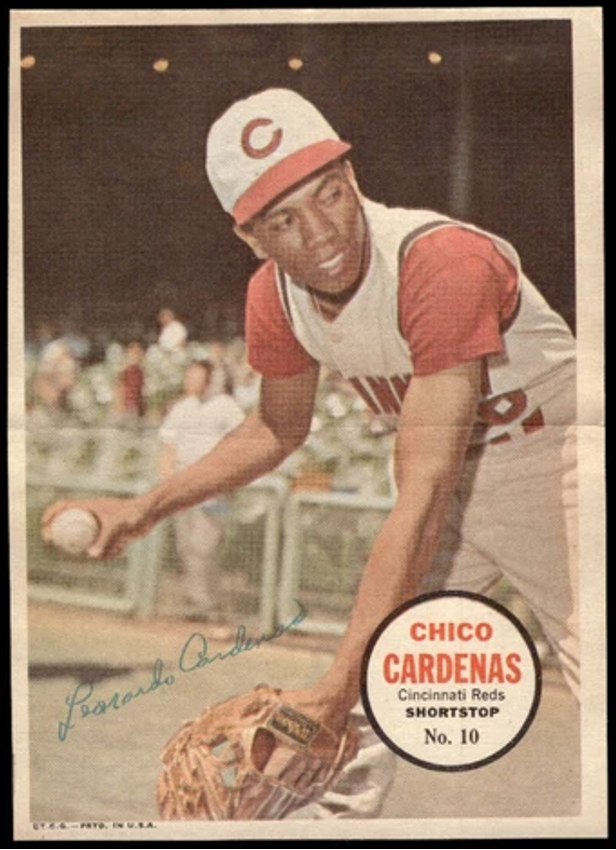
Each of the 1967 baseball card packs (at least in the early series) contained a pin-up poster of some of the big stars of the game. I did exactly what they wanted, I pinned the ones I got up in a row in my bedroom, or maybe I taped them. I didn’t have them all, maybe 10 or 15. Some of the ones I had included Matty Alou, Brooks Robinson, Mickey Mantle, and Hank Aaron. But the one I remember best was a poster of Cincinnati Reds shortstop Chico Cardenas.
I wasn’t a Reds fan, I just thought the pose was cool. I spent a lot of time trying to figure out what kind of play he was executing. Was he fielding a grounder to his right and sidearming it across the diamond? Maybe he was getting ready to do a sidearm flip to second to start a double play. As a shortstop myself, I definitely wanted to learn how to make a play like that.

Then there was Al Kaline posing in his right fielder ready position. What was interesting to me was that he wasn’t standing square to the infield like all the little league outfielders I’d seen. He was angled with one leg a bit in front of the other. That got me thinking about why that would be helpful. After tinkering around with it, it seems like it is a better way to push off and get a jump on a fly ball that you have to run after.
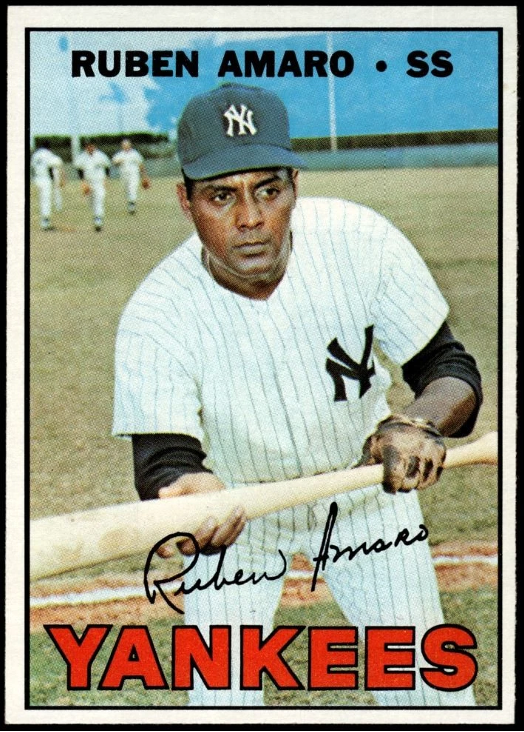
Then there’s the Ruben Amaro card in a cool bunting pose. To a little leaguer, bunting is one of the cooler baseball skills. Instead of swinging from the heels like everyone else, you can spin around and place the ball exactly where you want. It sends the other team scrambling while you speed through the first base bag for a free hit, making the other team look like a bunch of idiots. It’s like a magic trick.
Of course, I learned later from studies by SABR (Society for American Baseball Research) that bunting is actually a bad strategy most of the time. Most major league teams now rarely utilize the bunt, with the exception of extra innings. But Ruben Amaro definitely made it cool to an eight-year-old.
Four decades after Amaro’s bunting card was released, Ruben’s son, Ruben Amaro Jr. became the General Manager of the Philadelphia Phillies in 2008. I’ve always thought that his father’s classic bunting card and his cool name helped smooth the way to him getting that job. (To me, Ruben Amaro was a cool name like “Mario Andretti.”)

There’s one last 1967 card that always fascinated me, the Smoky Burgess card.
It was hard to believe Smoky was actually a player and not a manager. How could someone that old and out of shape be an active player? A quick glance at the back of his card showed that Burgess was 40 years old for the 1967 season and held the record for most pinch hits by anyone at that time. He had a batting average of .313 the previous season, earning him another year in the majors. He was old enough to be an all-time great, but he was not in that class, instead getting to continue playing at an advanced age through honing a specialized skill. He was an inspiration, showing what it took to outlast the rest of his peers.
THIS ARTICLE WAS WRITTEN
EXCLUSIVELY FOR BaseballCardFun.com
• • •
Text Copyright © 2026 by BaseballCardFun.com / Troy Kirk
No article appearing on this website may be reproduced without written consent of the Editor/Publisher

