
BY MARK A. LARSON
Editor & Publisher
He wasn’t my favorite player.
The Reds were not my favorite team and I wasn’t from Cincinnati.
He had a nice, short career, but nothing too out of the ordinary.
I didn’t know him and he wasn’t a friend of the family or related in any way.
We didn’t share a birthday or hometown or home state.
His card has no special significance … it’s a common with no valuable variations.
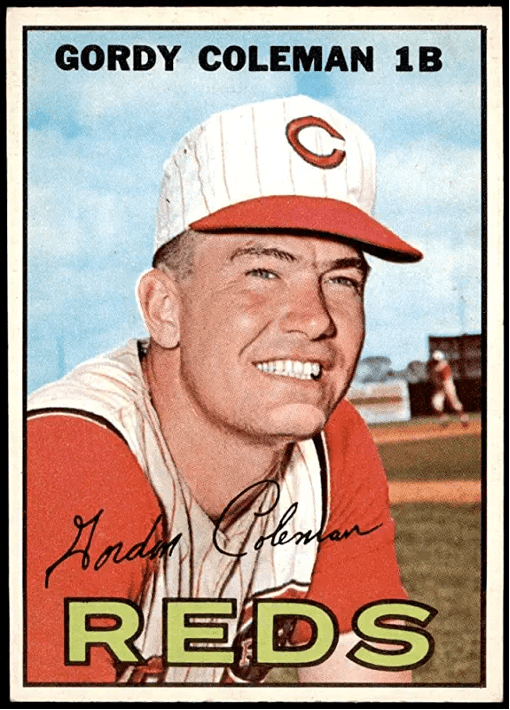
Then why do I have 150 Topps 1967 Gordy Coleman cards in my collection (and counting) ?????
Quite simply, the ’67 Topps #61 Gordy Coleman was my very first baseball card. Crazy as it sounds, as a joke, I wrote in a 1980s hobby article that I was going to acquire as many as I could so I could wallpaper my bedroom with them. The card was cheap — so why not?
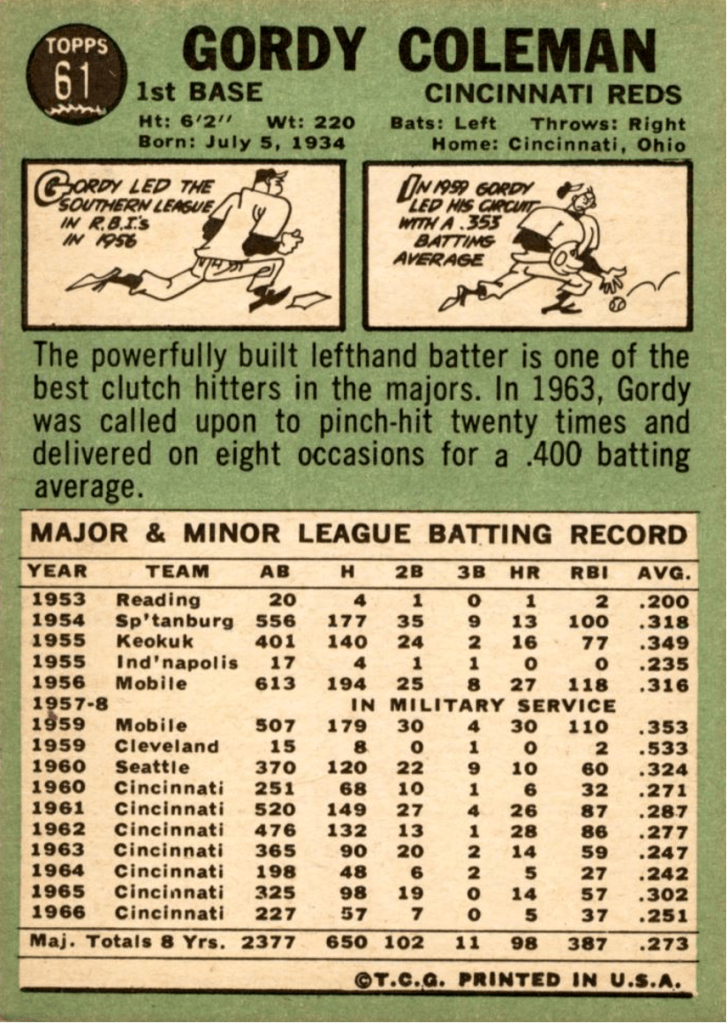
My first ’67 Gordy was given to me by a kid at school as I was discovering baseball in the spring of that year. Almost immediately, I wanted more cards. I didn’t even know how to obtain them, but soon found out and was buying pack after pack. In addition to being my first baseball card, I love the look of the card itself: The great design of the ’67s; the clear, crisp photo; Gordy’s smiling face; the older style Reds uniform and cap; and the green and white back.
To this day, every time I glimpse a ’67 Coleman it puts a smile on my face … so why not 150 smiles? It brings back the happy memories of not only being my first card, but also the gateway to following the game of baseball (and eventually writing about it and the hobby). From the mid-1980s to 1989, I would pick up a ’67 Gordy card now and then, but it certainly wasn’t a top priority. Then other hobby buddies and I made the trip to the downtown Chicago Hyatt Regency Hotel for my first National Convention in 1989.
The year before, I had turned my hobby into a business and became a dealer although I wasn’t set up in Chicago. Not long after entering the show, I realized card prices were too high for me to buy and make a profit and dealers naturally weren’t going to pay enough for anything I had to sell. Before long, I figured I had to do something so I started searching for — and buying — 1967 Colemans. Sometimes I’d buy just one from a dealer, other times two or three. When I bought multiples, it would sometimes elicit a puzzled look from the person behind the table. I knew what they were thinking: “Why’s this guy buying more than one of the same old common card?”
I remember one guy specifically asking “Is he your uncle or something?” Kind of embarrassed, I just mumbled “Yeah, something like that.” I paid and quickly walked away. Along the same lines, about 10 years later, I was at a large show where I went up to a dealer I knew and pulled out three ’67 Gordys and asked him how much?
Surprisingly, he answered with a price, but also wanted to know why I wanted three of them.
He was kind of a gruff guy, but I knew him well enough to say “why do you care?” Again, he demanded to know why. Soon it became a fun challenge of mind games for me. “No particular reason,” I told him. By now, he was convinced there had to be some kind of special (or valuable) error or variation. I laid my money on the table, but he wouldn’t make the deal. In over 50 years of attending shows it was the only time a dealer refused to sell me cards for cash at his price. However, I wasn’t offended, it just made for a great story. (A collecting friend who was with me and knew why I collected Gordys – and also knew this dealer — laughed his head off as we walked away empty-handed.)
As the years went on, friends that were aware of my “Crazy Coleman Collection” would sometimes even find the card and give it to me at no charge.
In addition, my wife has attended three Nationals with me and often helps out by scouting ahead for cards I may want while I’m busy looking at a dealer’s table. This includes looking for 1967 Gordy Colemans, which she’ll often buy for me. Sometimes, she’ll get asked why she’s only looking for that particular card and right up front she’ll explain it was my first card. On more than one occasion, the dealer has given her the card for free.
As mentioned earlier, 1967 was a very special year for me. Of course, I started collecting cards and the ’67 Topps set is still my favorite. Yet, it was also the year I really started following baseball closely. And toward mid-summer I started keeping a journal of the current baseball season and the exciting A.L. pennant race that year. It was the beginning of a lifetime of writing, which I still enjoy.
Unbeknownst to me, Gordy Coleman had played in his last major league game early in the 1967 season. He was sent down to the minors and never returned to the big leagues. In fact, he may have already left the majors by the time I got that first card.
As for his career, the first baseman played nine years in the majors — all, except a half-dozen games, with the Cincinnati Reds. He enjoyed two excellent seasons in 1961-62 when he belted 25-plus homers and had more than 85 RBIs per year, while hitting around .280. He played in five World Series games with the Reds in 1961. After his on-field career, Coleman worked in public relations for the Reds for many years and did some broadcasting. Unfortunately, he died at the relatively young age of 59 in 1994.
Some people may think I’ve lost my marbles by still — to this day — buying so many 1967 Topps Gordy Coleman cards. I guess it just serves as a good example of how sports card collecting can be as straightforward or as crazy as you want it to be. As long as it continues being fun, who cares?


• • • • • •
THIS CRAZY ARTICLE WAS WRITTEN
EXCLUSIVELY FOR BaseballCardFun.com
• • •
Text Copyright © 2026 by BaseballCardFun.com / Mark A. Larson
No article appearing on this website may be reproduced without written consent of the Editor/Publisher

