
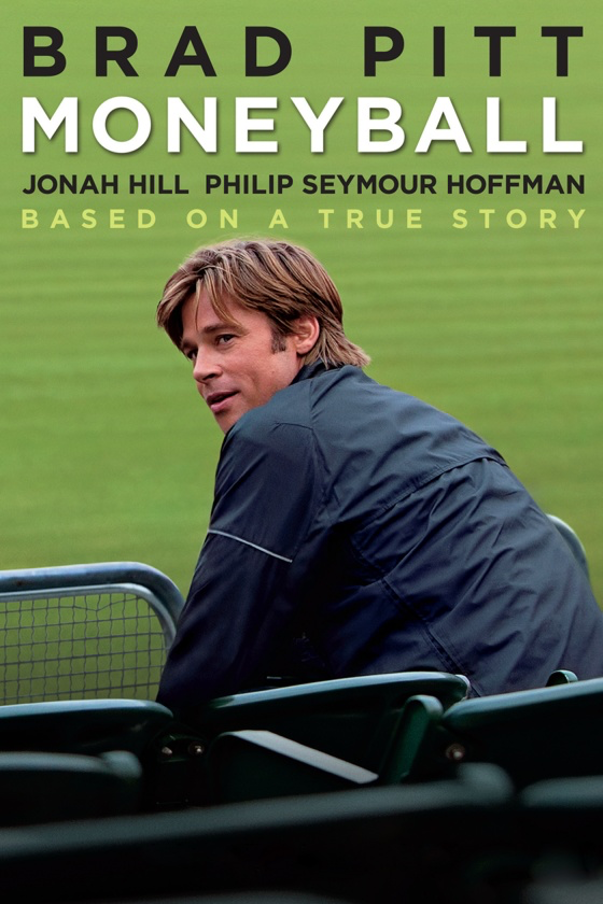
Starring: Brad Pitt, Jonah Hill &
Philip Seymour Hoffman(2011)


REVIEWED BY MARK A. LARSON
Editor & Publisher
Statistics-driven baseball – some love it, some hate it, but it’s definitely here to stay.
“Moneyball” starring Brad Pitt and Jonah Hill explores the early days of using modern mathematics to even the playing field for a small-market baseball team … in this case, the Oakland Athletics. (The movie is based on real events, but because it’s designed for entertainment – and not a documentary – it takes liberties with situations, characters and timelines.)
Pitt plays former major league outfielder Billy Beane who became the A’s General Manager in 1997. After his team loses early in the 2001 playoffs and three top stars leave for free agency, Beane has the daunting task of trying put together another winning team on a miniscule budget. The Yankees, for example, who beat the A’s in the playoffs, had a payroll three times that of Oakland.
Early in the movie, Beane visits the Indians’ headquarters in Cleveland hoping to swing a trade. He notices Peter Brand (played by Jonah Hill) in the room whispering advice to The Tribe’s general manager. After the meeting, Beane tracks down Brand and has a clandestine conversation with him. In short, Brand, who is just out of college with an economics degree, is an advocate of intricate statistical baseball analysis – think sabermetrics – most notably advanced by Bill James.

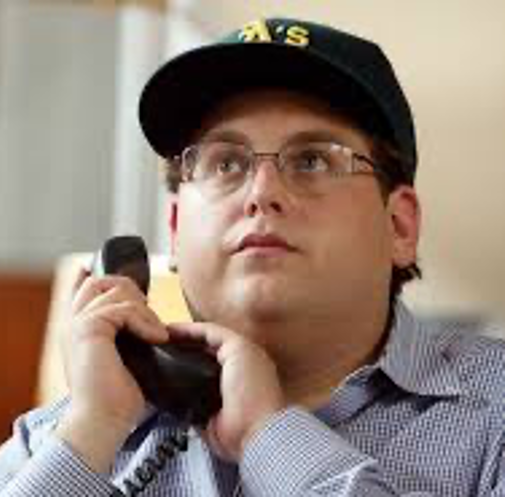
as Peter Brand
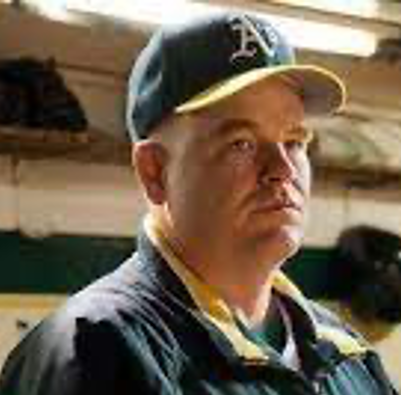
as Art Howe
Brand explains to Beane: “There is an epidemic failure within the game to understand what is really happening. And this leads people who run major league baseball teams to misjudge players and mismanage their teams. … People who run ballclubs think in terms of buying players. Your goal shouldn’t be to buy players, your goal should be to buy wins and in order to buy wins you need to buy runs. … Baseball thinking is medieval, they are asking all the wrong questions.”
Brand also tells Beane, he’s basically running into brick walls with resistance from baseball people. Beane leaves the one-on-one giving the impression he thinks Brand might be full of it. But it gets him thinking.
Moneyball has flashbacks throughout, focusing on Beane’s own career as a ballplayer. Right out of high school, scouts were going gaga over him as a complete five-tool, can’t-miss future star. He was chosen by the Mets in the first round of baseball’s 1980 draft, which included a big bonus. He finally made the majors in 1984 with New York at age 22. But he struggled. Between 1984-89, Beane only played sparingly for four teams (Mets, Twins, Tigers, A’s). He hit just .219 in 301 at-bats and had a paltry on-base percentage of a .246. He finally retired and became a scout.
Sometimes a very brief movie scene can say it all.
It is implied that since his meeting with Brand, Beane has been reflecting on his own career … all the hype, expectations and “natural” talent he had. Beane calls Brand and asks him where he should have been taken in the 1980 draft. In answer to the question, the math whiz sheepishly says “ninth round, no bonus.” … The truth hurt, but it was a lightbulb moment. Beane realizes intricate statistical analysis might have revealed his true value as a baseball prospect. Maybe, just maybe, the evaluation of him by scouts was faulty after all.
Beane then reveals that he has purchased Brand’s contract from the Indians and makes him Assistant General Manager of the A’s.
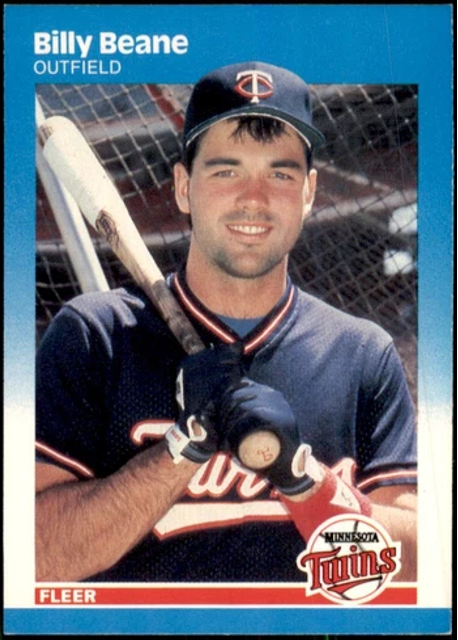
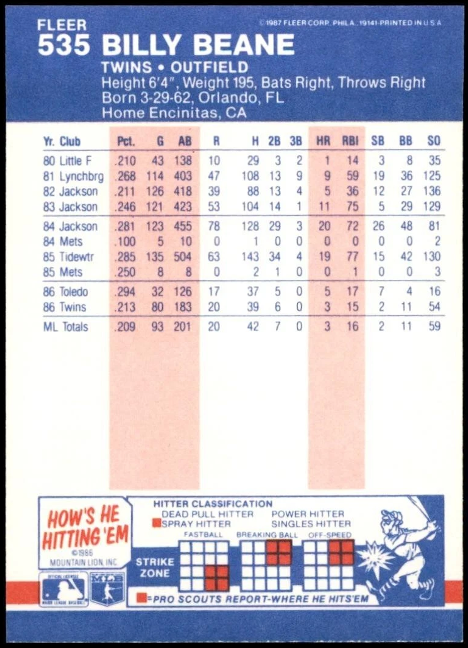
1987 •• Fleer
Next, Beane and Brand meet with Oakland’s scouting team on how to replace the three top players that left after the 2001 season. First problem: No getting around it, the budget is tiny and not about to increase. Beane explains he wants a new way of thinking. Brand remains quiet, but the scouts’ reactions can be summed up in three words: Resistance, resistance, resistance – plus some contempt. The old ways of thinking were not going to be easily replaced … especially by some kid in a business suit.
Likewise, Oakland’s manager, Art Howe, is obstinate about implementing Beane’s plan after what look like less-than-stellar players are acquired to fill the gaping roster holes.
The headwinds against Beane and Brand reach hurricane strength when the team is floundering under .500 during the 2002 season’s first 50 games. The fans, the media, the scouts, the manager and maybe some of the players are all just shaking their heads. They think Beane has completely lost it.
Then the GM starts to make some moves. After a red-hot confrontation, Beane fires the head of scouting for the A’s. He keeps Howe as manager, but makes what on the surface seem to be ridiculous trades. These roster moves force the manager to use players Beane and Brand think will outperform expectations based on seemingly hidden stats.
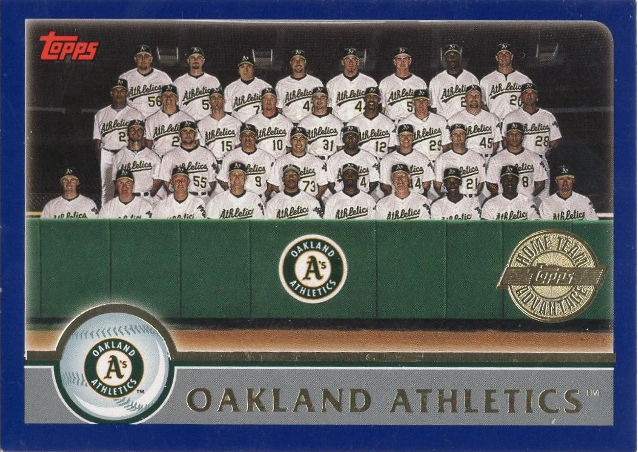
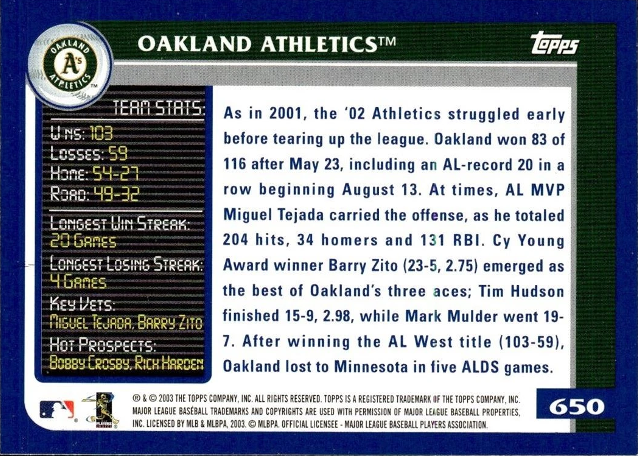
2003 • • Topps
Soon, like a bolt from the blue, the A’s start to win. … and win … and win. Eventually, the team pulls off a then American League record of 20 victories in a row. In the end, Oakland posts a 103-59 record – even better than the previous season.
However, like 12 months earlier, the A’s drop the divisional series. Naturally, in Beane’s mind, making it to playoffs is not enough. Anything less than “winning the last game of the season” is never enough. He is dismayed and tells Brand that he didn’t just want to win the World Series, he wanted to change baseball. Maybe Beane didn’t realize it at the time, but he did.
I really liked this movie … from the first minute through the 133rd – even more after a second viewing. It’s well-acted, well-crafted and moves along. Moneyball plays out like a good drama. It’s by no means fast or exciting, but steadily builds tension and has you rooting for Beane to be successful. It’s not just a good baseball movie, it’s a good movie, period. And, you don’t necessarily have to be an inside baseball junkie to enjoy it. Moneyball is right-on-the money.
• Nominations •
Moneyball was nominated for six Academy Awards, including “Best Picture,” “Best Actor” (Brad Pitt) and “Best Supporting Actor” (Jonah Hill). In addition, it was nominated for four Golden Globe Awards, including those same categories. Although a commercial success, the film was shut out when it came to the Oscars and Golden Globes.

Award


Globe
Both actors’ performances were worthy of their Academy Award and Golden Globe nominations. Jonah Hill’s understated portrayal of the Peter Brand character is especially effective and definitely deserved recognition. Brad Pitt doesn’t portray Billy Beane as too over-the-top, but rather exuding a quiet confidence. And there are scenes with his 12-year old daughter that seem genuine – not sappy – and add a degree of warmth and dimension to his personality and the movie.
• • • • • •
THIS ARTICLE WAS WRITTEN
EXCLUSIVELY FOR BaseballCardFun.com
• • •
Text Copyright © 2026 by BaseballCardFun.com / Mark A. Larson
No article appearing on this website may be reproduced without written consent of the Editor/Publisher
To keep up-to-date on additions to BaseballCardFun.com, subscribe below*
* Your email address will never be shared and is only used to announce new articles
 BaseballCardFun.com