
BY TROY KIRK
Staff Writer
The 1954 Topps set holds unusual interest for Detroit Tiger collectors, containing an interesting mix of past and present Tiger stars. Coming just two years after the worst year in Tiger history up to that time and with most other Topps and Bowman sets from that period containing little to interest a Tiger collector, the richness of the 1954 Topps set is surprising.
In 1954, Topps was nearing the end of their five-year battle with Bowman for contractual rights with the players for baseball cards. Topps held exclusive contracts with about one-quarter of the players, while Bowman controlled the contracts of another quarter. The rest of the players were under non-exclusive contracts and could be pictured in both sets. Since Topps was limited in who they could picture that year, they became unusually creative, using managers and coaches to fill out their set. Even with these additional subjects, there are only 250 cards in the set, making it the second smallest regular Topps set ever issued.
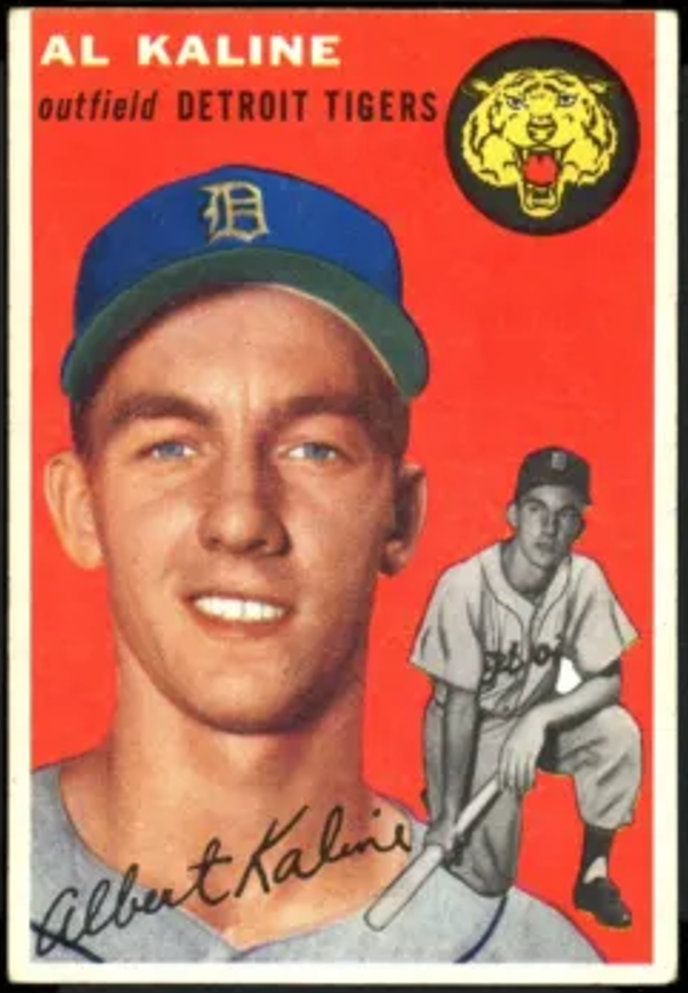
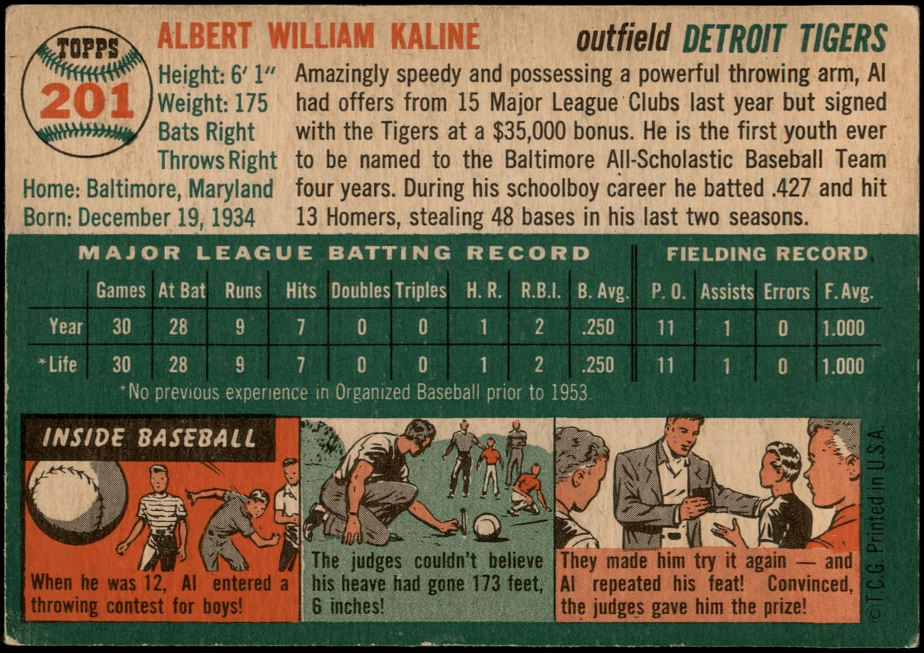
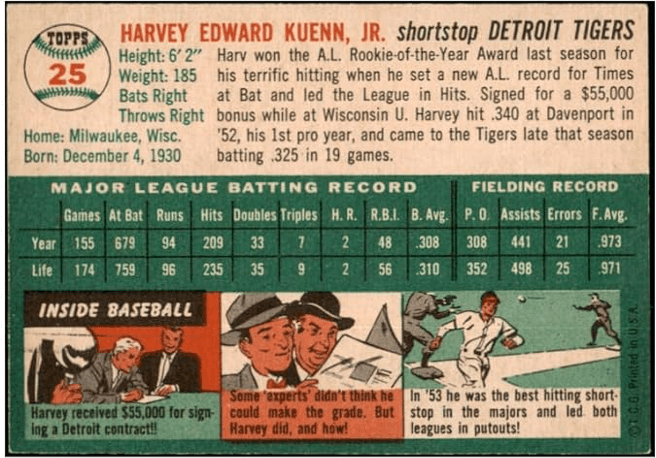
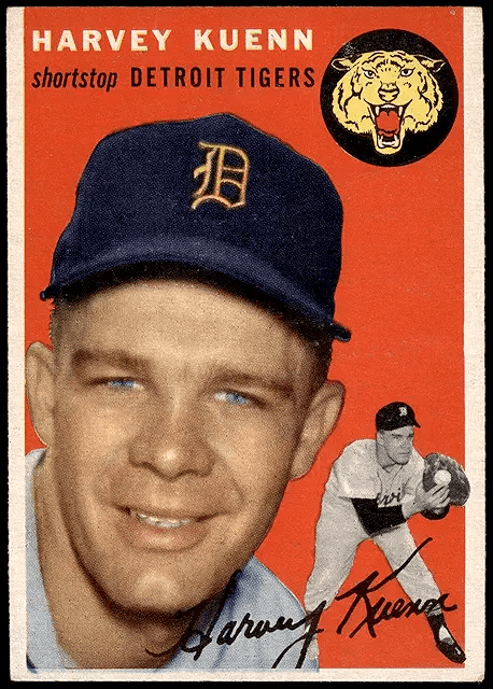
The 1954 Tiger roster contained few notable players, with the exception of two youngsters named Al Kaline and Harvey Kuenn. Both of these stars made their first appearance on a Topps card in this set. One of the best right fielders of all time, Kaline went on to a 22-year Hall of Fame career with the Tigers. The Kaline card is by far the most expensive Tiger card in the set, a PSA 8 copy selling for over $6,000 on eBay in 2024.
Starting out as a shortstop, Harvey Kuenn was an All-Star for eight straight years. After moving to the outfield, he won the American League batting title in 1959. In one of the most celebrated and controversial trades of all time, he was traded for American League home run leader Rocky Colavito for the 1960 season.
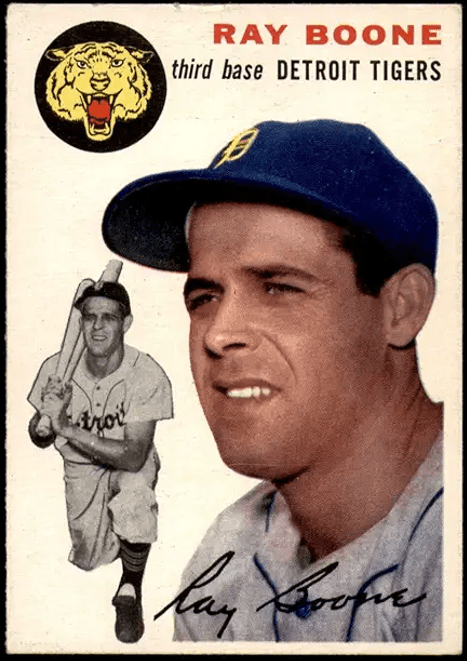
Ray Boone had just been traded to the Tigers during the previous season and made his first Tiger baseball card appearance in this set. Boone had some very successful years in the mid-1950s as the Tiger third baseman, then staked a claim as the patriarch of the first three-generation baseball family. Son Bob Boone and grandsons Bret and Aaron Boone followed him to major league stardom. Aaron went on to manage the New York Yankees, leading them to the pennant in 2024.
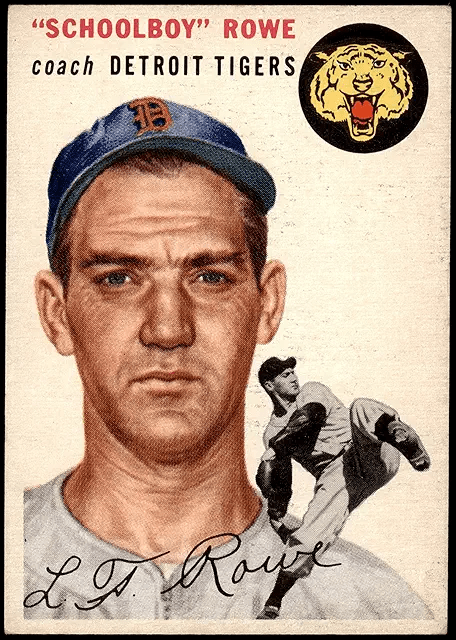
A really interesting card shows grizzled Tiger coach Schoolboy Rowe. Rowe was a top pitcher for the Tigers through most of the 1930s into the early 1940s, helping the Tigers win three pennants and a World Championship in 1935. This is the only Topps card of Rowe, and his first appearance on a baseball card since 1949.
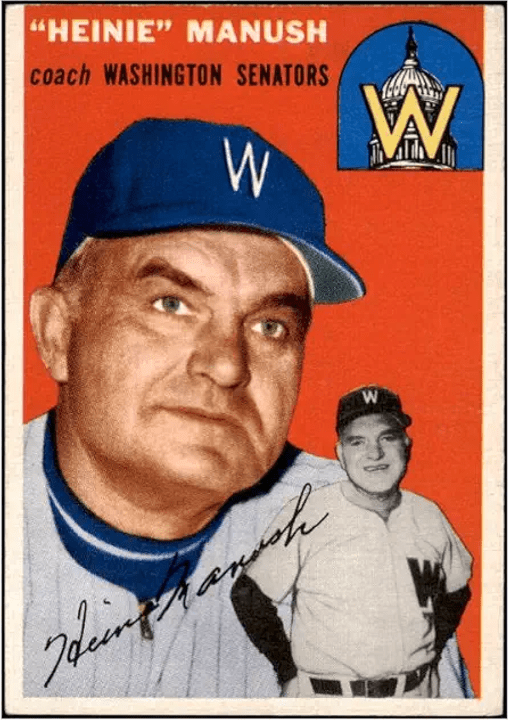
Going back even further into Tiger history, Hall-of-Famer Heinie Manush is pictured as a coach for the Washington Senators. Manush came up with the Tigers in the 1920s, edging out Babe Ruth for the 1926 A.L. batting title. This is the only Topps card for Manush, and his first appearance on a baseball card since his Play Ball card in 1940.
Pirates manager Fred Haney makes his Topps baseball card debut in the 1954 set. Haney began a long baseball career as the second baseman for the Tigers for four years in the 1920s, playing for Tiger manager Ty Cobb. Haney became more famous as a manager, leading the 1957 Braves to their only Milwaukee World Championship.
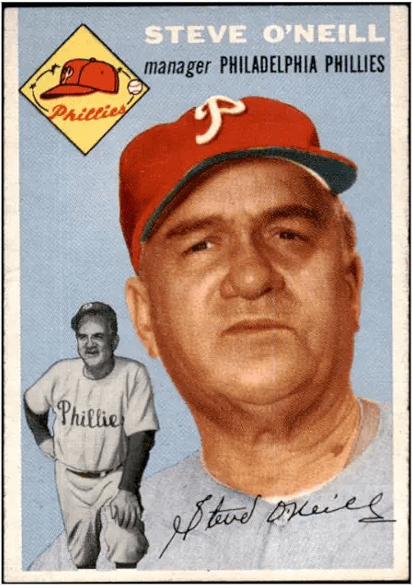
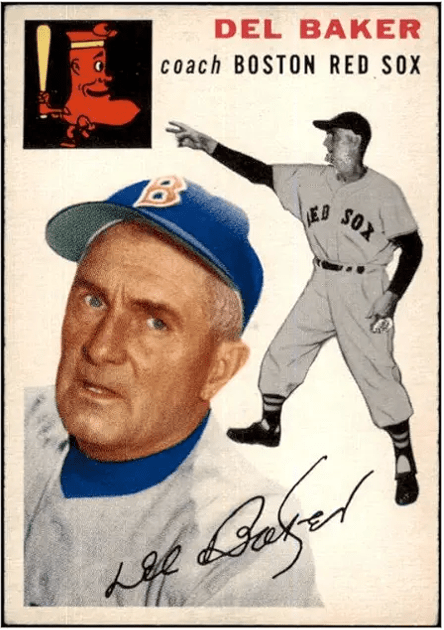
The two previous Tiger managers to pilot the Tigers into the World Series are both in the 1954 Topps set. Steve O’Neill, the manager of the World Champion Tigers of 1945 appears as the manager of the Phillies. This is O’Neill’s only Topps card and his last card as an active manager. Del Baker, a Tiger player from as far back as 1914 and the manager of the Tiger pennant winners of 1940, is shown as a coach for the Red Sox.
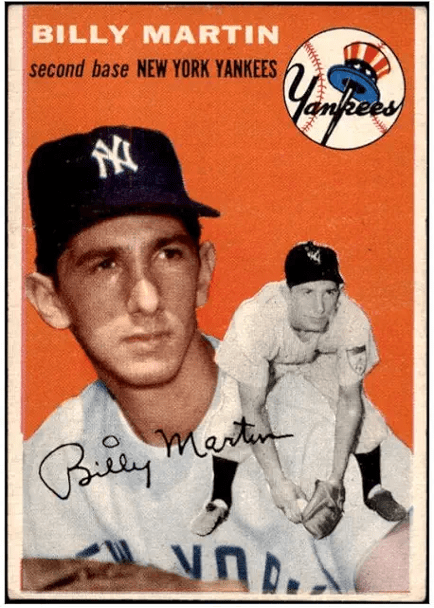
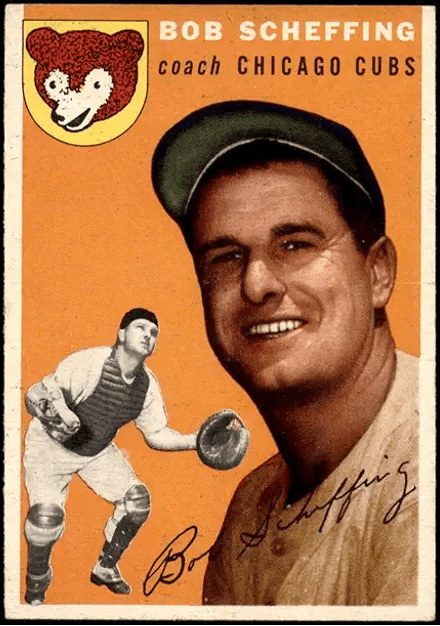
Future Tiger manager Billy Martin appears as a player for the Yankees. Martin led the Tigers into the playoffs in 1972. Bob Scheffing, another future Tiger manager, is shown as a coach for the Cubs. Scheffing led the Tigers to 101 wins in 1961, but Detroit could not catch the powerful Mantle-Maris Yankees that year. Johnny Sain, the pitching coach for the World Champion 1968 Tigers, is shown as a pitcher for the Yankees.
Curiously, the 1954 Tiger manager, Fred Hutchinson, does not have a card in the 1954 set. Hutchinson was on a 1953 Topps card as the manager of the Tigers, but he wasn’t in either the 1954 Topps or Bowman sets. Three Tiger coaches have cards, but the manager doesn’t.
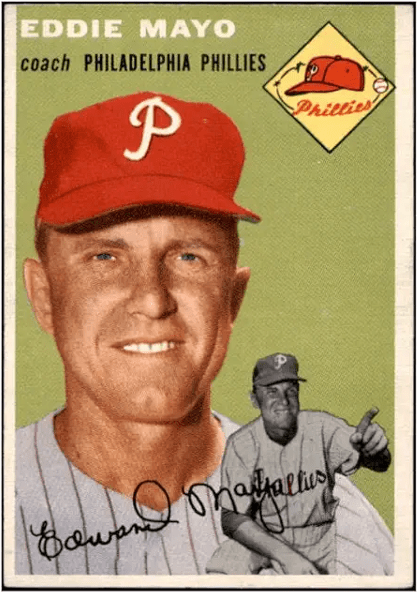
Eddie Mayo, second baseman for the Tigers in their World Championship 1945 season, is shown as a coach for the Phillies. This is Mayo’s only Topps card and his first baseball card appearance since 1949. Mayo had such an outstanding season in 1945 that The Sporting News named him the Most Valuable Player in the American League.
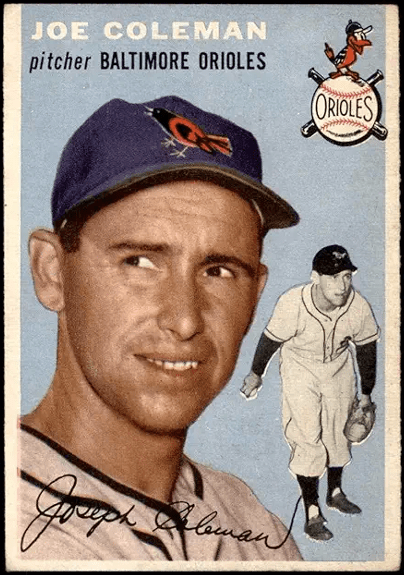
Joe Coleman appears as an active pitcher for the Orioles. He ended his career with the Tigers the following year, and his son Joe had a fine Tiger career in the early 1970s. Son Joe won 20 games twice for the Tigers and set a playoff record (since broken) when he struck out 14 Oakland A’s in a 3-0 shutout win in 1972.
Another Baltimore pitcher, Duane Pillette, holds the opposite distinction of being the son of a former Tiger pitcher, Herm Pillette. Herm won 19 games for the 1922 Tigers, then lost 19 in 1923 before quickly disappearing from the major league scene.
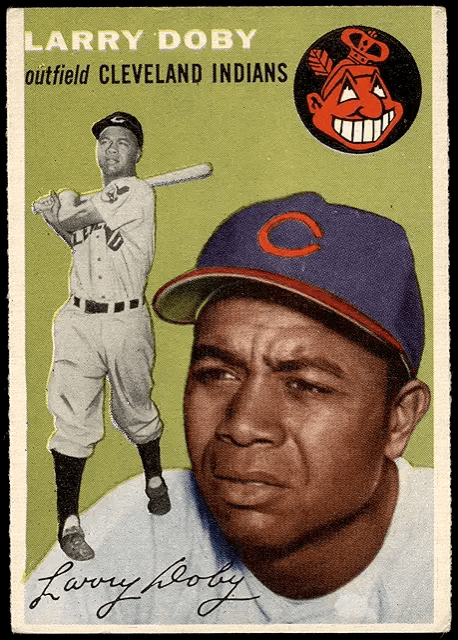
Hall-of-Famer Larry Doby is in the set as a Cleveland outfielder. The powerful Doby played in seven straight All-Star games and won two home run titles. He also played briefly for the Tigers near the end of an illustrious career that included being the first player of African-American heritage to play in the A.L.
When Eddie Gaedel became the only little person to bat in the majors for the St. Louis Browns in 1951, he batted against the Tigers. Bob Cain was the pitcher who faced Gaedel, and he is shown as a member of the A’s on his 1954 Topps card, his last card as an active player. Bob Swift was the catcher that day, and he is shown as a coach of the Tigers. In 1966, when Tiger manager Chuck Dressen died during the season, Swift briefly managed the Tigers before becoming ill and passing away later that year himself. Jim Delsing pinch-ran for Gaedel after he walked, and he is shown as an outfielder for the Tigers.
Two Hall-of-Fame Tigers who were still active with other teams do not appear in the 1954 Topps set. Hal Newhouser, one of the best Tiger pitchers of all time, was not on a Topps or Bowman card in 1954. He was shown as a Tiger in the 1953 Topps set and resurfaced as a Cleveland Indian in the 1955 Topps set. George Kell, former Tiger star third baseman and later a long-time broadcaster for the Tigers, was not on a Topps card in 1954. He did appear on a 1954 Bowman card with the Red Sox.
Other active Tigers in the 1954 Topps set include first basemen Walt Dropo and Chuck Kress, second basemen Johnny Pesky and Reno Bertoia, catchers Frank House and Matt Batts, outfielder Don Lund, pitchers Ned Garver, Ray Herbert, Dick Weik, Al Aber, and Bob Miller, and coach Johnny Hopp.
The 1954 Bowman Tiger lineup included seven players that also appeared in the 1954 Topps set – Matt Batts, Jim Delsing, Walt Dropo, Ned Garver, Harvey Kuenn, Don Lund, and Johnny Pesky. The Bowman set also included catcher Johnny Bucha, second baseman Fred Hatfield, outfielders Pat Mullin and Steve Souchock, and pitchers Steve Gromek, Billy Hoeft, and Ted Gray.
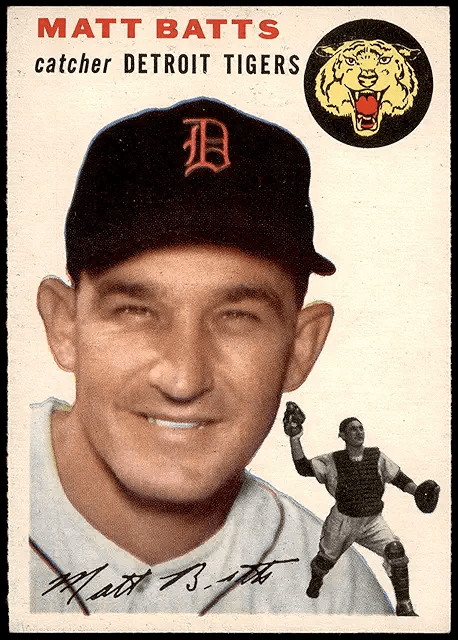
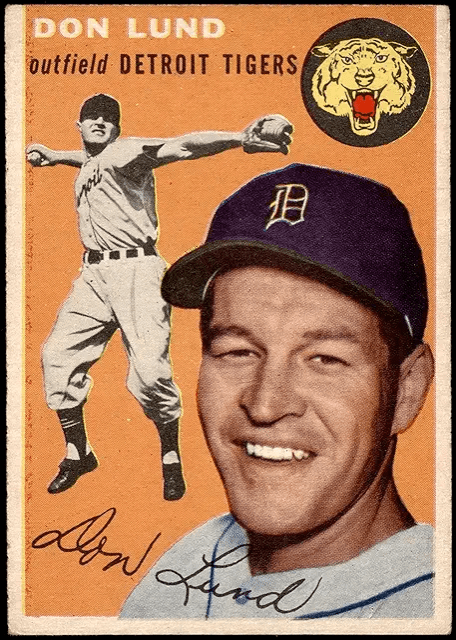
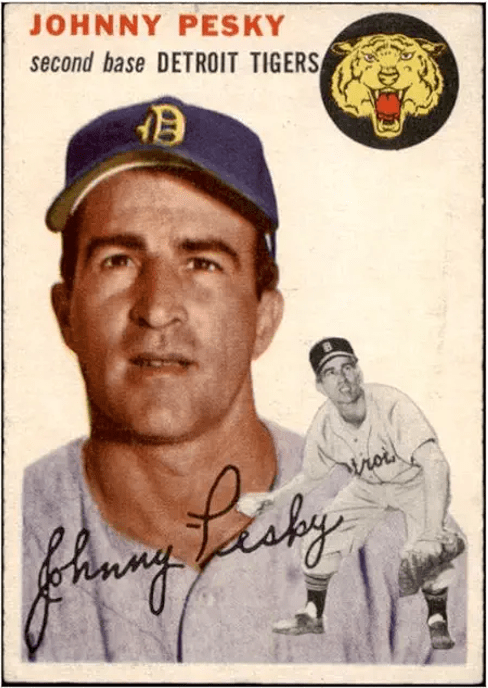
Players who appeared in both 1954 sets: Topps (above) and Bowman (below).
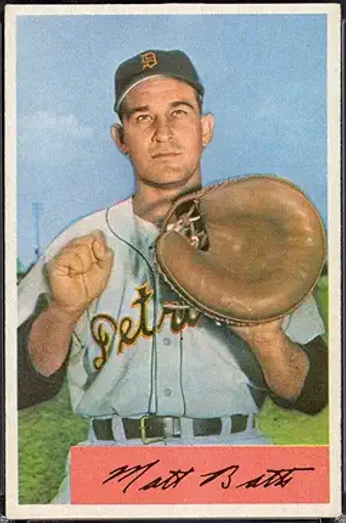
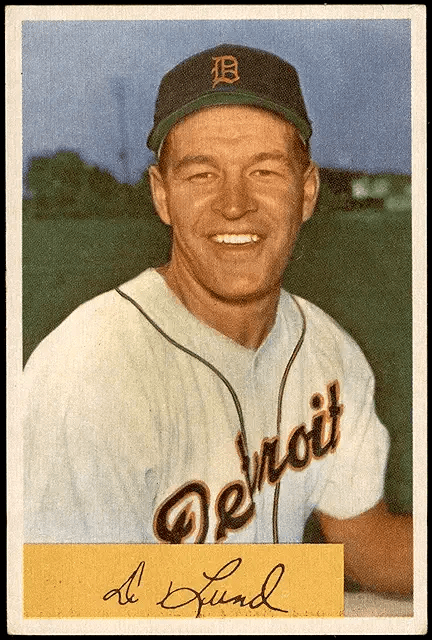
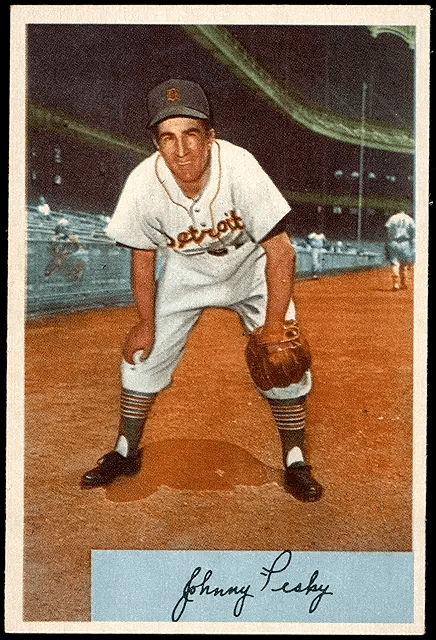
Comparing the 1954 Topps and Bowman sets, the Topps set contained six of the eight regulars in the Tiger lineup while the Bowman set contained only two. Neither set had a card of regular second baseman Frank Bolling or outfielder Bill Tuttle. Both of those players became regulars for the first time in 1954. Bowman did better with the Tiger pitchers, showing cards of four of the six main starters, while Topps pictured two starters and three relievers. Topps was the clear winner in Tiger player selection, especially with their exclusive on Al Kaline, though Bowman did have an exclusive on top Tiger pitcher Steve Gromek, who went 18-16 in 1954.
Neither company issued cards for Bob Nieman, Wayne Belardi, or George Zuverink, all of whom got considerable playing time with Detroit that year. Also missing is Tiger pitcher Ralph Branca, the former Dodger who became famous for serving up the “Shot Heard Round the World” home run to Bobby Thomson in the 1951 Giants-Dodgers playoff game.
Other notable former or future Tigers in the 1954 Topps set include Hall-of-Famer Ed Mathews, Gus Zernial, Johnny Podres, Johnny Lipon, Bill Bruton, Johnny Klippstein, and Roy Face.
Other notable former or future Tigers in the 1954 Bowman set include Hoot Evers, Vic Wertz, Art Houtteman, Ed Yost, Bill Pierce, Saul Rogovin, Les Moss, and Virgil Trucks.
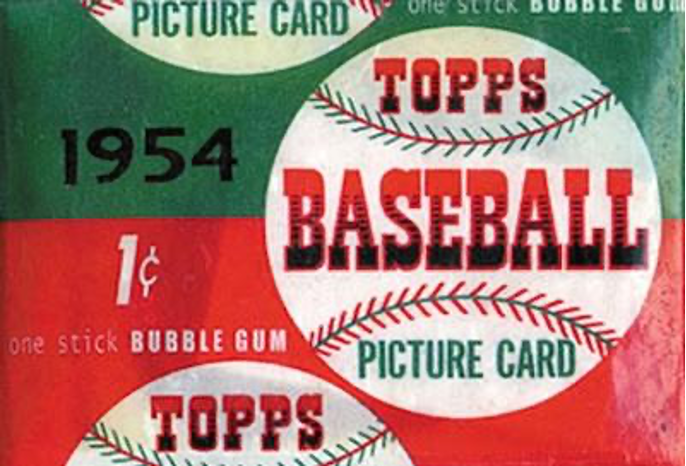
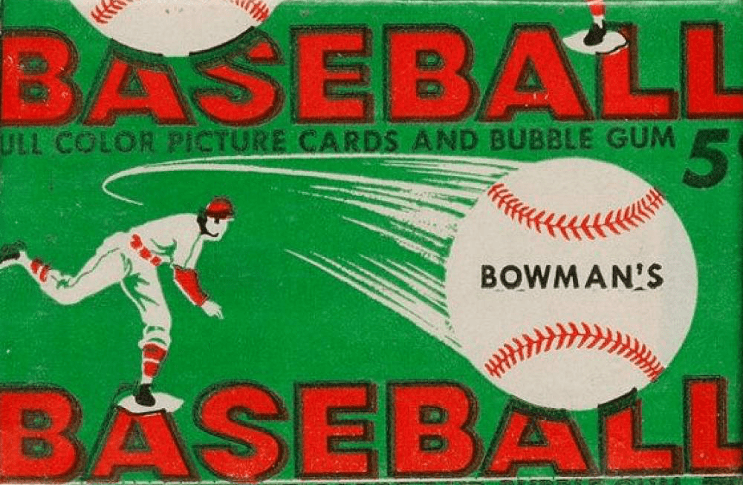
1954 Topps and Bowman wax packs
• • • • • •
THIS ARTICLE WAS WRITTEN
EXCLUSIVELY FOR BaseballCardFun.com
• • •
Text Copyright © 2025 by BaseballCardFun.com / Troy Kirk
No article appearing on this website may be reproduced without written consent of the Editor/Publisher
To keep up-to-date on additions to BaseballCardFun.com, subscribe below*
* Your email address will never be shared and is only used to announce new articles
 BaseballCardFun.com