
The history of Topps baseball card sets
BY MARK A. LARSON
Firsts and lasts … 1980 had its share.
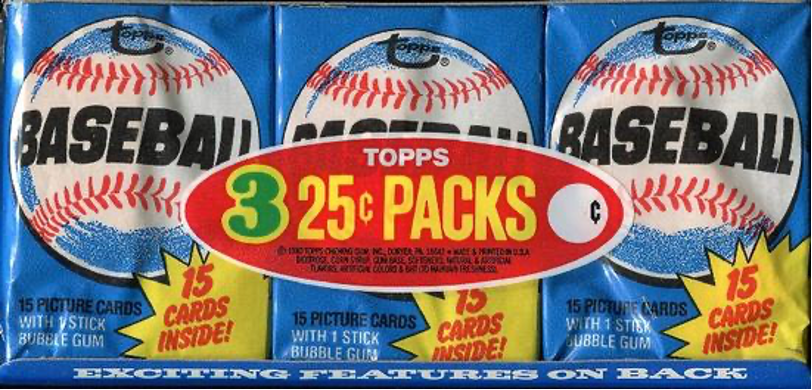
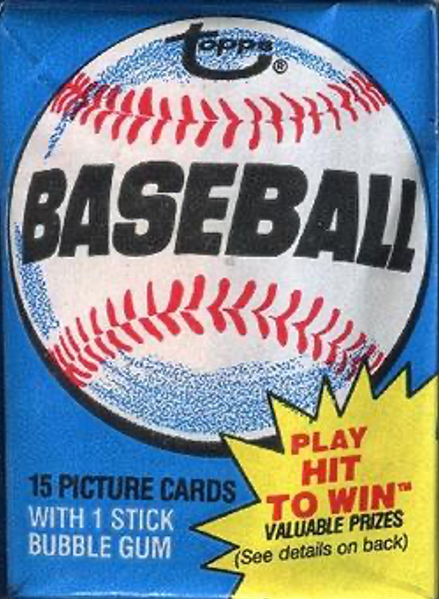
The first National Sports Collectors Convention was held in the summer of 1980. Meanwhile, the 1980 card set would be Topps’ last without major competition.
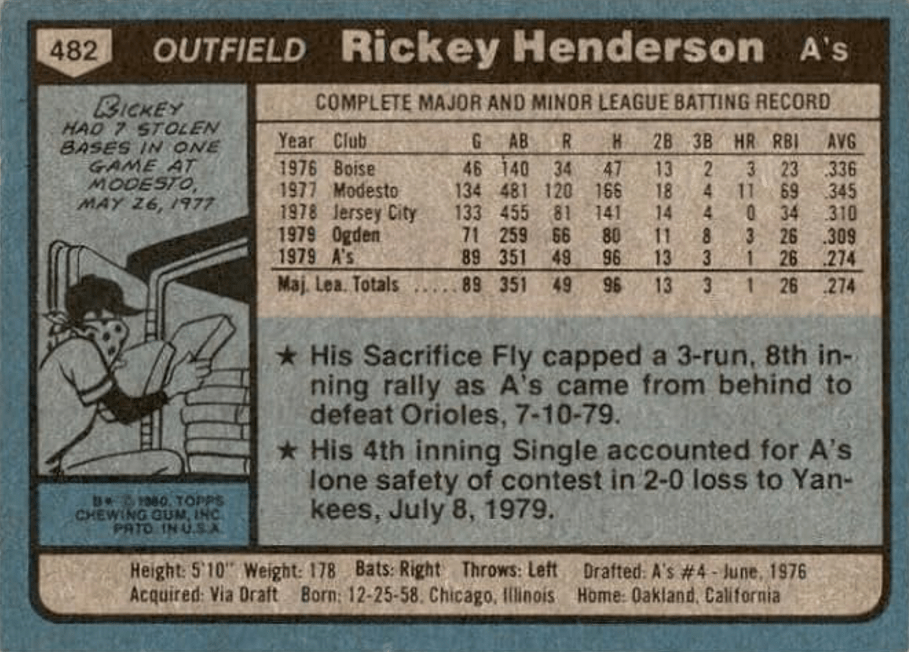
The first card of Rickey Henderson was featured in the ’80 set, while the last regular Topps cards of nine significant players were also included.

R★★KIE CARD
On the national scene, 1980 marked the last full year in office for Democratic President Jimmy Carter, who was defeated in November by Republican Ronald Reagan. It would prove to be a significant turning point in the nation’s political landscape.
Yet, while national and international events (such as the hostages in Iran) would dominate headlines in 1980, card collectors were starting to see the first signs that their hobby was beginning to mature.
The National Convention was held in Los Angeles in mid-1980. Even its founders never dreamed it would grow into the hobby’s premier event each summer. Tens of thousands of collectors make the trek to the National every year to visit hundreds of dealers and corporate sponsors from across the country. It has become the single most important annual hobby happening, our own World Series.
But the biggest news in card collecting in 1980 was the bombshell handed down in federal court. Fleer had challenged Topps’ 25-year monopoly of the baseball card business. The courts ruled in favor of breaking Topps’ stranglehold. When the new sets were released in the spring of 1981, it would be the first time since 1955 Topps had serious competition. (Bowman was Topps’ chief rival back then.)
Most collectors were elated. This development, along with the publication of the first comprehensive price guide the year before, would radically change sports collecting forever.

From the looks of its 1980 set, Topps needed a jolt to spur its creativity. The ’80s aren’t bad looking cards, they just don’t have much pizzazz. Their relatively lackluster design is basically a rehash of the style used in 1974.
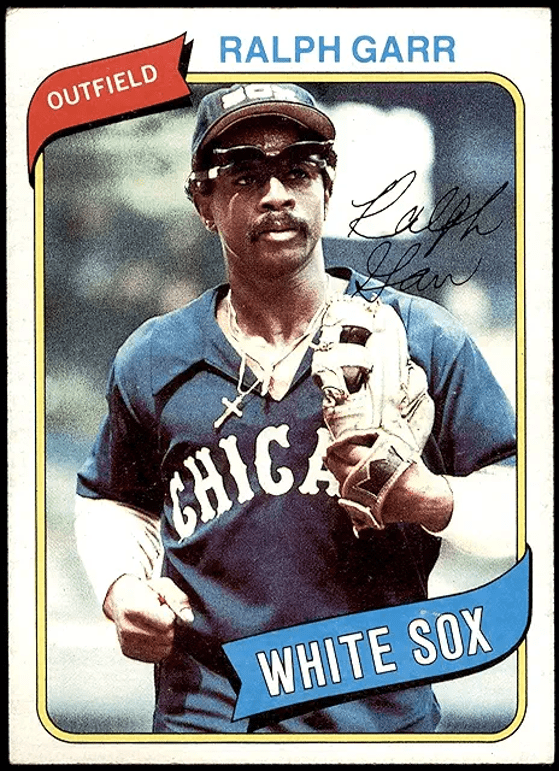
Card fronts feature a small color band at the top indicating the player’s position, while a larger color band at the bottom shows his team’s nickname. The player’s name is also at the top and a facsimile autograph is included.
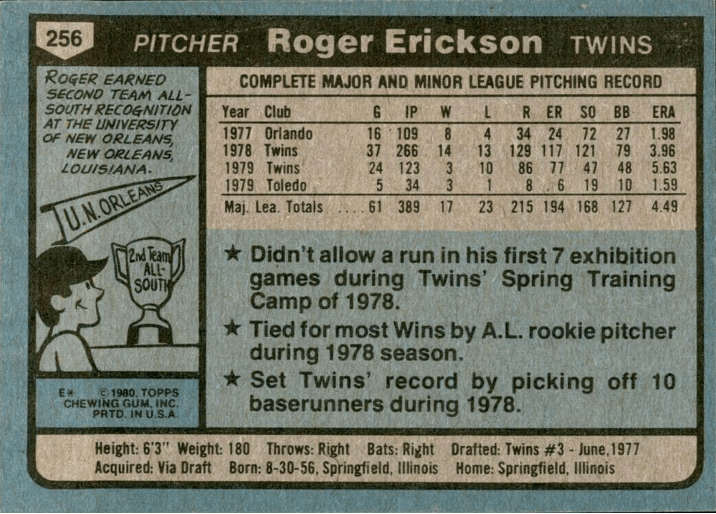
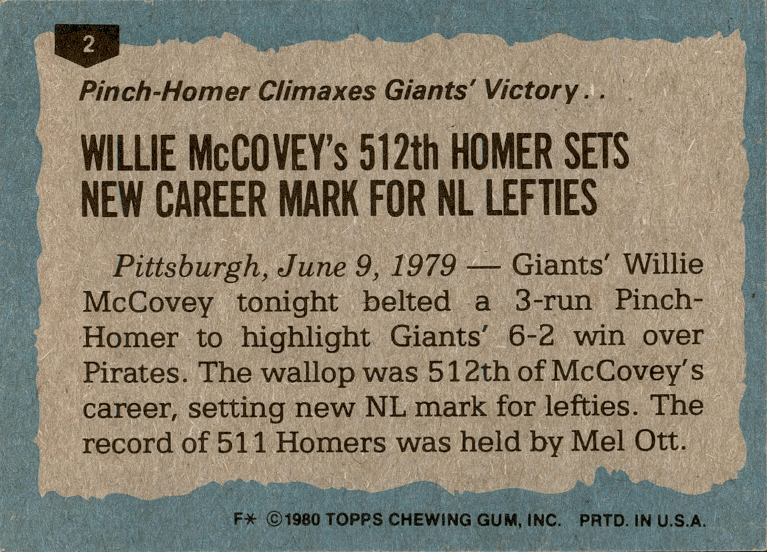
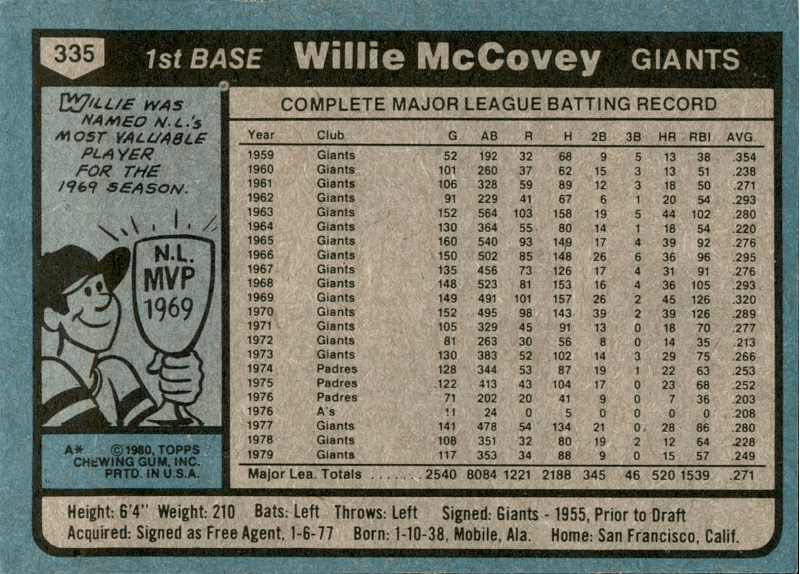
Backs were typical Topps. Year-by-year statistics are shown, along with vital information and a cartoon. They feature black ink, with blue trim on gray cardboard stock. Blue is usually a nice color for a card back, but only when used on white stock – such as in 1965 or 1970. But on gray stock it just looks dark and somber.
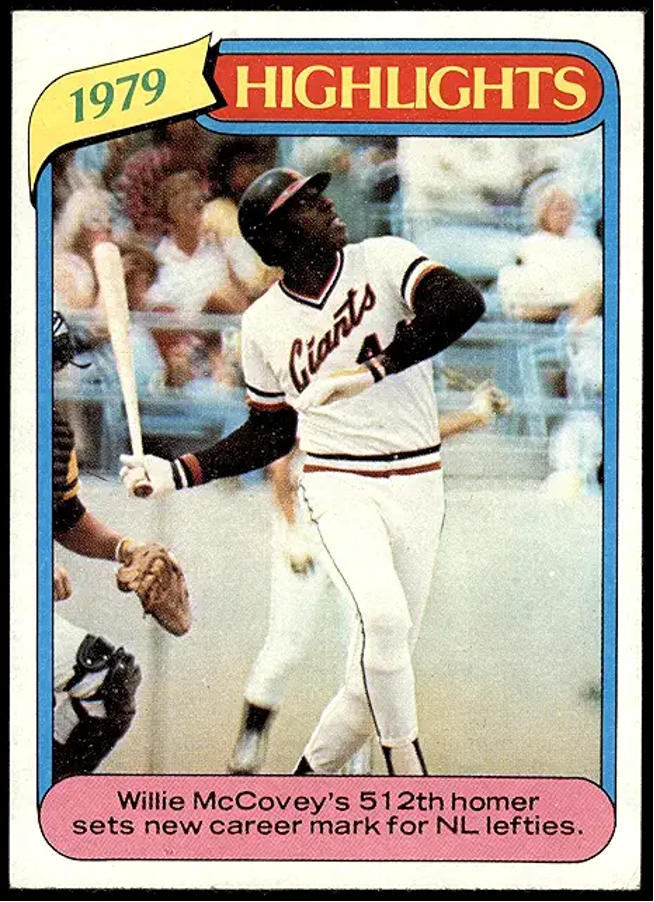
Topps certainly didn’t put much effort into utilizing subsets for the 1980 issue. Only three are included: “Highlights,” “Leaders” and “Future Stars.” Notably absent are Playoff/World Series cards and other special subsets such as the previously-used “All-Time Leaders,” “Father and Son” cards, “Turn Back the Clock,” etc.
Heaven forbid, Topps should come up with something new. (This was the primary reason many collectors were fed up with the company. Topps had grown lazy and complacent and was totally deficient in the creativity department.)
The 726-card set leads off with the “Highlights” subset (#1-6). It includes cards that feature Hall-of-Famers Lou Brock and Carl Yastrzemski (on the same card) and Willie McCovey. Also included is Pete Rose.
“Leaders” (#201-207) includes cards of Dave Winfield (N.L. RBI Leader), new Colorado Rockies manager Don Baylor (A.L. RBI Leader), Nolan Ryan (A.L. Strikeout King), plus Phil and Joe Niekro who tied for the N.L. lead in victories.
Each of the then 26 major league teams was assigned a “Future Stars” card in the 1980 set (#661-686). Three players are grouped per card/team. Among them were Dan Quisenberry of the Royals (#667) who went on to save 244 major league games. He led the A.L. in the department five times and posted a lifetime 2.76 ERA between 1979-90.


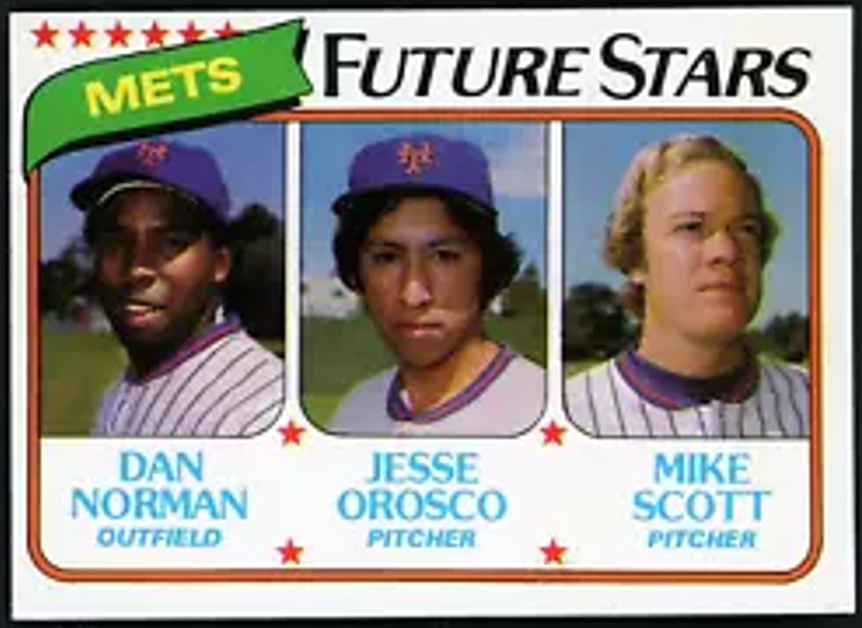
Other players included on Future Stars cards were: Mike Morgan (#671), plus Mike Scott and Jesse Orosco who shared the same card (#681).
Additional players who appeared on their first card in 1980 were Dave Stieb (#77) and Rickey Henderson (#482). Each had his own card.
Stieb has gone on to compile a 174-132 lifetime record that includes six seasons of 15 or more wins for the Toronto Blue Jays. Henderson, of course, is the all-time stolen base leader with 1,042. In addition, the speedster has led the league in swipes 10 times. He has also scored 100 or more runs in 10 seasons, leading the league five times. And in 20 Championship and World Series games, Henderson has hit .377, with 18 steals.
At one time – in the spring of 1991 – Henderson’s 1980 Topps rookie card was the most expensive major set card from the 1974-91 period. But because of his poor attitude (at times he doesn’t seem to give a rip), collectors have soured on Henderson’s ’80 card, and other cards from the period have surpassed his.
The last Topps cards of several prominent players were also included in the 1980 set. Among them were Rico Carty, Ralph Garr, Mickey Lolich, Willie Horton, George Scott, Ken Holtzman, Manny Mota, Tim McCarver and McCovey.
Carty (first Topps card in 1964) was a .299 career hitter who also belted 204 home runs. Carty spent most of his career with the Braves and won the National League batting title in 1970, hitting .366.

🔹🔹 LAST 🔹 CARDS 🔹🔹
Garr also spent the majority of his career with the Braves. His first Topps card was in the 1970 set. He hit .306 over the course of his career. From 1971-77, he batted .343, .325, .299, .353, .278, .300 and .300. In 1974, “The Roadrunner” led the senior circuit with both his .353 average and 214 hits. In fact, he topped the 200-hit mark three times.
Southpaw Lolich was a top Tigers hurler for many years. Between 1963-79, he compiled a lifetime record of 217-191, with a 3.44 ERA. He struck out 200 or more batters seven times and ended his career with 2,832 whiffs. Lolich’s best years were 1971-72.
In ’71, he went 25-14, with a 2.92 ERA. He had 308 strikeouts in an astonishing 376 innings that year. He also completed 29 games. The following year, Lolich was 22-14, with 250 K’s and an ERA of 2.50. Perhaps his most notable accomplishment was in 1968. He pitched three complete-game victories in the World Series against the Cardinals, compiling a 1.67 ERA. His first Topps card was in the 1964 set.


🔹🔹 LAST 🔹 CARDS 🔹🔹
Horton was a teammate of Lolich for many years in Detroit. His first Topps card appearance was also in the ’64 set. Horton was a power-hitter who blasted 325 homers between 1963-80. He also accumulated a lifetime total of 1,163 RBIs. He topped the 20-homer plateau seven times and had 90-plus RBIs in five seasons.
First-baseman Scott split most of his career between the Red Sox and Brewers. From 1966-79, he had 271 homers and 1,051 RBIs in 2,000-plus games. He hit 20 or more round-trippers a half dozen times. He led the A.L. in home runs and RBIs in 1975 with 36 and 109 respectively. His first Topps card was in 1966.


🔹🔹 LAST 🔹 CARDS 🔹🔹
Holtzman’s initial Topps card was in 1967 when he was with the Cubs. The pitcher spent most of his career with Chicago and Oakland. He won 17 or more games six times, posting a lifetime record of 174-150. His best years were with the first-place A’s teams of 1972-75. During that four-year span, Holtzman had records of: 19-11 (2.51 ERA); 21-13 (2.97); 19-17 (3.07); and 18-14 (3.14). In eight Fall Classic games, he was 4-1, with a 2.55 ERA.
Pinch-hitting king Mota first appeared on a Topps card in 1963 as a Houston Colt .45. He spent the bulk of his 20-year career with the Pirates and Dodgers. He owns an overall lifetime .304 average. Mota also possesses a career .297 pinch-hitting average (150-for-505). His 150 lifetime pinch-hits are No. 1 all-time.


🔹🔹 LAST 🔹 CARDS 🔹🔹
McCarver is now a well-known broadcaster, but he toiled behind the plate for most of his 21-year major league career. His first Topps card appearance was in 1962. The backstop spent the majority of his years with the Cardinals and Phillies. In 21 World Series games for St. Louis in 1964, 1967 and 1968, he hit .311. In 1966, he led the N.L. with 13 triples, which is an unusual accomplishment for a catcher.
The most well-known – and only Hall-of-Famer – among those with their last regular Topps card in the 1980 set is McCovey. “Stretch,” as he was known, belted 521 career home runs and has 1,555 RBIs. The first-baseman played most of his career in the shadow of Willie Mays in San Francisco. In the six-year period from 1965-70, he averaged 38 homers and 106 RBIs per season for the Giants. He made his Topps card debut in the 1960 set.

🔹🔹 LAST 🔹 CARD 🔹🔹
Firsts and lasts … Topps’ first set of the 1980s decade was its last as the major sole producer of baseball cards – ending a 25-year monopoly. The following year would signal the start of the avalanche of card sets that we see today.

• • • • • •
• Originally Published in May 1993 “Baseball Hobby News” •
THIS ARTICLE FROM “BASEBALL HOBBY NEWS” MAGAZINE IS REPRINTED WITH THE PERMISSION OF BOTH THE EDITOR/PUBLISHER AND THE AUTHOR. IT HAS BEEN RETYPED, BUT NO CONTENT HAS BEEN CHANGED (EXCEPT FOR VERY MINOR ADJUSTMENTS, CORRECTIONS TO TYPOGRAPHICAL ERRORS AND CHANGES TO GRAPHICS). COMMENTS OR INFORMATION IN THE ARTICLE MAY BE OUT-OF-DATE.
To keep up-to-date on additions to BaseballCardFun.com, subscribe below*
* Your email address will never be shared and is only used to announce new articles
 BaseballCardFun.com