
His majesty has appeared on a
wide variety of cards through the years

BY MARK A. LARSON
If Elvis is the King of Rock ’n Roll, then surely Mickey Mantle is the King among baseball card collectors.
Mantle’s cards have always been highly-prized by hobbyists. This is reflected in the fact that in most sets in which he’s included, Mantle’s cards are at or near the top in value.
From the time the 19-year old Oklahoman made his major league debut in 1951 until he announced his retirement from the game in the spring of 1969, Mantle was among the most popular of all ballplayers. That popularity has only increased in the nearly 25 years since he retired.
Obviously, the combination of raw talent – from both sides of the plate – big career numbers, his pennant-winning and world championship teams, the “New York Factor” (heavy media exposure), likeable personality, and even his name itself all combined to make “The Mick” a card collecting favorite.
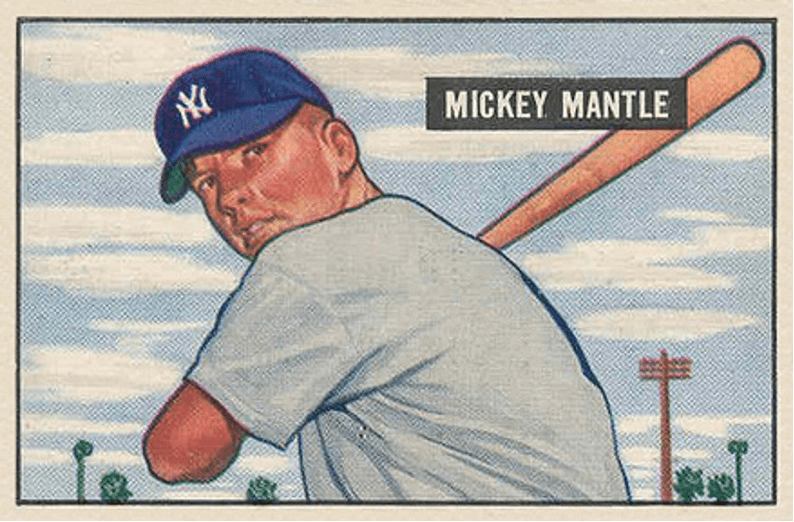
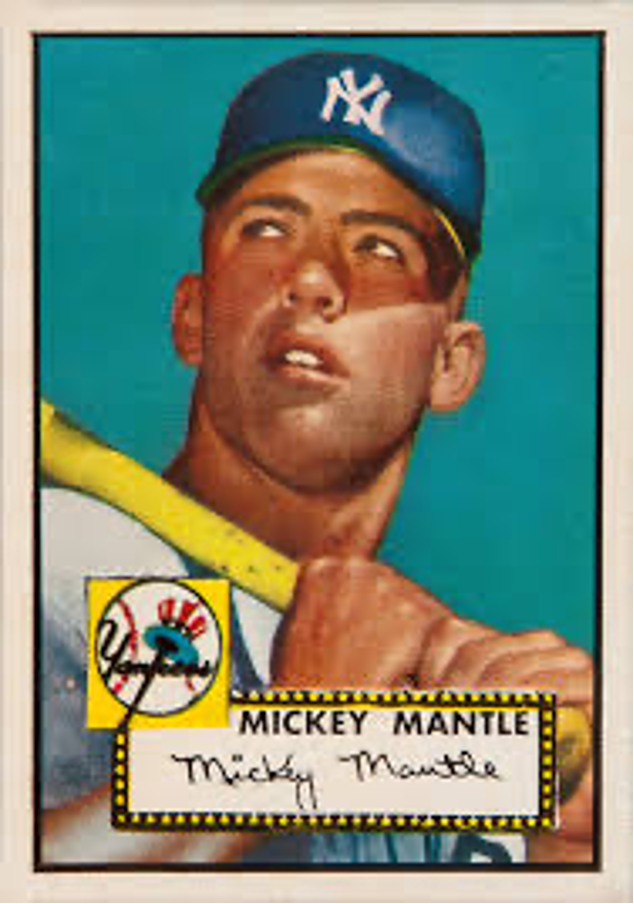
Although Mantle’s 1952 Topps card has received oodles of publicity over the years, and is one of the most expensive cards in the hobby, it is not his rookie card. It’s his first Topps card. Mantle’s rookie card is in the 1951 Bowman set.
The ’52 Topps Mantle has garnered so much interest over the years because of its inclusion in the first major Topps set. Plus, it’s in the hard-to-find last series of 1952 (although it was double-printed).
When Mantle came upon the big league scene, the battle royale between the Bowman and Topps companies was just getting under way. The two gum giants would soon be duking it out over players’ rights to appear in their baseball card sets.
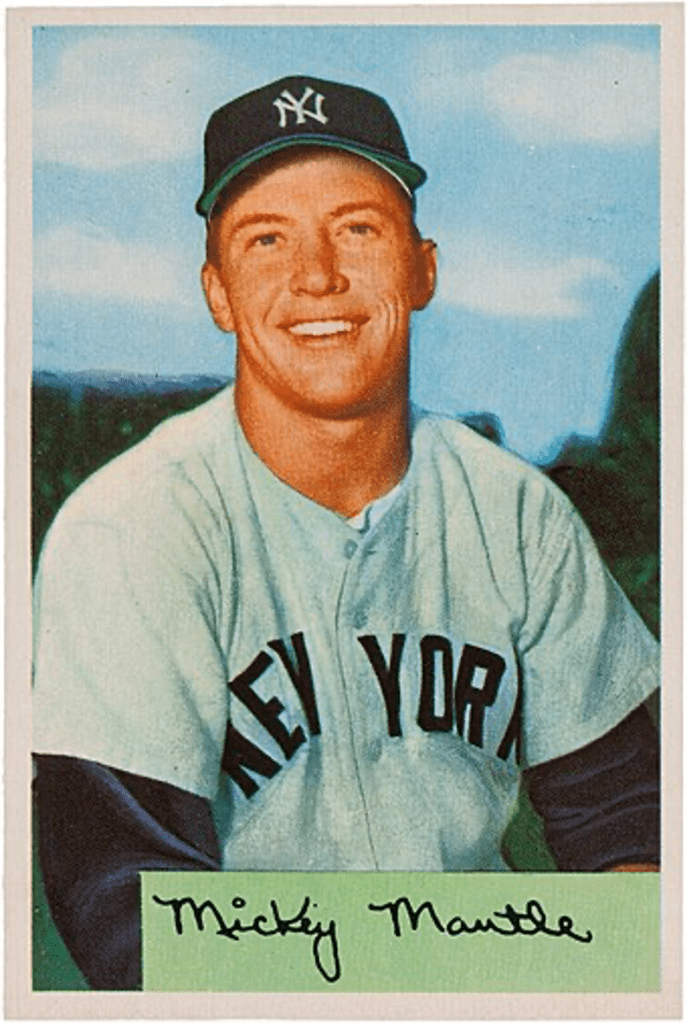
Mantle appeared in the five major Bowman sets between 1951-55, including the exquisite 1953 color set. In fact, he appears twice in the set. Once on his own card and on another with a fellow Yankee, Yogi Berra.
Because of these contractual battles, Mantle appears in the 1952-53 Topps sets, but not in the 1954-55 issues. In Jan. 1956, Topps bought out Bowman and thus Mantle appeared in every regular Topps baseball card issue from 1956-69.
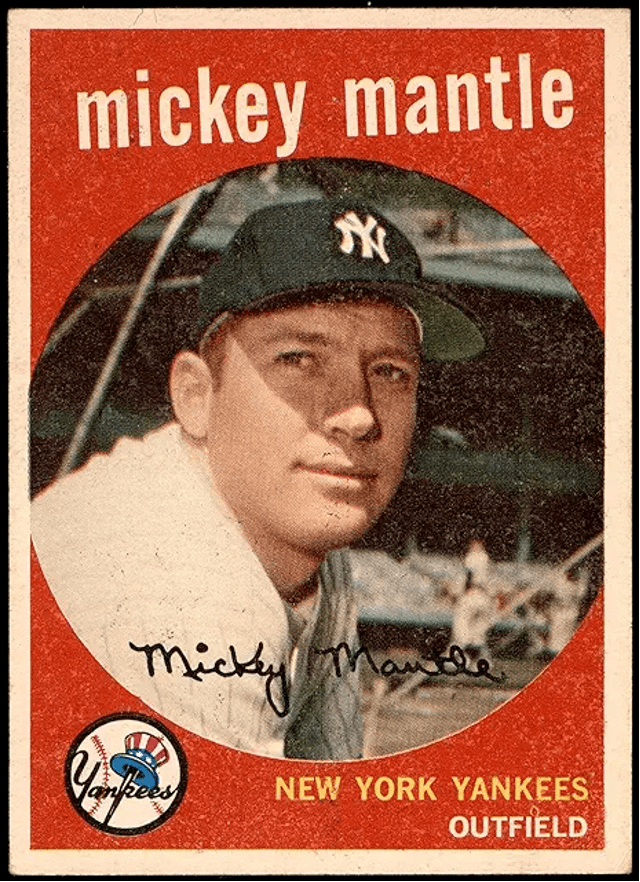
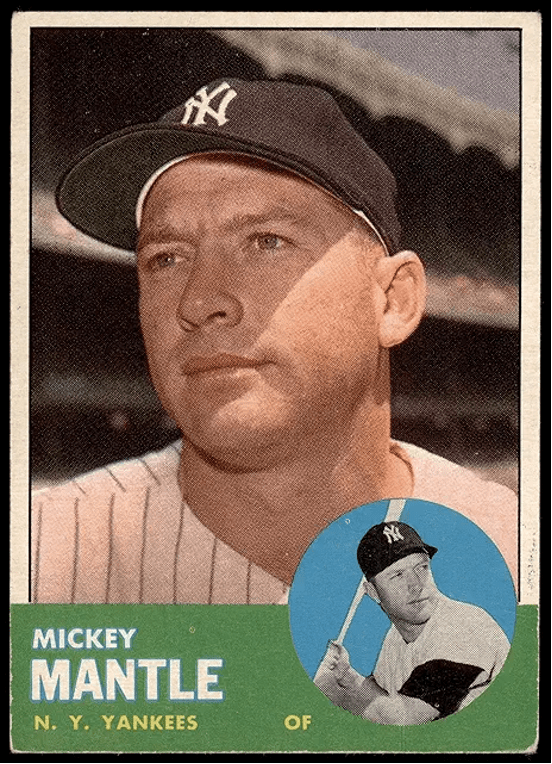
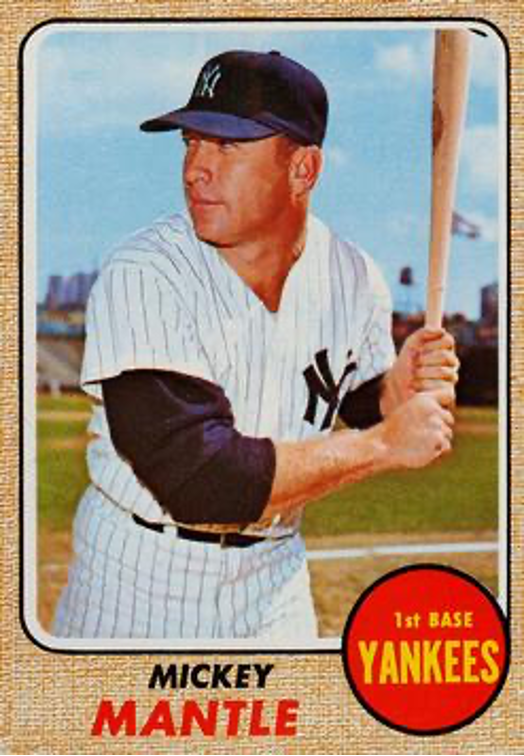
One of the most striking things about all of Mantle’s regular Topps cards throughout the years is how photogenic he is. All of the photos are excellent.
There are no dumb poses, no capless shots, and of course, no need for airbrushing because he never changed teams. Being a switch-hitter, it is interesting to note that over the years on cards where Mantle is in a batting pose, photos are about evenly split between showing him bat lefthanded and righthanded.
The one Topps Mantle variation of note involves his final regular card in the 1969 set. The Yankees’ slugger is one of 23 in the 5th series to have a “white letter” variation. The scarce version has Mantle’s last name in white, while the more common variety has it in yellow.
Of course, Topps included many other Mantle cards in its sets besides the regular ones. Here is a brief rundown: The Mick appeared on seven multi-player star cards in Topps sets between 1957-68. These included: 1957’s “Yankees Power Hitters” with Yogi Berra; 1958’s “World Series Batting Foes” with Hank Aaron; 1960’s “Rival All-Stars” with Ken Boyer; 1962’s “Manager’s Dream” with Willie Mays; 1963’s “Bombers Best” with Tom Tresh and Bobby Richardson; 1964’s “A.L. Bombers” with Roger Maris, Norm Cash and Al Kaline; and finally 1968’s “Super Stars” with Harmon Killebrew and Willie Mays.

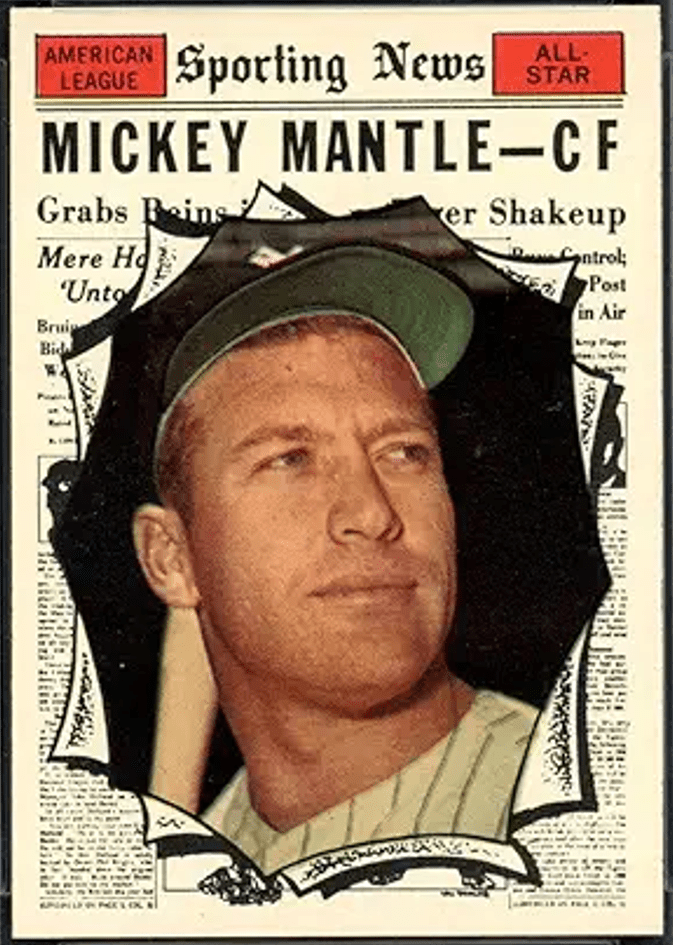
Mantle appeared in all five Topps “All-Star” subsets from 1958-62. His is the most expensive card in each of these groups. The fact that almost all of these cards were issued near the end of the summer in the final series of Topps cards for the year, adds greatly to their value. These late series were usually printed in smaller quantities than earlier ones. Each of these cards has either one of two headlines proclaiming “Sport Magazine All-Star Selection” or “The Sporting News All-Star Selection”.
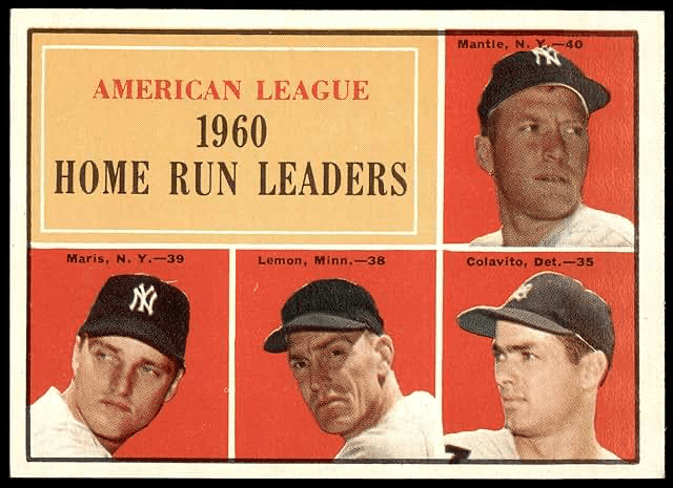
The Yankees’ slugger is featured on five Topps “League Leader” cards between 1961-65. He shares the 1961 Topps “Home Run Leaders” card with Maris, Rocky Colavito and Jim Lemon. On the ’62 card, Mantle is among the “Home Run Leaders” again. This time, he shares it with Killebrew, Maris and Jim Gentile. In the 1963 set, The Mick is among five players on the front of the “Batting Leaders” card (along with Pete Runnels, Floyd Robinson, Chuck Hinton and Norm Siebern).
Finally, Mantle appears on two League Leader cards in the 1965 set: “Home Run Leaders” and “RBI Leaders”. Also on the “Home Run Leaders” card are Boog Powell and Killebrew. Sharing the “RBI Leaders” card is Killebrew, Brooks Robinson and Dick Stuart.
Mantle appears on eight other cards that were included in regular Topps sets from 1959-69. In 1959, he appears in the “Baseball Thrills” subset, with the headline on his card reading “Mantle Hits 42nd Homer For Crown”. In 1961, another “Baseball Thrills” card proclaims “Mantle Blasts 565 Ft. Home Run”. And in the ’62 Topps set, the centerfielder has an “In-Action” card that includes three small photos on the horizontal front with the caption “The Switch-Hitter Connects”.
In 1961 and 1965, Mantle’s World Series slugging exploits were captured on two cards: “Mantle Slams 2 Homers” is included in the ’61 set, while “Mantle’s Clutch Home Run” is featured in the ’65 set.

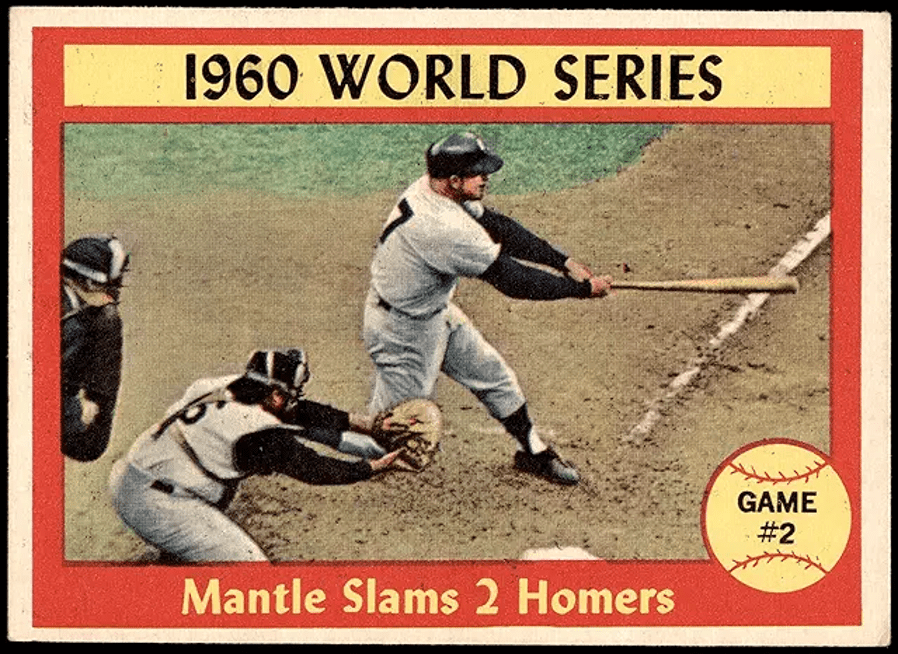
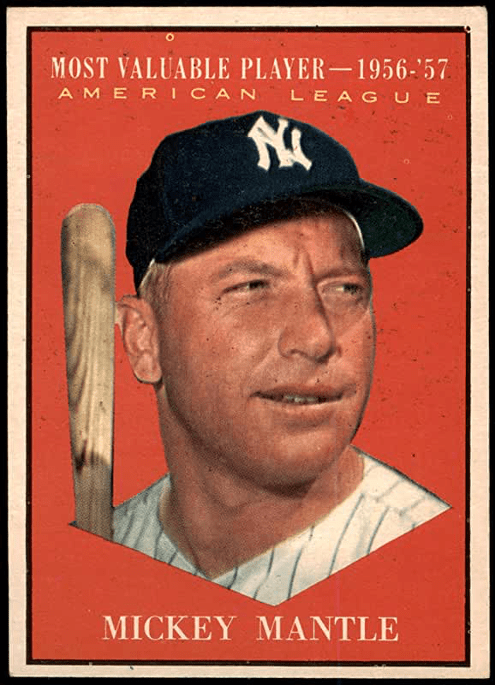
In 1961, Topps included a subset of Most Valuable Players from each league (1950-60). Mantle occupies a card that highlights his 1956-57 MVP years.
What Mantle collection would be complete without a couple of checklist cards? In the late 1960s, Topps included head shots of stars at the top of their checklist cards to spruce them up a bit. Mantle is featured on the 2nd Series checklist card in 1967 and the 5th Series checklist in 1969. The ’67 is rather ugly in that it shows just Mantle’s head … no background, no body, no neck … just a floating noggin.
Naturally, over the course of his playing years, Mantle appeared in several sets other than Topps and Bowman. Most of these were small – sometimes regional – sets usually used to promote a variety of products.
In 1952, Mantle appears in two of these kinds of issues: The 72-card Berk Ross “Hit Parade of Champions” set, and the 48-card Tip Top Bread set. The Tip Tops were actually bread-end labels depicting ballplayers.
In 1953-54, Mantle was included in the Briggs Meat set (one set was issued over a two-year period). Cards of Washington Senators players and those from New York teams were distributed in packages of hot dogs in the Washington D.C. area. The entire set consisted of 38 cards.
From 1953-55, Stahl-Meyer Franks issued sets of nine cards, a dozen cards and another dozen cards respectively in hot dog packages in the east. Each set contained cards of New York area players only … Yankees, Dodgers and Giants.
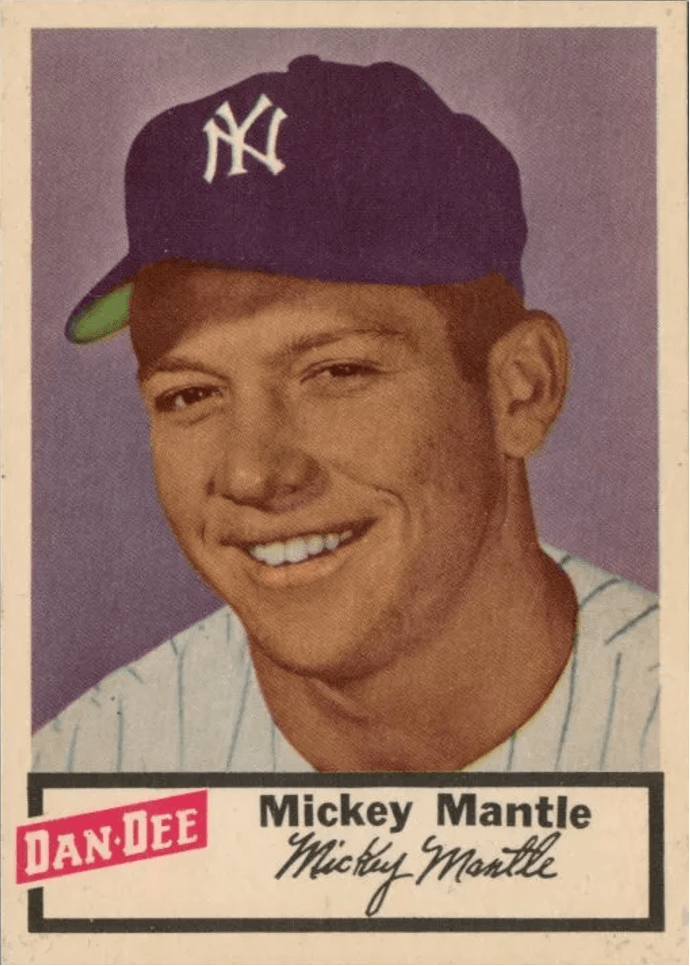

Mantle cards from 1954: Dan-Dee Potato Chips (above) and Red Heart Dog Food (below)

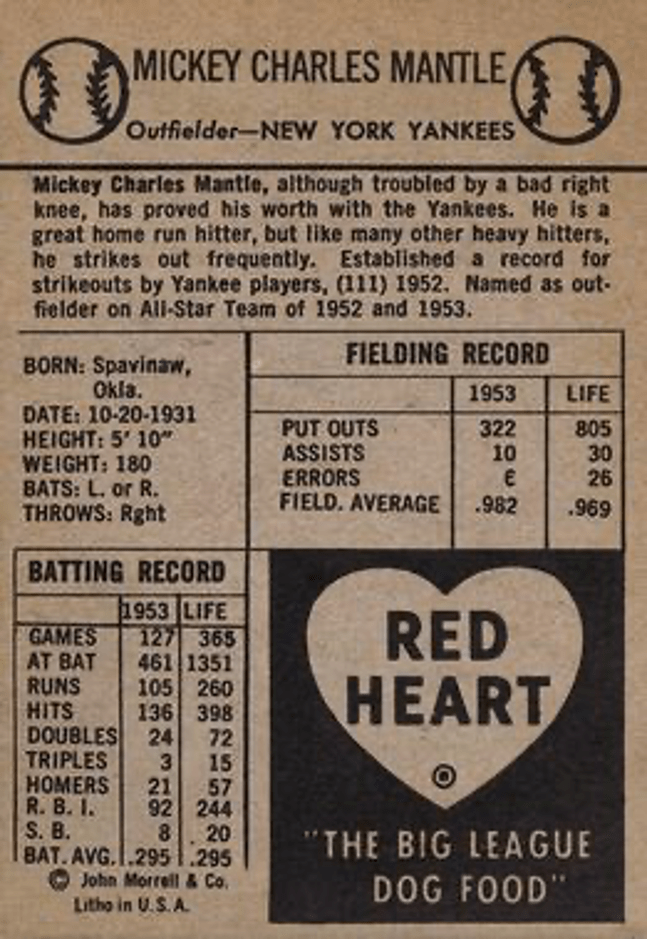
Mantle appears in three other small sets from 1954: Dan-Dee Potato Chips, Red Heart Dog Food, and the New York Journal-American newspaper. Dan-Dee issued a set of 29 cards in bags of potato chips, resulting in cards with grease stains. The Dan-Dee set featured mostly Indians and Pirates, with some Yankees. Red Heart Dog Food’s 33-card set included players from many teams. The New York Journal-American issued a set of 59 cards of Big Apple players at newsstands (the paper has since folded).
From 1959-68, Bazooka Bubble Gum issued cards of Mantle on boxes of its product. (Bazooka is still a Topps brand.) Card designs and set sizes varied over the years, as did the number included in each set.
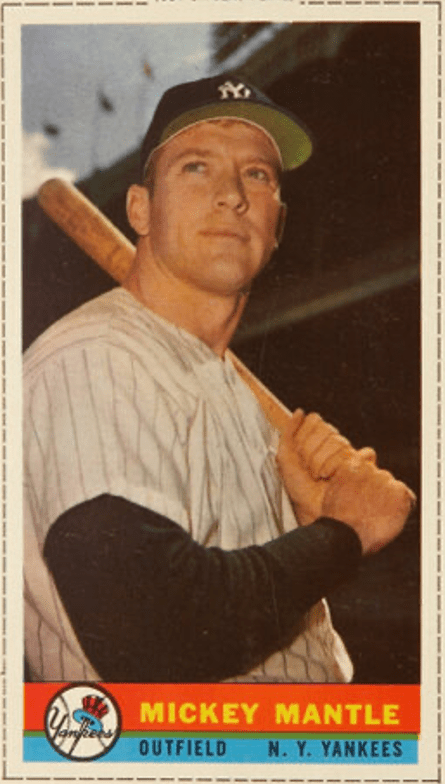
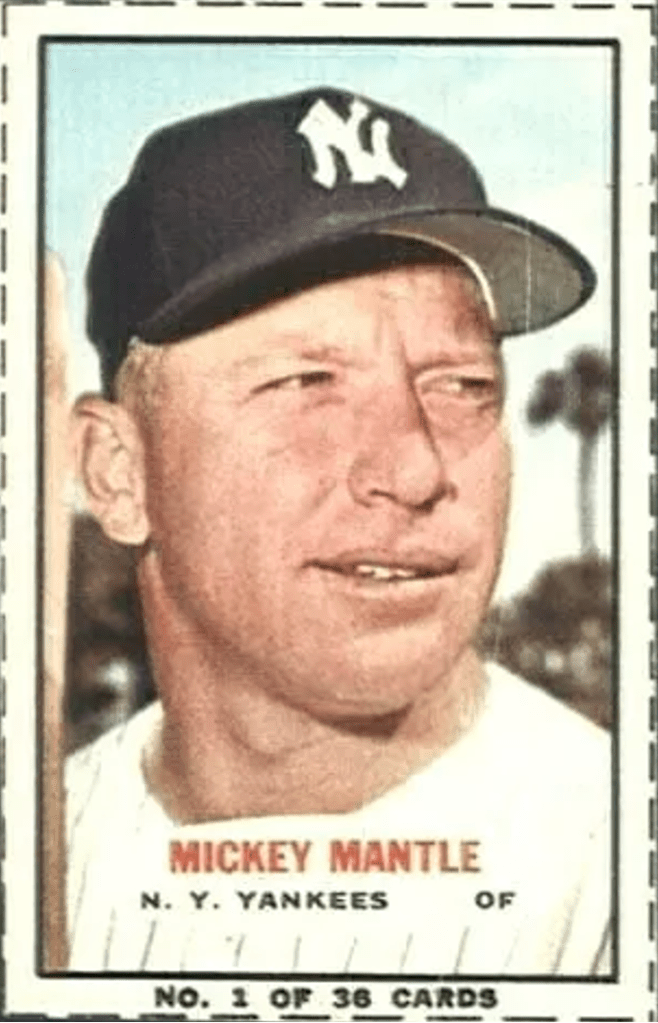
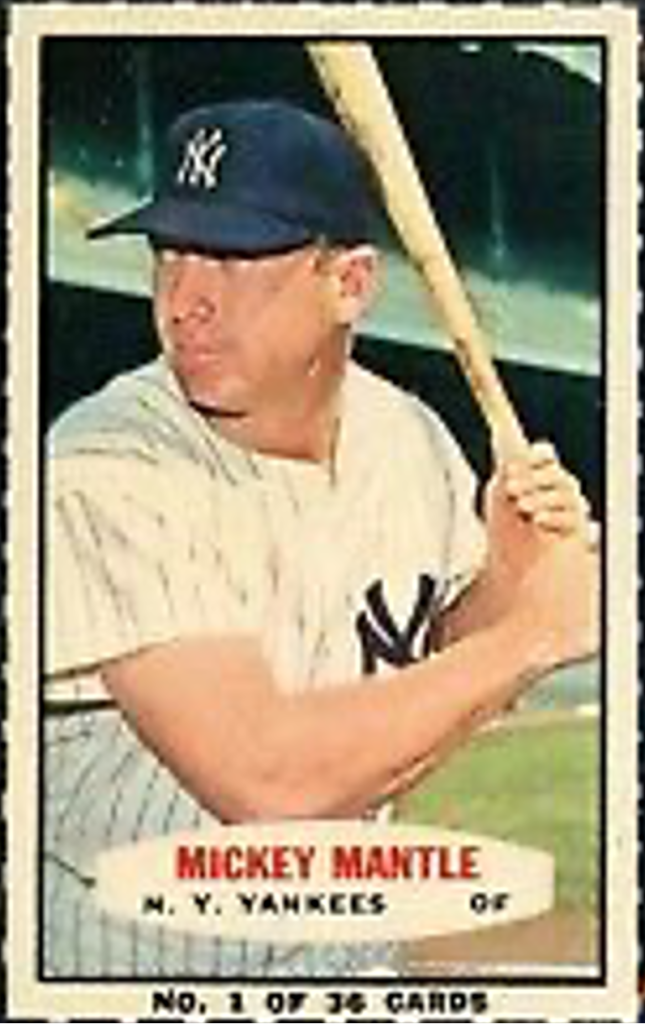
Bazooka Bubble Gum cards of Mantle in: 1959, 1964 and 1965
In 1959, American Motors produced a 20-card “Home Run Derby” set to promote the television show of the same name. Mantle was included. This set has been reprinted in recent years and the shows have been rebroadcast on ESPN. Both the cards and the show were in black and white.
In 1960-61, a company called Nu Card issued sets of 72 and 80 cards per year. Two Mantle cards are included in each set. Fronts of the cards are done in a newspaper-style format. In 1960, the set was entitled “Baseball Hi-Lites”. The following year it was called “Baseball Scoops”. Many of these cards have either been counterfeited or reprinted.
From 1960-63, Mantle appeared in each of the Post Cereal Company’s card sets. The 1960 set consists of just nine 7-by-9 inch cards that could be found on the back of cereal boxes. From 1961-63, each set included 200 cards and were issued several to a box (approximately standard-size, 2-1/2 by 3-1/2 inches per card).
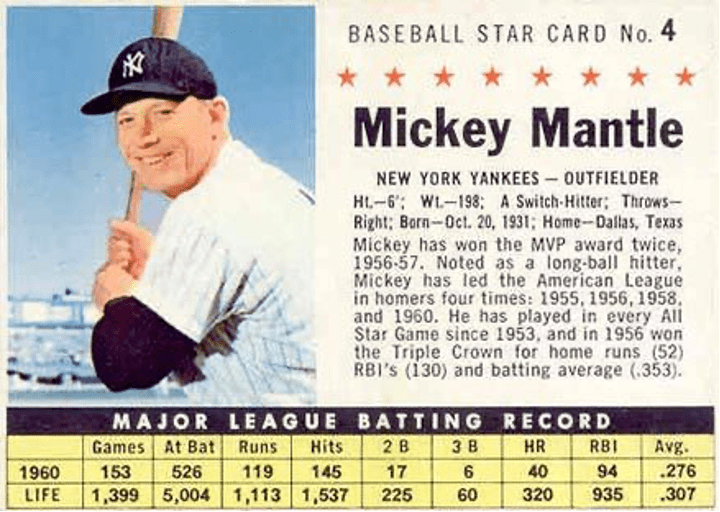

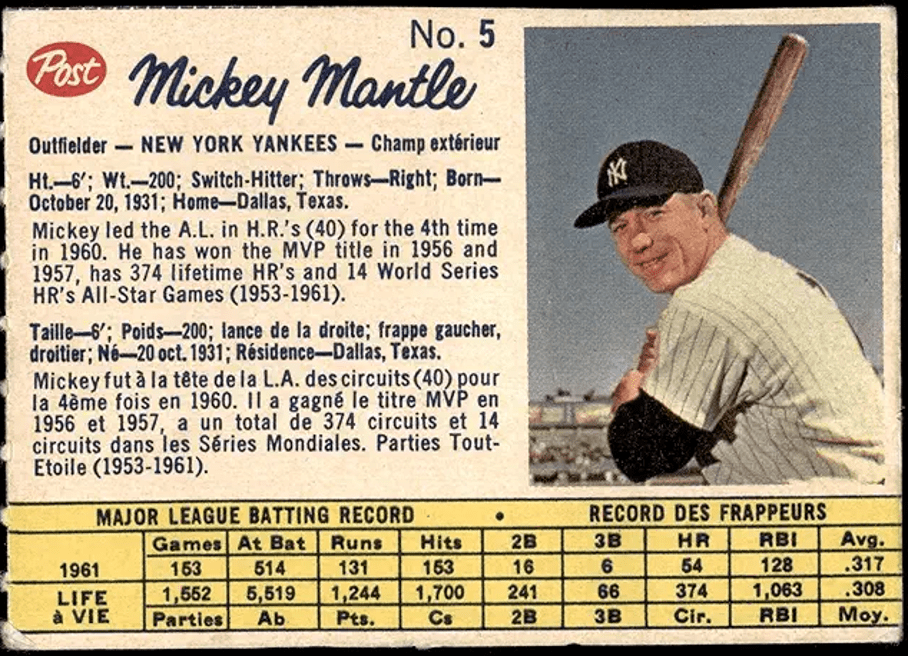
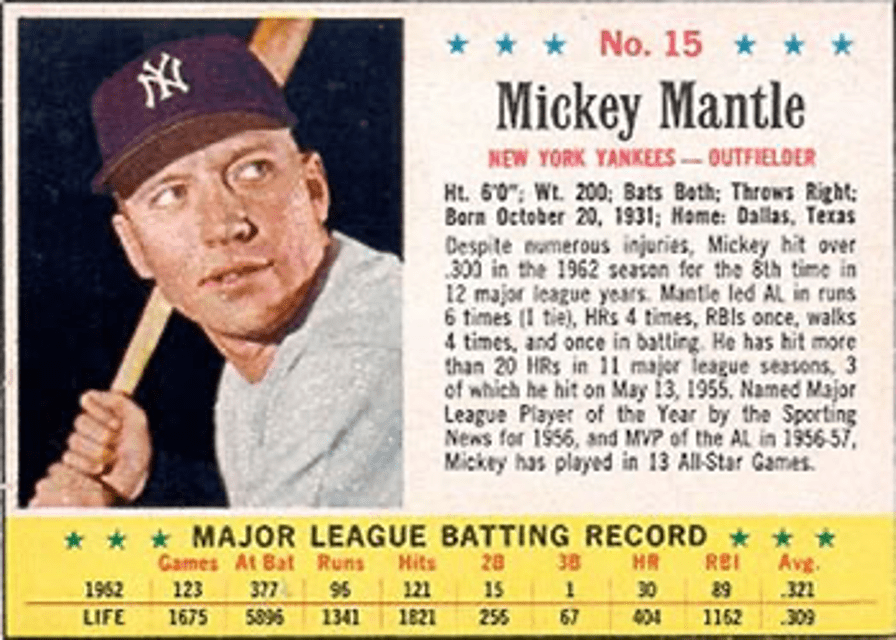
Mantle is also featured in the 1962 Post Canadian issue and the 1962-63 Jello sets. The Jello sets are very similar to the cereal issues from the same years. They were issued one to a box of Jello.
The Mick appeared on a half-dozen Exhibit cards. These oversized (3-by-5 inch) black-and-white or sepia-toned cards were issued by the Exhibit Supply Co. of Chicago in vending machines over the years.
Mantle is included on several cards issued by the O-Pee-Chee Company between 1965-67. O-Pee-Chee was Topps’s Canadian affiliate. These cards very closely resemble their American counterparts from the same years. The primary differences are the O-Pee-Chee copyright line on the back and card stock color. (Some O-Pee-Chee cards are on gray cardboard stock while their American cousins are on white.)
Finally, Mantle has appeared in many card sets since his retirement. And you can bet that more cards will be forthcoming. Why not? He’s the King.
• • • • • •
See related article on BaseballCardFun.com entitled:
“BASEBALL HOBBY NEWS — Mantle on Topps Inserts, Test Issues”
Click Link Here
• Originally Published in Apr. 1993 “Baseball Hobby News” •
THIS ARTICLE FROM “BASEBALL HOBBY NEWS” MAGAZINE IS REPRINTED WITH THE PERMISSION OF BOTH THE EDITOR/PUBLISHER AND THE AUTHOR. IT HAS BEEN RETYPED, BUT NO CONTENT HAS BEEN CHANGED (EXCEPT FOR VERY MINOR ADJUSTMENTS, CORRECTIONS TO TYPOGRAPHICAL ERRORS AND CHANGES TO GRAPHICS). COMMENTS OR INFORMATION IN THE ARTICLE MAY BE OUT-OF-DATE.
To keep up-to-date on additions to BaseballCardFun.com, subscribe below*
* Your email address will never be shared and is only used to announce new articles
 BaseballCardFun.com