
The history of Topps baseball card sets
BY MARK A. LARSON
“Mr. October” … those two words pretty much sum up 1977.
Reggie Jackson’s arrival in New York in 1977 was the final ingredient needed for the Yankees to recapture baseball’s Word Championship. During the regular season, Jackson belted 32 home runs, with 110 RBls for the Bronx Bombers. But it was his performance in the World Series that secured his nickname for posterity.
In game six, with New York leading the series three games to two over Los Angeles, Jackson hit three consecutive homers – all on first pitches – and drove in five runs to help clinch the Fall Classic. Overall, Jackson blasted five round-trippers in the series and hit .450.
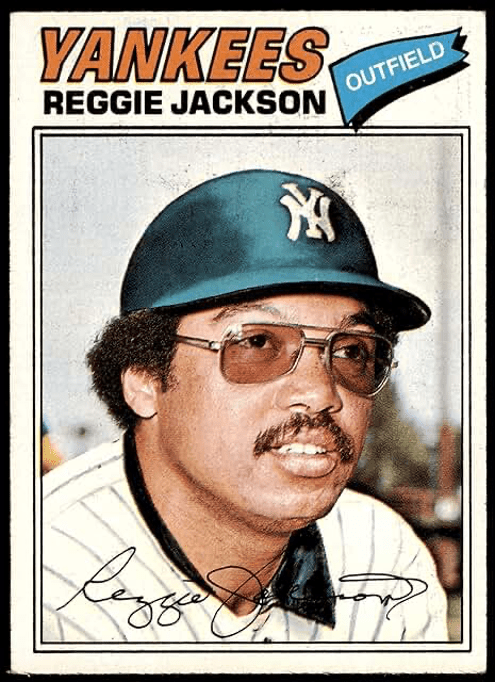
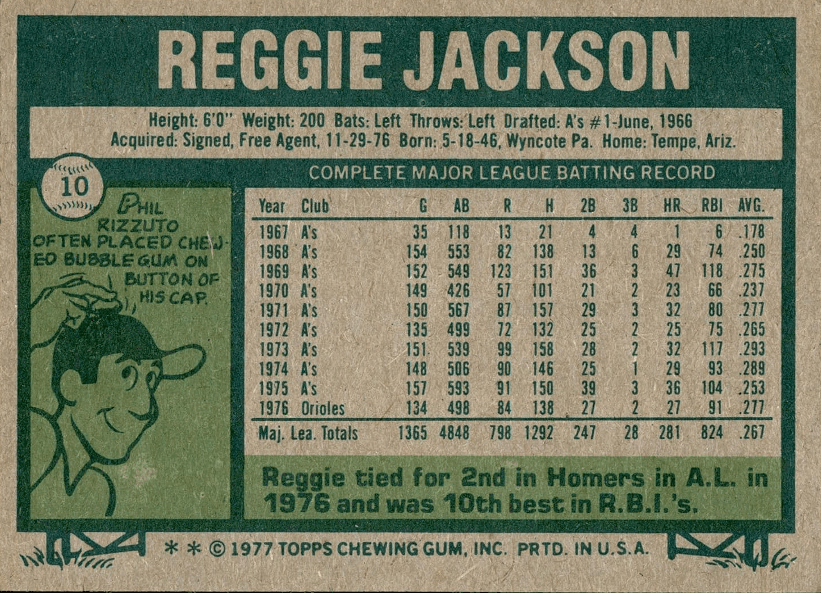

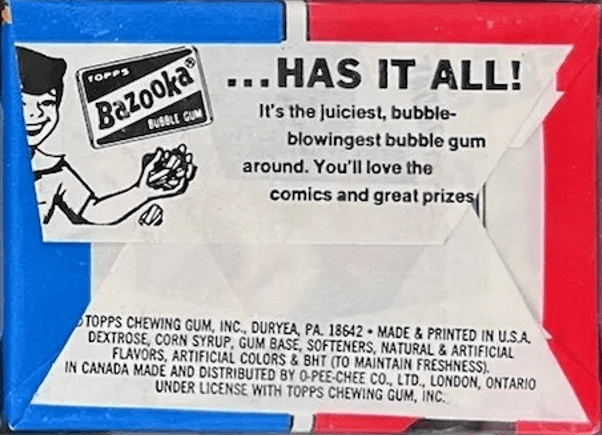
It was a year for big numbers. Minnesota’s Rod Carew hit .388, having flirted with .400 most of the season. He was named MVP in the American League. George Foster was MVP in the senior circuit. The Reds’ outfielder slugged 52 homers, with 149 RBIs and hit .320. He came close to winning the Triple Crown, leading the league in home runs and RBls, but falling 18 points short of the batting title.
Rookies of the Year in 1977 were future stars Andre Dawson of the Expos and Eddie Murray of the Orioles. While the Cy Young Awards went to the Phillies’ Steve Carlton and the Yanks’ Sparky Lyle.
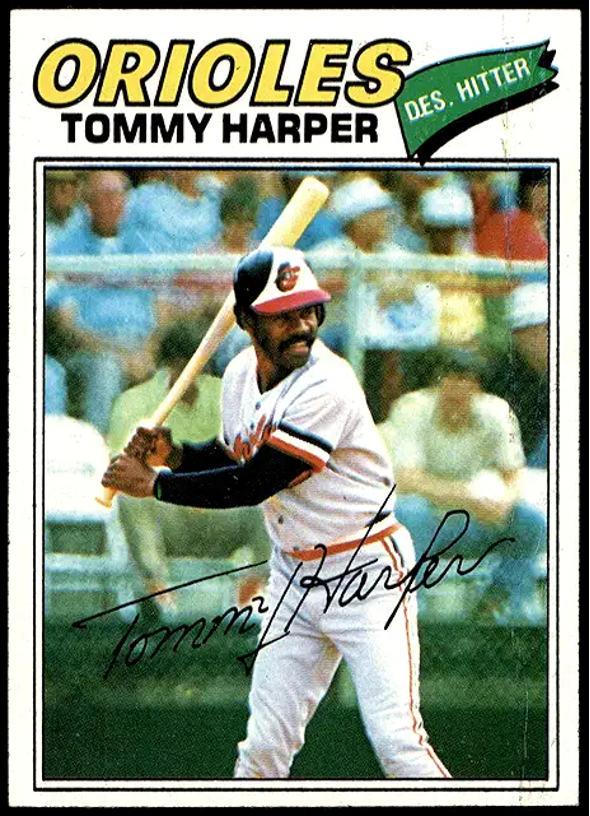
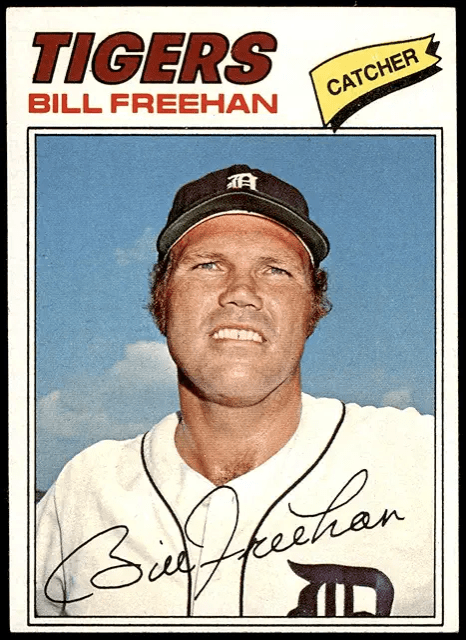
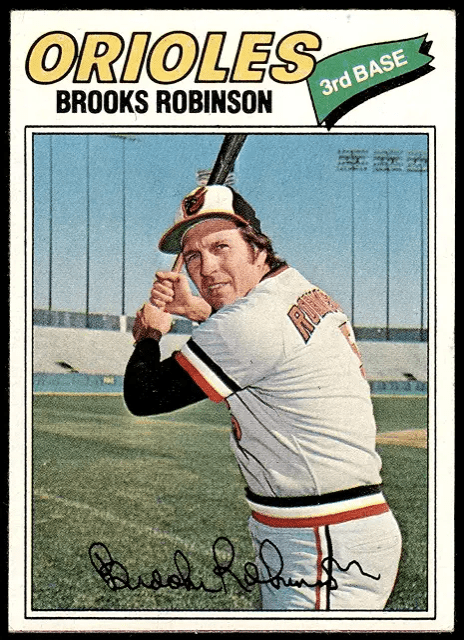
Topps’ 660-card 1977 issue was the company’s 26th major baseball card set. Fronts of the cards once again featured a large team nickname at the top. Below the team was the player’s name. Also at the top was a small pennant with the player’s position printed on it. The pennants were somewhat reminiscent of Topps’ 1965 design.
Also printed on the fronts was a facsimile autograph of the player. This was the ninth time Topps incorporated the printed autograph on a card front. The idea was near death, however, as it would only be used two more times, 1980 and 1982.
Green, green, once again green. Of course, we’re talking about the backs of the 1977 cards. The green motif so overused by Topps included the usual stats and cartoon.
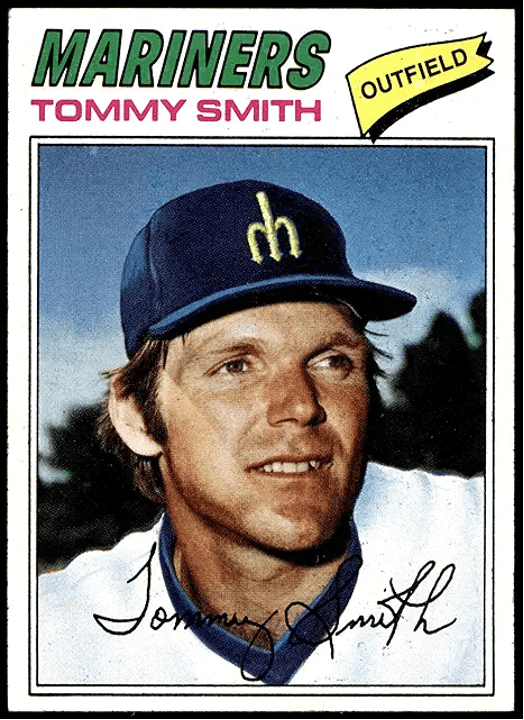

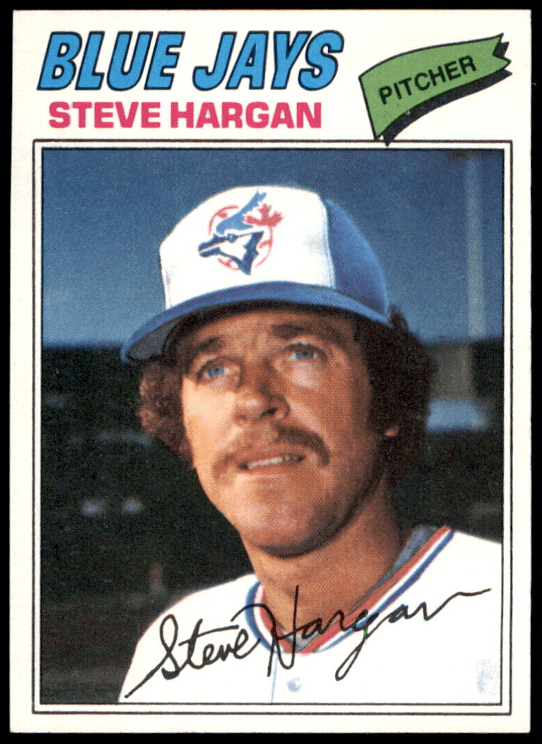
The ’77 set featured the first cards of players on the A.L. expansion Toronto Blue Jays and Seattle Mariners. Due to early deadlines, Topps resorted to airbrushing many of the Toronto and Seattle players’
caps and uniforms. The on-field performance of the two new teams was typical of expansion franchises in general. The Jays were 54-107, while the Mariners were 64-98.
Yet within a half-dozen years or so, Toronto would begin to establish itself as a power to be reckoned with, culminating in its 1992 World Championship. The Mariners, on the other hand, have only managed one .500 or better season in their 16-year existence (1991).
The first two players on the new teams to appear in the ’77 set were outfielder Tommy Smith (#14) of Seattle and pitcher Steve Hargan (#37) of Toronto.
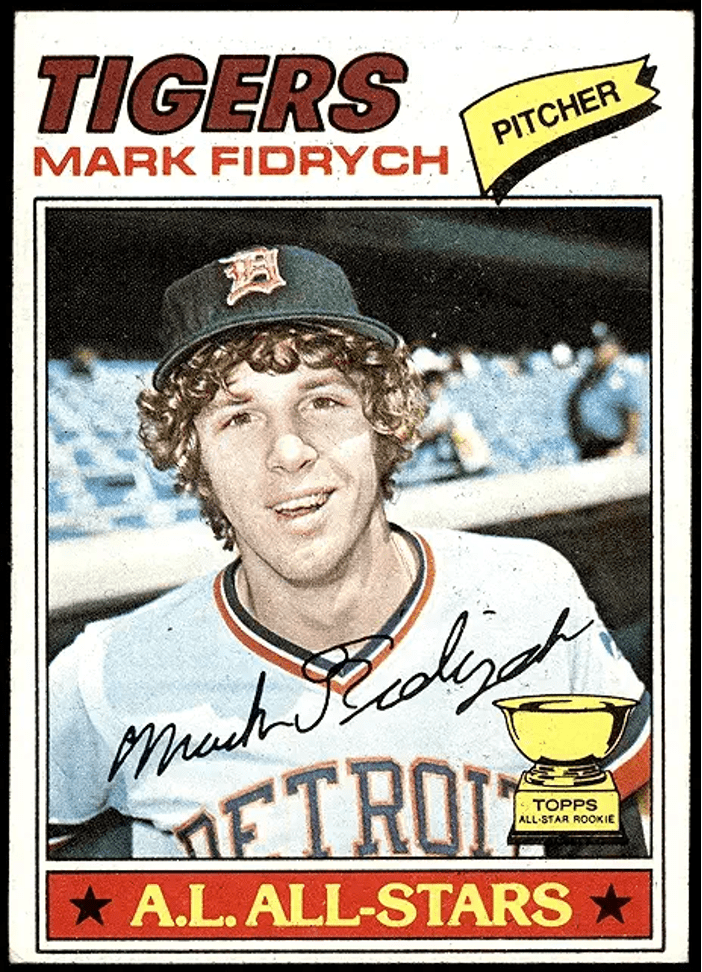
At the time, it appeared flamboyant Detroit pitcher Mark Fidrych’s first card (#265) would be in demand for years to come. “The Bird,” with his curly locks, captured baseball fans’ fancy the summer before with his antics of talking to the baseball and rearranging the dirt on the mound with his hands. But he could pitch too. Fidrych went 19-9 with the Tigers and posted a 2.34 ERA. He threw 24 complete games. But injuries took their toll and he was never the same again.
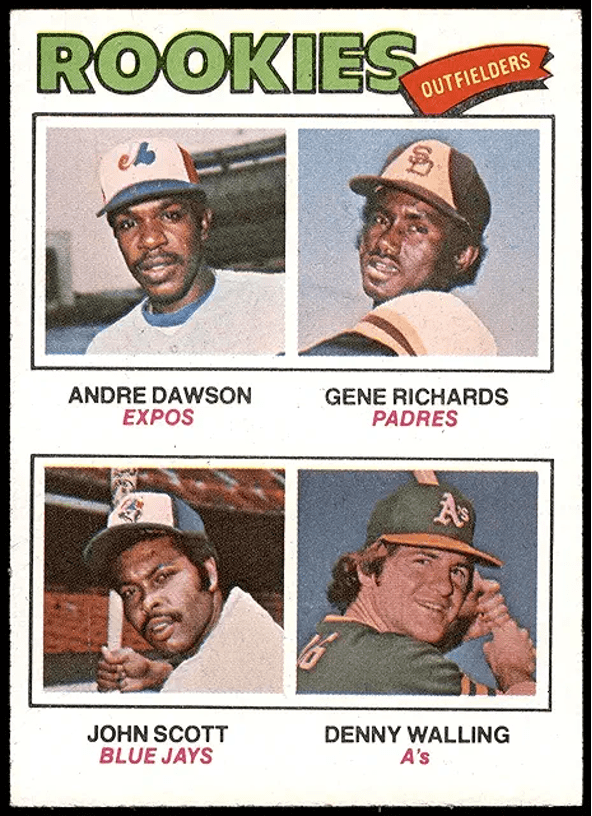
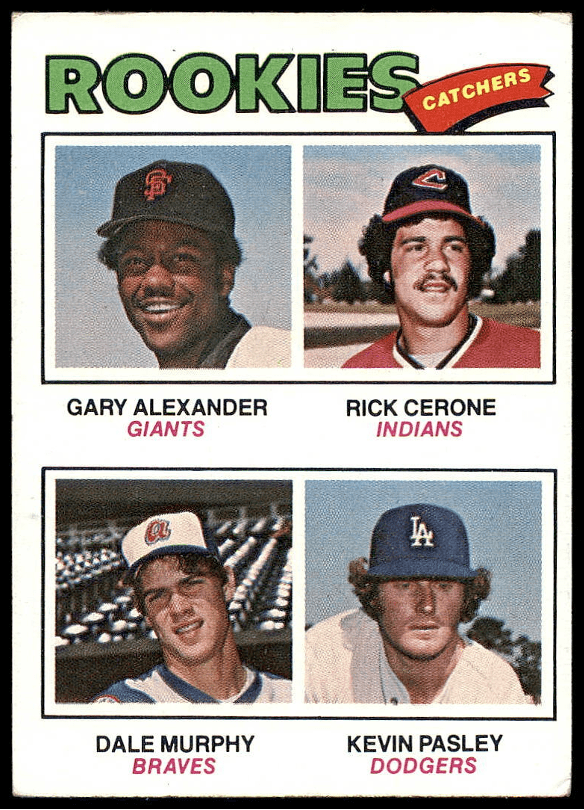
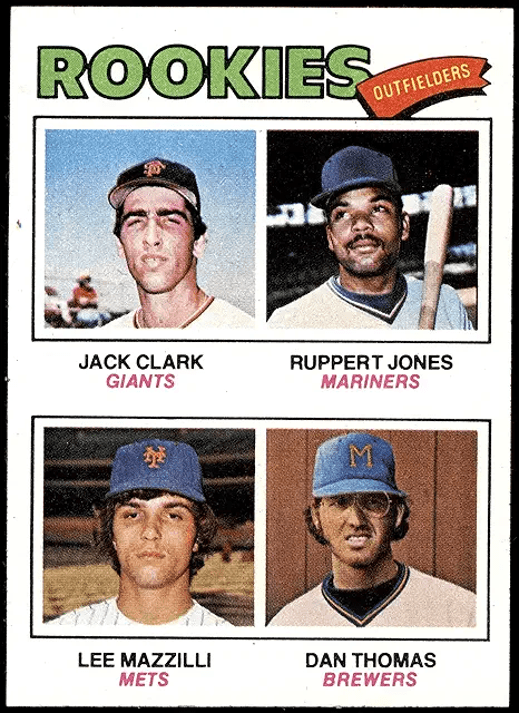
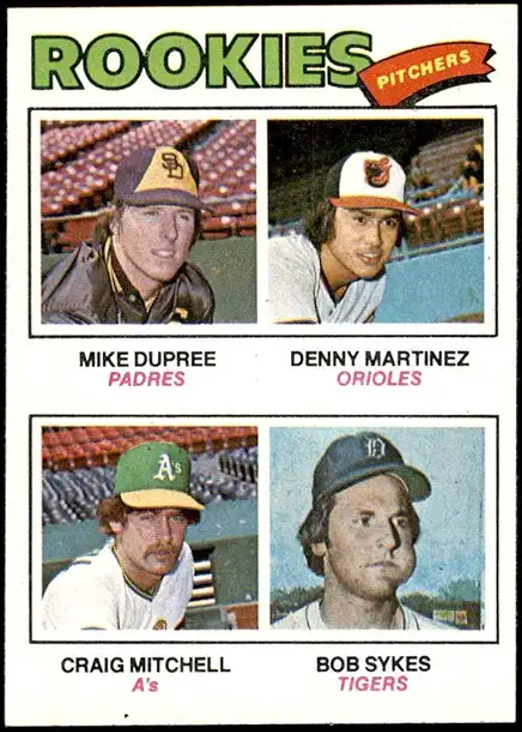
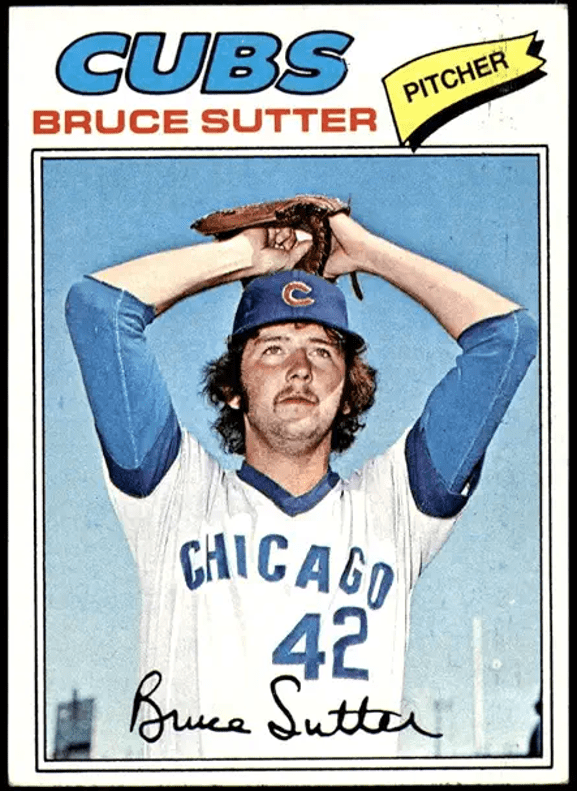
Other rookie cards in the ’77 set included relief specialist Bruce Sutter (#144), outfielder Dawson (#473), then-catcher Dale Murphy (#476), outfielder Jack Clark (#488), pitcher Dennis Martinez (#491) and outfielder Tony Armas (#492). Dawson, Murphy, Clark and Armas have each slugged over 250 homers, while Sutter had 300 career saves and Martinez has won nearly 200 games.
In addition to the usual League Leader, Rookie and Playoff/World Series cards, the 1977 set includes three other subsets, “Record Breakers” … “Turn Back The Clock” … and “Big League Brothers.”
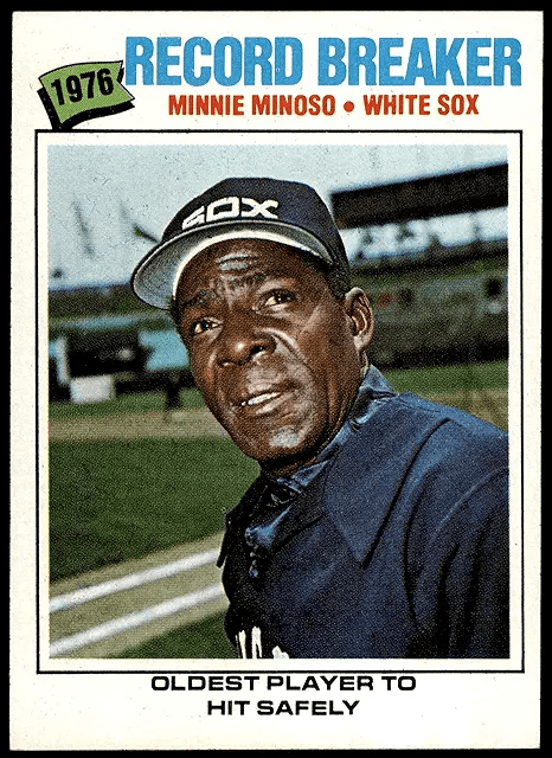
For the second year in a row, “Record Breakers” appeared in a Topps set (#231-234). Among the players depicted were George Brett, Nolan Ryan and Minnie Minoso. Minoso’s card was headlined “Oldest Player to Hit Safely.”
Minoso’s playing career spanned the period from 1949-64. He was a .298 lifetime hitter, with 186 home runs and 1,023 RBls in more than 1,800 games. In 1976, White Sox owner Bill Veeck (the same man who once signed a midget to play major league ball and sent him to the plate with a toy bat, sporting a uniform with the number 1/8th) brought back Minoso. In eight at-bats, Minoso singled and became the oldest major leaguer to get a hit.
In 1980, Minoso came back once more, going 0-for-2, while playing in his fifth decade at age 58. There was even talk of getting Minoso into a game in 1990 or 1991 to play in a sixth decade at age 68, but this idea was squelched by Commissioner Fay Vincent who viewed it as a publicity stunt that would tarnish the game’s image.
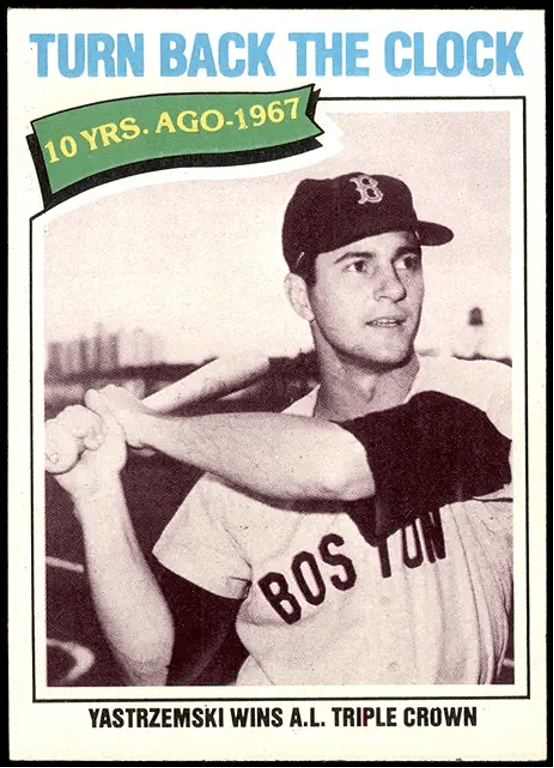

“Turn Back The Clock” (#433-437) featured black-and-white photos on card fronts of famous events five, 10, 15, 20 and 25 years ago. For instance, Carl Yastrzemski’s Triple Crown season is highlighted on the 10 Years Ago (1967) card. Maury Wills’ record 104 stolen base season was featured on the 15 Years Ago (1962) card, and Ralph Kiner’s seventh consecutive N.L. home run title was shown on the 25 Years Ago (1952) card.
“Big League Brothers” (#631-634) featured the then-active brother combinations of George and Ken Brett, Bob and Ken Forsch, Lee and Carlos May, and Paul and Rick Reuschel.
The final regular Topps cards for several veterans appeared in the 1977 set. These included: Hall-of-Fame third-baseman Brooks Robinson, slugging first-baseman Boog Powell, catcher Bill Freehan, outfielder Tommy Davis, catcher/infielder Joe Torre, speedster Tommy Harper and outfielder Willie Davis.
Finally, 1977 was the season when one of the longest-standing all-time records bit the dust. Lou Brock passed Ty Cobb’s 892 lifetime stolen bases that summer. It was a mark that had stood for nearly 50 years. Brock ended the season with 900 thefts on the button.

• • • • • •
• Originally Published in Feb. 1993 “Baseball Hobby News” •
THIS ARTICLE FROM “BASEBALL HOBBY NEWS” MAGAZINE IS REPRINTED WITH THE PERMISSION OF BOTH THE EDITOR/PUBLISHER AND THE AUTHOR. IT HAS BEEN RETYPED, BUT NO CONTENT HAS BEEN CHANGED (EXCEPT FOR VERY MINOR ADJUSTMENTS, CORRECTIONS TO TYPOGRAPHICAL ERRORS AND CHANGES TO GRAPHICS). COMMENTS OR INFORMATION IN THE ARTICLE MAY BE OUT-OF-DATE.
To keep up-to-date on additions to BaseballCardFun.com, subscribe below*
* Your email address will never be shared and is only used to announce new articles
 BaseballCardFun.com