
BY TROY KIRK
It’s a story that’s pretty much forgotten now, but the biggest baseball card news of 1976 was the discovery of a T206 Honus Wagner variation. Of course, the T206 Honus Wagner card is the Mona Lisa of the baseball card hobby. It is the most famous and expensive baseball card in existence, and the discovery of a variation of this card was a major event.
It all started at a weekend card buying expedition in Connecticut. Three collector-dealers, the late Dick Reuss, Tom Wickman and Bob Rathgeber, had traveled to Connecticut, rented a hotel room, and had advertised in the local newspapers to buy baseball cards.
In the late 1970s, this was a common method used by dealers to beat the bushes for cards. The theory was to get non-collectors to bring in their old baseball cards and then buy them for next to nothing. Since there weren’t any price guides in those years and most non-collectors thought baseball cards were worthless, this buying method was often very successful.
This particular buying trip was successful for the three hobbyists, as they were able to purchase a good quantity of cards. One of their purchases was a large lot of baseball tobacco cards for approximately 60 cents apiece, with no Hall-of-Famers pulled. The dealers routinely checked through the tobacco cards before the purchase in search of the famous Wagner card and other known rarities and determined that none of these cards were present.
After returning home and sorting through the cards more carefully, Reuss noticed something he had overlooked when purchasing the cards. There was a Honus Wagner card in the batting pose that Reuss had assumed was a caramel card. Now as he flipped the card over, Ruess was stunned to see that the card had a Piedmont T206 back. Assuming this was a real card, it meant that this was a one-of-a-kind T206 Wagner variation.
Reuss realized the implications of this discovery immediately. Since the T206 Wagner was the most valuable card in the hobby and there were at least a dozen copies known at that time, this new Wagner card would instantly move to the top of the ladder as the most valuable baseball card in existence.
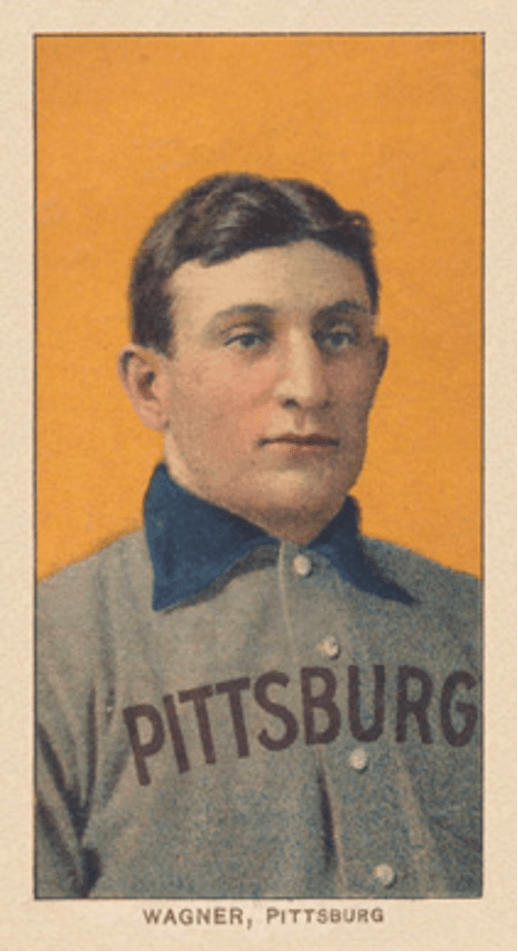
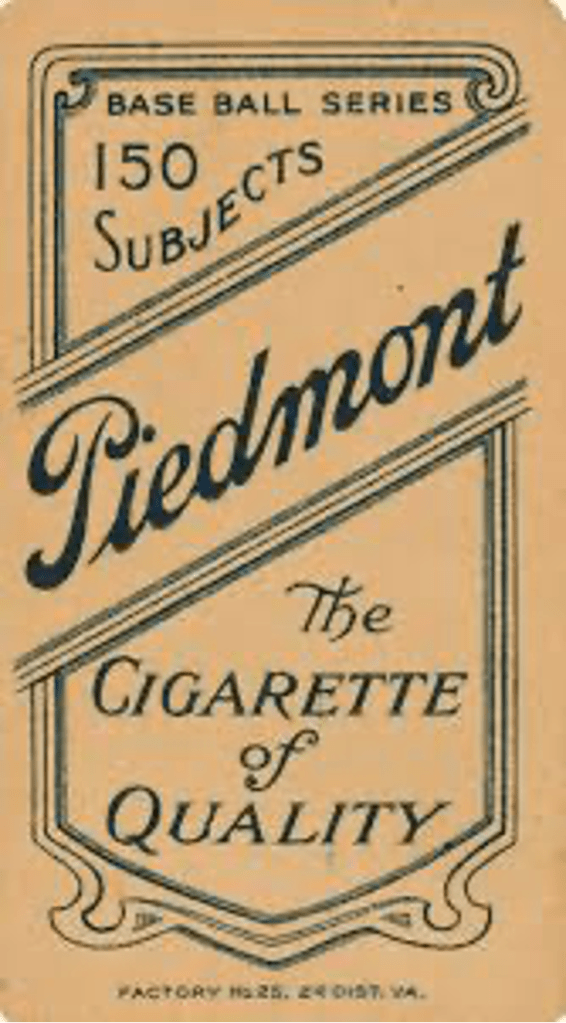
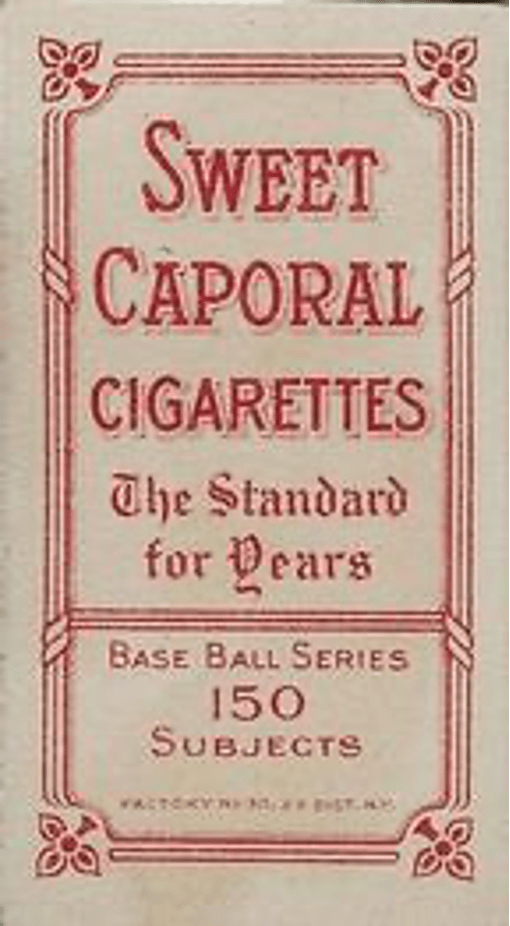
Famous T206 Honus Wagner card with its two known back variations

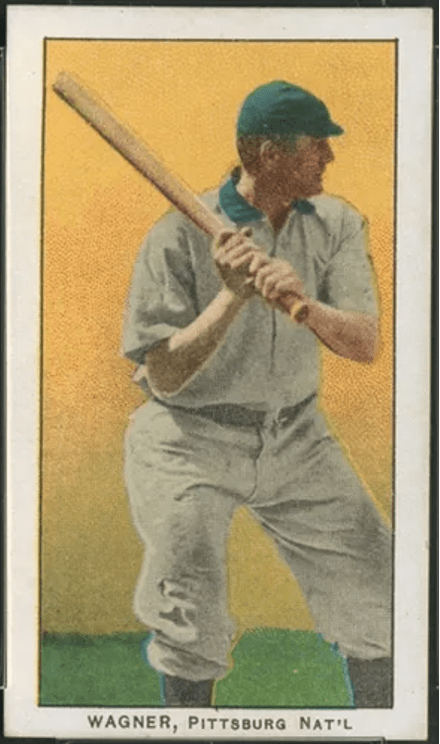
Before publicizing the discovery, Reuss wanted to make sure the card was genuine. He had his doubts about its authenticity. For one thing, the front of the card was identical to the Wagner batting pose found in the E95 caramel card set. Some of the player poses in the early card sets were used in more than one set, but there were no known poses that were identical between the E95 and T206 sets.
Also, the player and team name text at the bottom of the T206 cards were always in black ink, while the new Wagner card had this information printed in brown ink. Brown ink was used for the E95 cards. In addition, the text on the Wagner card stated the team as “Pittsburg, Nat’l”, while there was no league designation after any of the known Pittsburg T206 cards. Again, the “Pittsburg Nat’l” designation was correct for an E95 card of Wagner.
All of these facts made Reuss speculate that it was possible somebody could have glued a Piedmont T206 back to an E95 Wagner front to create the card. He ruled this out as implausible for a couple of reasons. First, the card was not sold as anything special – it was just one card in a large group that was sold inexpensively. If someone went to the trouble of doctoring the card, it seemed likely he would at least try to sell it for a high price. Second, the card showed no evidence of having two parts glued together.
It was also possible someone could have created the card from scratch using modern technology. To check for this possibility, Reuss had bits of the card date-tested by professionals and determined the paper was from the same era as T206 cards. The fact that the card was found with a large group of other tobacco cards provided further evidence that the card was in fact from the 1910 era.
Reuss still wasn’t completely convinced that the card was a genuine T206, but decided to publicize the discovery. Big headlines soon appeared in the major hobby publications of the time. The discovery of the card even made it into some of the mainstream newspapers around the country, at a time when baseball card news was virtually nonexistent at the national level.
The publicity started a wide-ranging debate within the baseball card hobby. Collectors openly argued about whether the card was real and how much it was worth. At the time, the original T206 Wagner was valued at $1,500 and people speculated that the new Wagner must be worth $2,000 to $3,000. Although this figure seems paltry for a Wagner today, it was high enough to make the national news in 1976.
In the ensuing weeks after the initial publicity about the card, Reuss showed the card to many of the top baseball card experts in the country to get their opinions about its authenticity. It should be noted that Reuss himself was one of those experts at the time.
The consensus of opinion seemed to be that nobody could say for sure whether the card was real or not. Sports Collectors News published a picture of Reuss showing the card to top collectors Frank Nagy and Ed Lotz. In the photo, Nagy and Lotz are holding up their hands to indicate that they can’t say for sure whether the card is real or not.
The question of whether the card was a glued E95 front and T206 back persisted. It seemed the only way to be sure about the gluing question was to tear the card apart, which was out of the question for possibly the most valuable baseball card in existence.
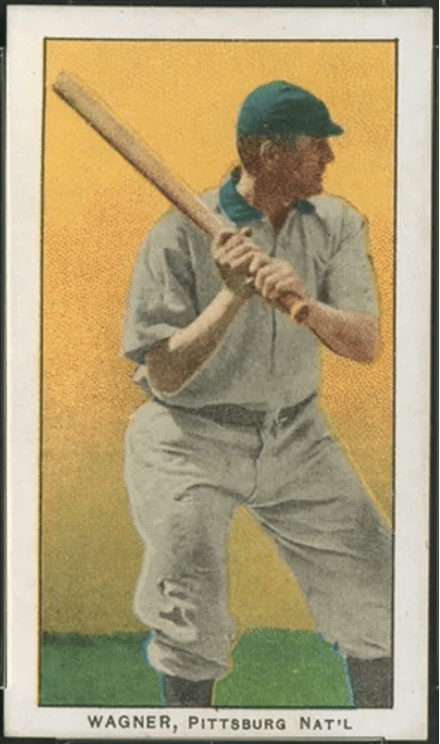
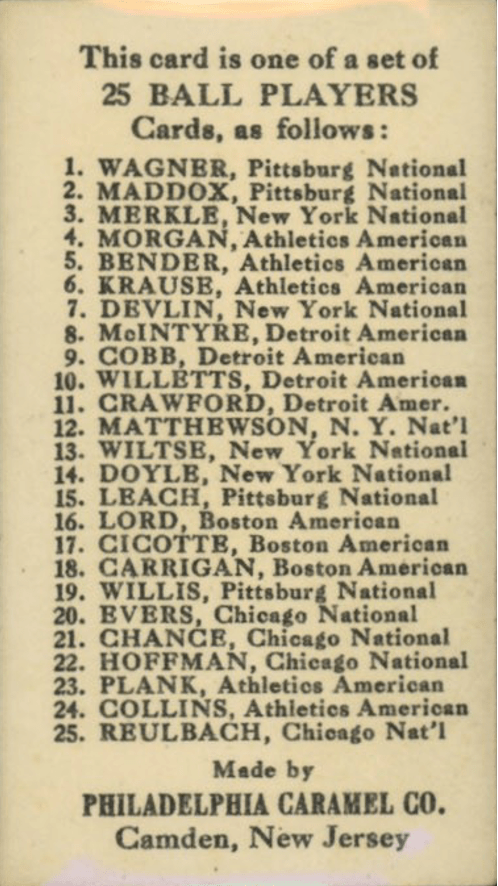
1909 Wagner E95 Caramel card with standard back

One-of-a-kind T206 Wagner variation?
While at a baseball card show, collector Cliff Lambert suggested to Reuss that he submerge the card in water. If there was glue on the card, this would loosen the glue and separate the two halves. Sports Collector Digest columnist Wirt Gammon indicated that it was a common practice to soak T206 cards to remove them from albums in which they were glued. Gammon also said that soaking T206 cards didn’t seem to damage them, though soaking other types of cards might cause damage.
While Reuss considered soaking the card, he sought the advice of other card experts on the matter. Frank Nagy and others reportedly told him he was crazy to consider soaking it because of the potential damage.
Finally, after weighing all the pros and cons, Reuss decided to take a chance and soak the card. After sitting in water for a few minutes the sad news became evident. The card was after all an E95 Wagner card with a T206 back glued on. When submerged, the real E95 back showed through the glued T206 back. When removed from the water and allowed to dry, the E95 back once again disappeared behind the T206 back. The two halves did not separate and the doctored card remained together.
To Reuss’s credit, he immediately informed all the hobby publications that the Wagner was indeed a doctored card and not a new discovery.
In the aftermath of the Wagner variation incident, the question of who created the card still remained. Reuss was convinced that the card was not created with the intent to defraud anyone. His theory was that some collector long ago had never been able to get a Honus Wagner card for his T206 set, and had created his own version.
With the passage of time, the card was forgotten. The collection where it was housed probably changed hands a time or two before Reuss bought it, possibly being passed down from one generation to the next. In the mid-1970s, when baseball card reference guides were practically non-existent, it was mere chance that an expert such as Reuss would stumble upon the Wagner variation card and recognize it for what it was.
Even though the card turned out to be a fake, the Wagner “variation” incident is still an interesting chapter in the history of baseball cards. It is one of many stories that has added to the lore of the T206 Honus Wagner card.
• • • • • •
• Originally Published in Nov. 1992 “Baseball Hobby News” •
THIS ARTICLE FROM “BASEBALL HOBBY NEWS” MAGAZINE IS REPRINTED WITH THE PERMISSION OF BOTH THE EDITOR/PUBLISHER AND THE AUTHOR. IT HAS BEEN RETYPED, BUT NO CONTENT HAS BEEN CHANGED (EXCEPT FOR VERY MINOR ADJUSTMENTS, CORRECTIONS TO TYPOGRAPHICAL ERRORS AND CHANGES TO GRAPHICS). COMMENTS OR INFORMATION IN THE ARTICLE MAY BE OUT-OF-DATE.
To keep up-to-date on additions to BaseballCardFun.com, subscribe below*
* Your email address will never be shared and is only used to announce new articles
 BaseballCardFun.com