
The history of Topps baseball card sets
BY MARK A. LARSON
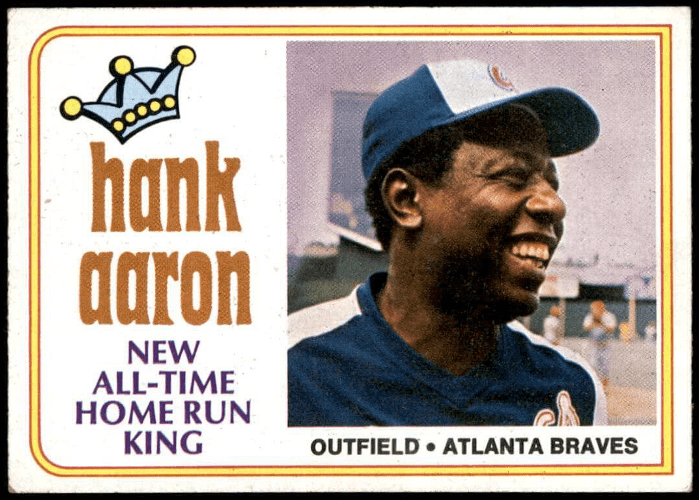
Topps’ 1974 baseball card set can be summed up in just a few words … Hank Aaron and the Washington National Leaguers.
Aaron smashed Babe Ruth’s all-time home run record early in the ’74 season. And the Padres stayed put in San Diego after speculation they would be moving to the nation’s capital.
Baseball and baseball cards were a welcome relief from news headlines in the spring and summer of 1974. It was the year of impeachment hearings against President Richard Nixon, his resignation and eventual pardon. The economy was in a shambles as oil prices skyrocketed and a recession gripped the nation.
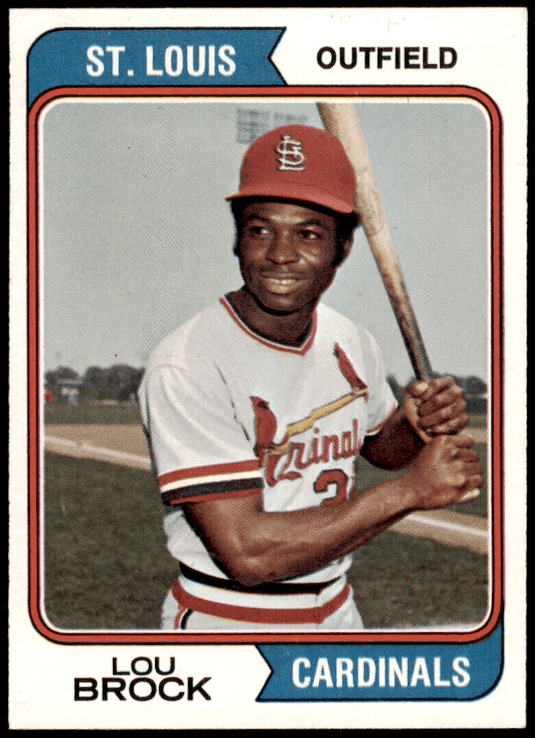
Still, the national pastime was in relatively good shape in 1974. Aaron’s historic feat spurred interest in the game, as did Lou Brock’s pursuit of the single-season stolen base record that summer. Brock ended up with 118 swipes, eclipsing the record of 104 set by Maury Wills in 1962. Oakland beat Los Angeles for its third straight World Championship in the first all-California World Series. The mustachioed Rollie Fingers was the Fall Classic’s Most Valuable Player.
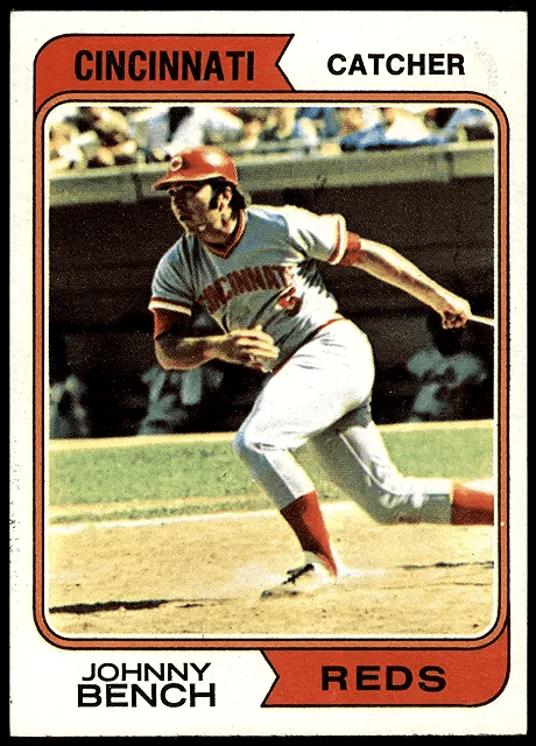
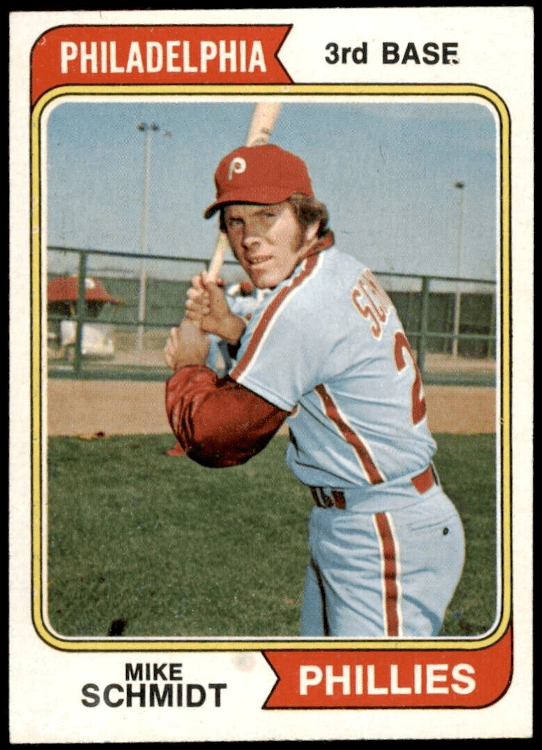

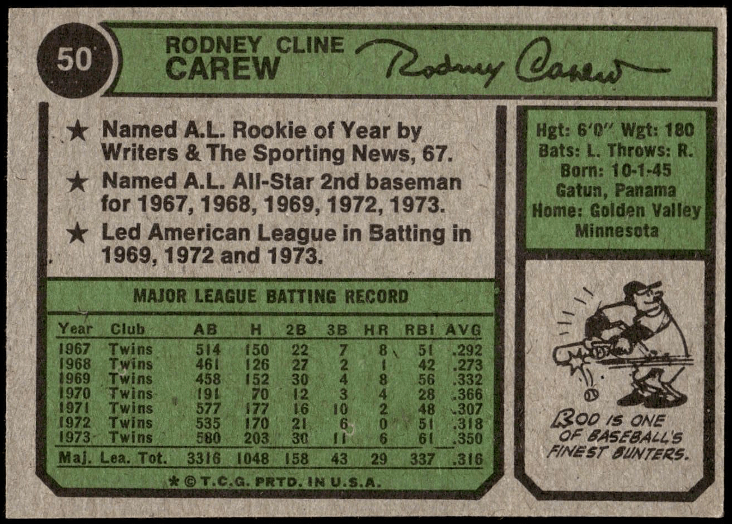
Atlanta’s Ralph Garr and Minnesota’s Rod Carew won batting titles in 1974. It was Carew’s third-straight batting crown and fourth overall. (He would eventually capture seven.) Mike Schmidt of the Phillies and Dick Allen of the White Sox both won their first home run championships. Meanwhile, Cincinnati’s Johnny Bench and Texas’ Jeff Burroughs were tops in RBIs.
Burroughs and Steve Garvey of the Dodgers were named MVPs by their respective leagues. Garvey was also MVP in the All-Star game. In addition, he hit .389 in the League Championship Series and .381 in the World Series.
Jim “Catfish” Hunter was 25-12, with a 2.49 ERA en route to the A.L.’s Cy Young Award. The National League Cy Young plaque went to Dodgers’ reliever Mike Marshall. Marshall appeared in a record 106 games, posting a 15-12 record, with 21 saves and 2.42 ERA.
The Cardinals’ Bake McBride and the Rangers’ Mike Hargrove took Rookie of the Year honors, as each batted above .300.
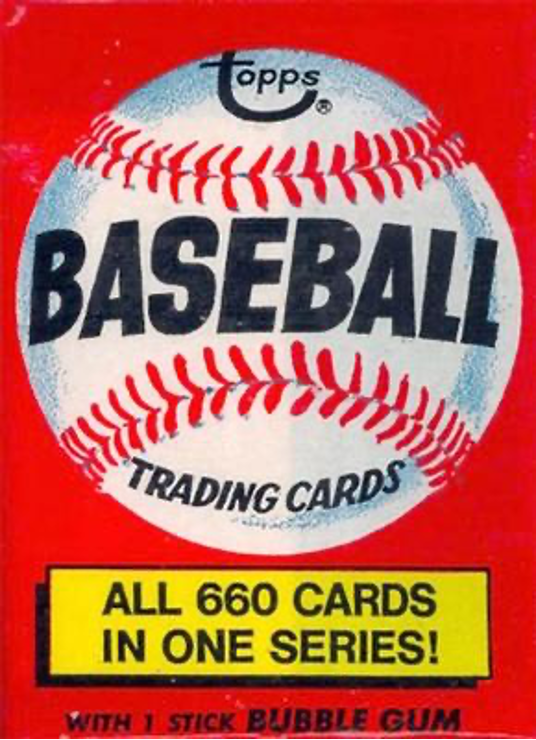
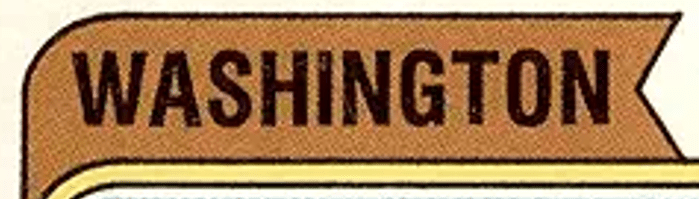
The 1974 set represented the first time Topps issued all cards at one time, as opposed to several series throughout the spring and summer. The 660-card set features a fairly dull design on both front and back. Color-coded bars feature the team’s city and nickname at the top and bottom of card fronts. The player’s name and position are located next to the bars. Backs were horizontal and featured a very dark green color scheme.
During the winter of 1973-74, rumors were rampant the San Diego Padres were going to move to Wash- ington, D.C. Since Topps most likely went to press with its set before the new year began – or shortly thereafter – it had to decide how to depict Padres players.
In 1970, Seattle moved to Milwaukee shortly before the season began. However, instead of replacing the Pilots name on cards printed in later series, the company simply stuck with Seattle throughout the season. Topps even issued a Pilots team card in the 1970 set’s 7th series late that summer.
In 1974, Topps gambled and lost. Big. Instead of going ahead and issuing San Diego Padres cards, a decision was made to produce cards featuring “Washington Nat’l Lea.” – since the new nickname wasn’t known at the time. When the Padres remained in San Diego, Topps ended up with egg on its face. Lots of egg. The strange thing was, when the 1974 cards hit the streets 13 regular player cards, the team card and one multi-player rookie card contained the Washington designation. At the same time, 10 other players appeared with the Padres as their team. All players from card #387 on down were listed with Washington, plus card #599 of Dave Freisleben in the rookies subset. Starting with Steve Arlin (#406), the remaining players were shown with the Padres, except for that pesky #599 rookie card.
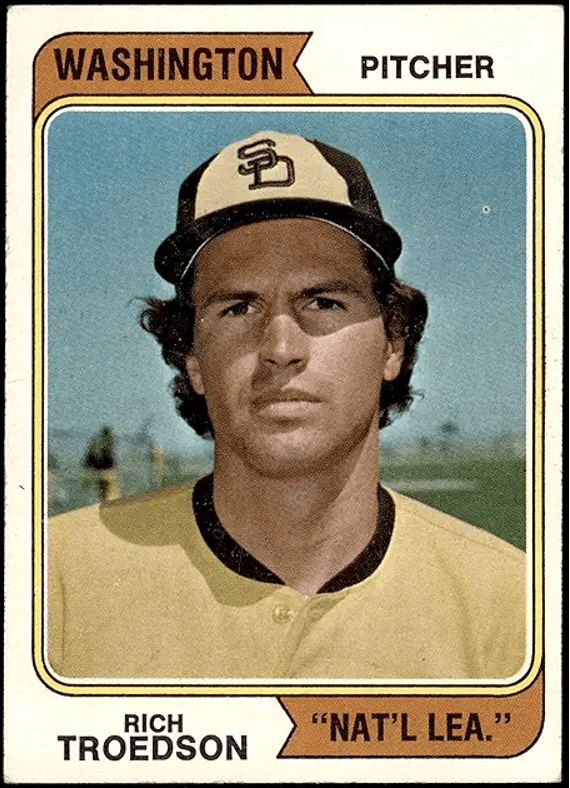

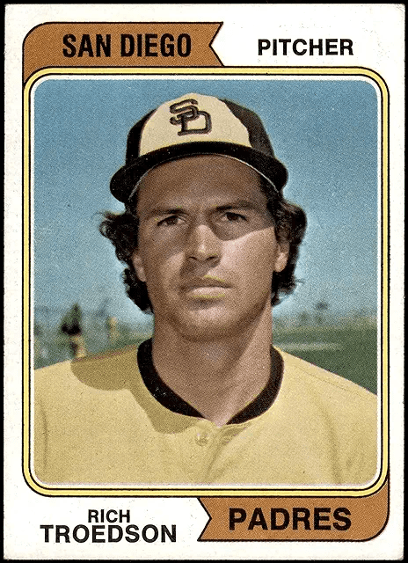
All Washington cards were changed to San Diego in subsequent press-runs. Other minor errors were also corrected. The Washington versions command premium prices of between five and 15 times the San Diego corrections. The most valuable of the variations is Willie McCovey’s card (#250). His Washington Nat’l Lea. card goes for about $30, while his San Diego card is $5.
Jesus Alou’s card (#654) was also issued in two versions. The first – and more scarce – variety omitted his position on the front of the card. The second version has “outfield” listed. The no position card is about $8, while the corrected version is 50 cents.
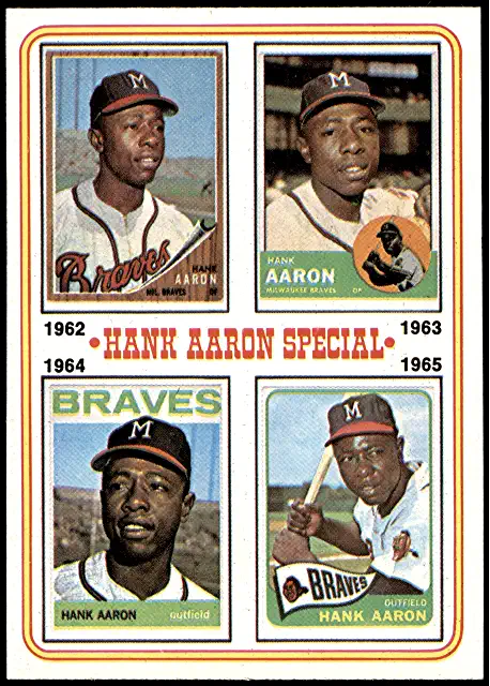
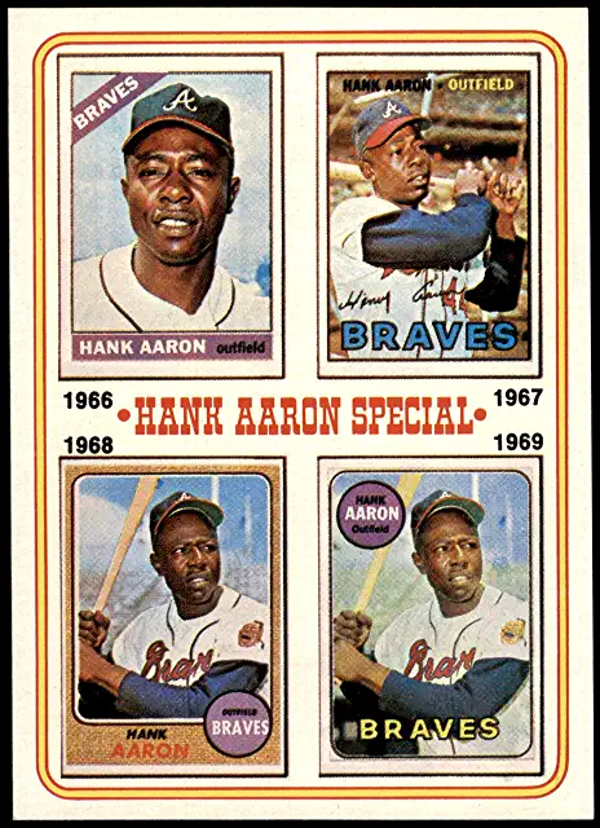
Hank Aaron is featured on the first six cards in the 1974 set. Card #1 is entitled “New All-Time Home Run King.” Actually, the card was issued before Aaron passed Babe Ruth. The next five cards in the set have fronts showing Aaron’s previous Topps cards. For instance, card #2 shows his 1954-57 cards. Card #3 shows 1958-61 Aaron cards and so on. This was the first of many times Topps would use previous cards to make up a new one.
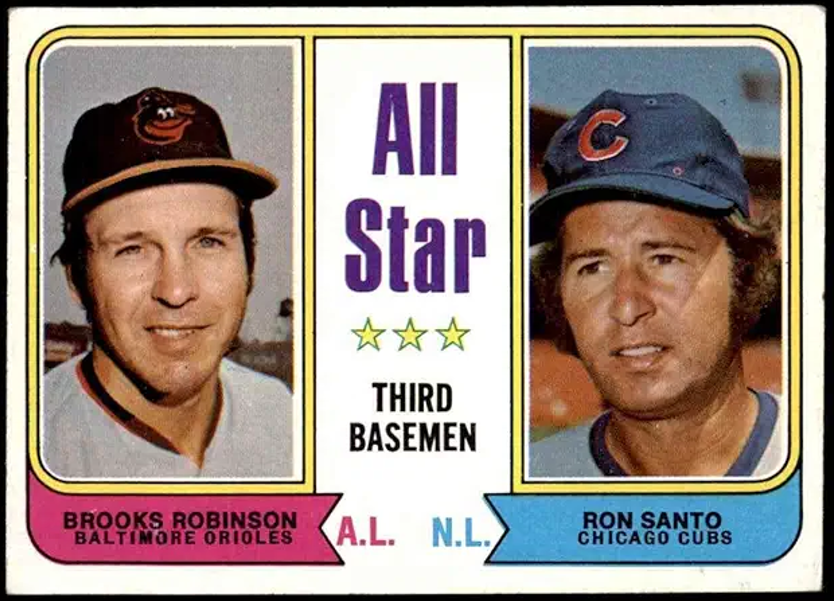
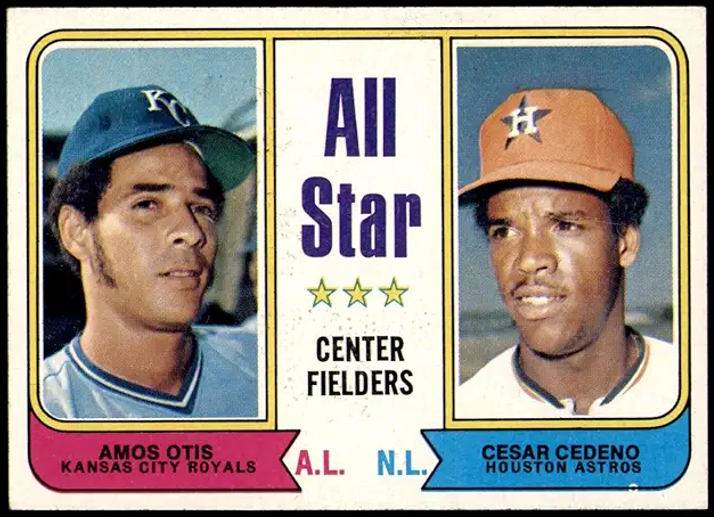
All-Star cards (#331-339) return to a Topps set for the first time since 1970. Only this time, two players are shown on each card. The cards feature top players from both leagues at a particular position. An example is “All-Star Catchers” (#331) in which Johnny Bench and Carlton Fisk share the card.
With the set no longer issued in series, Topps must have felt obligated to provide updated cards of players who were traded after the set went to press. Therefore, the 44-card Traded series was created.
These cards were not issued as a separate set as is now common with Topps’ end-of-the-season boxed Traded sets. Rather, they were inserted into regular 1974 card packs toward mid-season … much like Upper Deck now does with its high series cards.
Each player in the Traded series appears on a regular card in the set. Their Traded card number is a combination of their regular card number plus the letter “T” for traded. The most prominent player featured is Juan Marichal.
Marichal appears on card #330 in the 1974 set. His Traded card is #330T. Backs of the Traded cards are done in a newspaper style, with the publication name “Baseball News” at the top. Below is a headline, followed by an explanation of the trade involving the player featured. The headlines are usually corny.
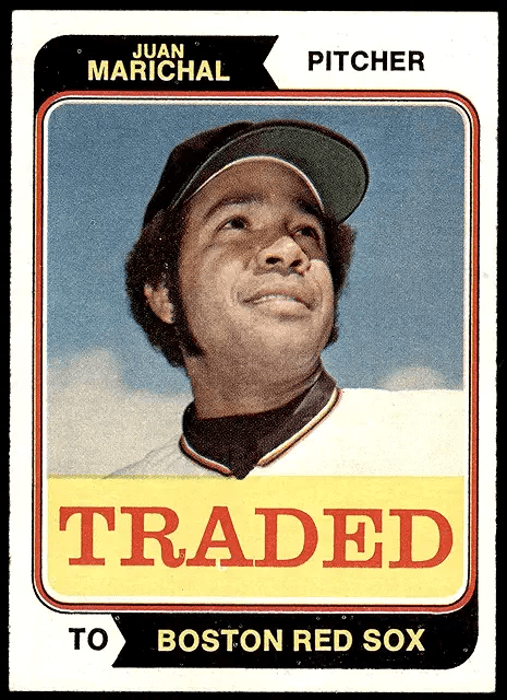
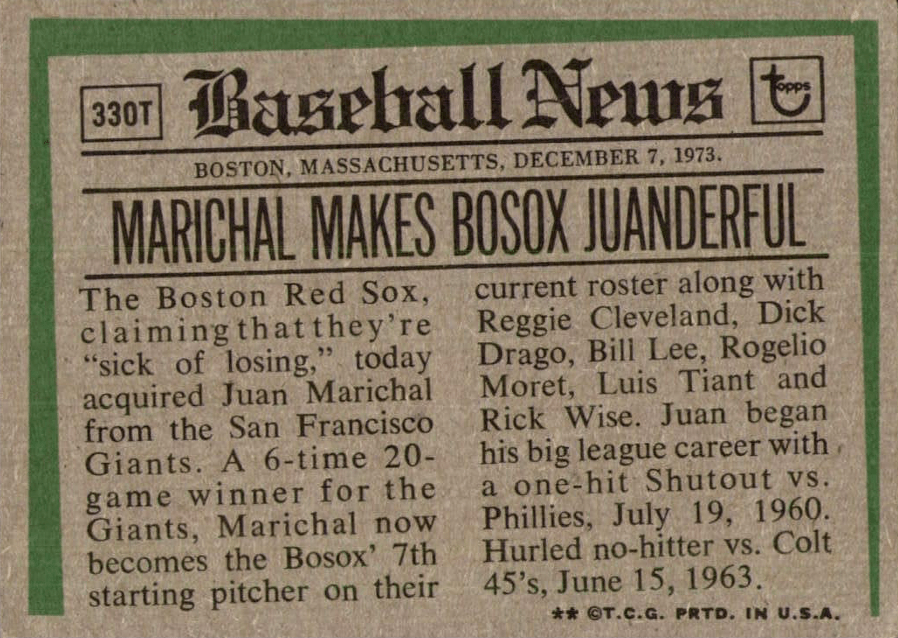
The one on Marichal’s card reads: “Marichal Makes Bosox Juanderful.” He was dealt by San Francisco to Boston.
The 1974 set is also home to three noted rookie cards: Dave Parker (#252), Dave Winfield (#456) and Ken Griffey, Sr. (#598).
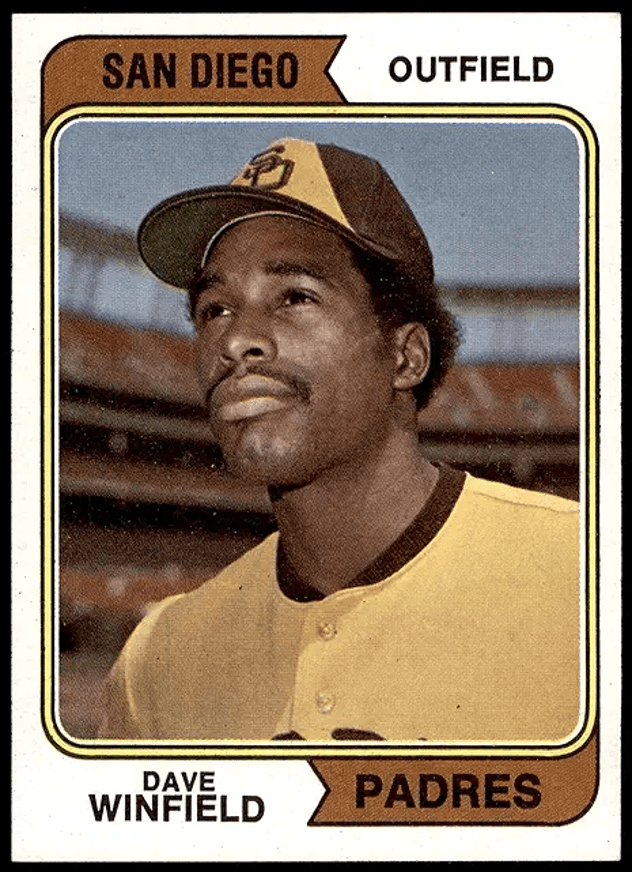
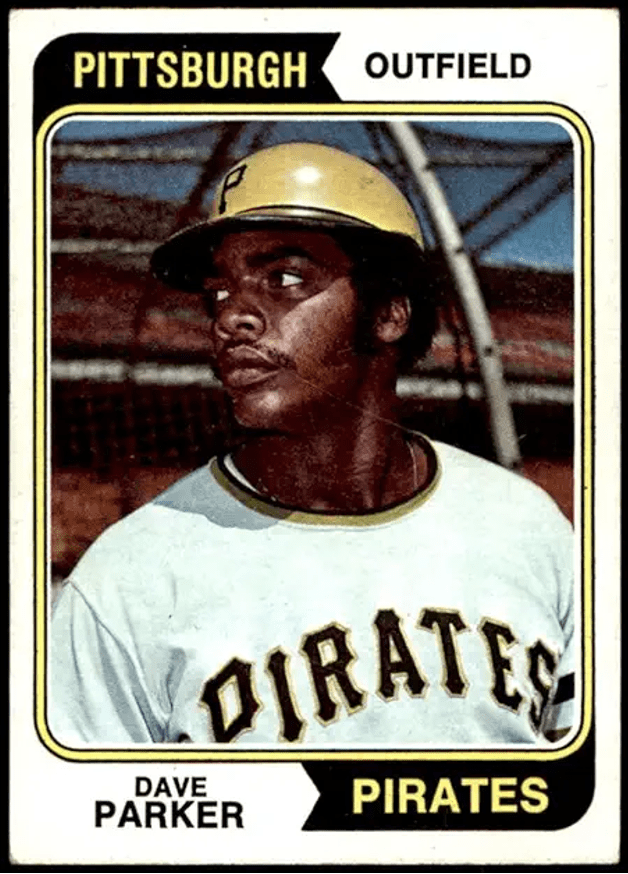

The set is far from being the most exciting one ever produced by Topps. But during the spring of 1974, the growing legions of adult hobbyists across the country did scurry around in hot pursuit of Washington cards and other variations. Yes, believe it or not, collectors went after error cards a full 15 years before Billy Ripken opened a colossal can of worms with his 1989 Fleer card.
• • • • • •
• Originally Published in Nov. 1992 “Baseball Hobby News” •
THIS ARTICLE FROM “BASEBALL HOBBY NEWS” MAGAZINE IS REPRINTED WITH THE PERMISSION OF BOTH THE EDITOR/PUBLISHER AND THE AUTHOR. IT HAS BEEN RETYPED, BUT NO CONTENT HAS BEEN CHANGED (EXCEPT FOR VERY MINOR ADJUSTMENTS, CORRECTIONS TO TYPOGRAPHICAL ERRORS AND CHANGES TO GRAPHICS). COMMENTS OR INFORMATION IN THE ARTICLE MAY BE OUT-OF-DATE.
To keep up-to-date on additions to BaseballCardFun.com, subscribe below*
* Your email address will never be shared and is only used to announce new articles
 BaseballCardFun.com