
The history of Topps baseball card sets



BY MARK A. LARSON
A trio of features distinguishes the 1972 Topps baseball set from most others:
• The ultra-modern psychedelic lettering used on card fronts.
• The massive size (787 cards – the largest Topps set until 1982).
• The inordinate number of subsets … In-Action cards … Boyhood Photos … and the first “Traded” cards.
The set was a shock to youngsters in 1972 who were used to relatively lackluster Topps designs. But the ‘72s probably reflect the era in which they were issued better than any other set. You couldn’t help notice the brightly-colored team names on the front – a direct descendent of the “Flower Power” days. Like wow, man.
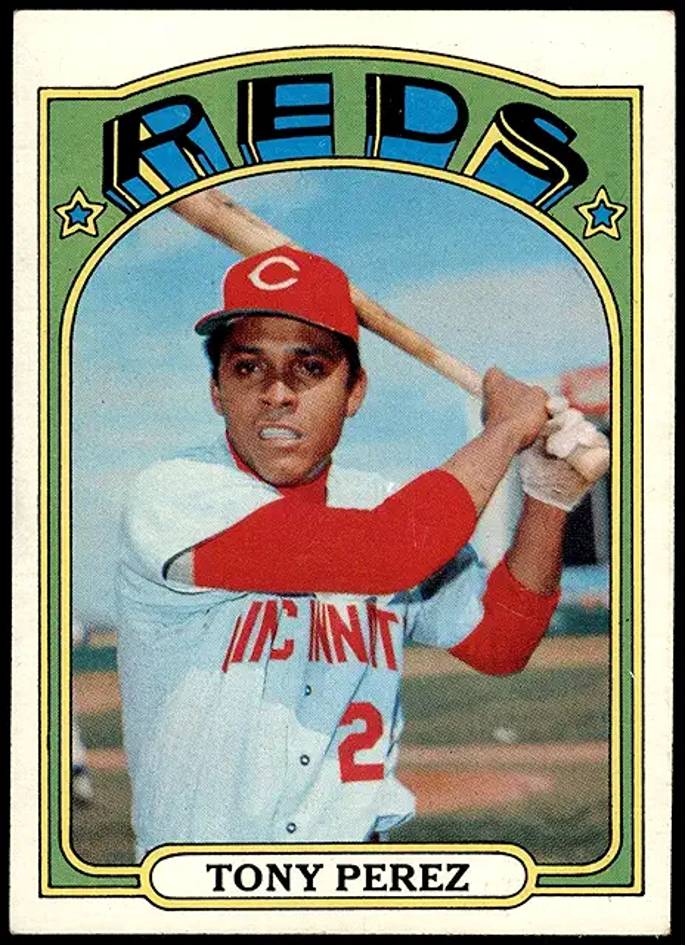
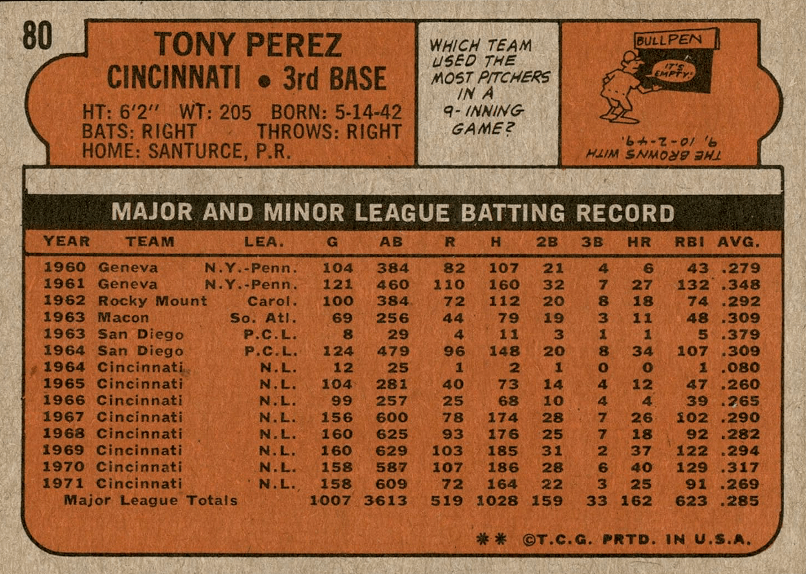
To this day, collectors disagree vehemently on the loud design of the ’72s. Many find them ugly and overbearing, while others respect the fact Topps was at least trying to keep up with the times and do something different. While the front of the cards can still spark controversy, card backs were enough to make even the most hyperactive collector grab some No-Doz. Nothing new on the backs: Dark, drab orange coloring on dull gray cardboard, with no design innovations. Yawn.
Card fronts were missing an element that had been included in every Topps set since 1953 … the player’s position. In fact, 1972 is the only set in the 34-year period from 1953-86 the company does not list each player’s position on the card front. (Interestingly, five out of the last six Topps sets – 1987-92 – have omitted positions on the front. The 1991 set is the only exception.)
The enormous size of the set dictated the inclusion of several subsets, many of which had never been used by Topps before. After all, at 787 cards, each of the then 24 teams would have had to have at least 32 players included to fill out the set. The padding of the 1972 set is evident.

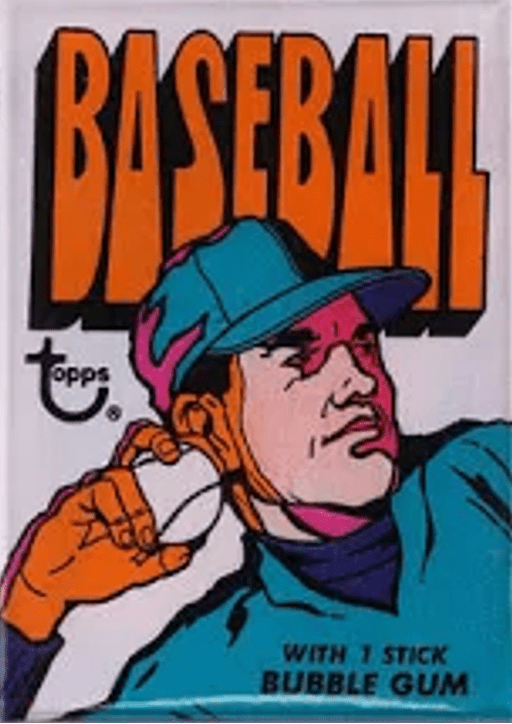
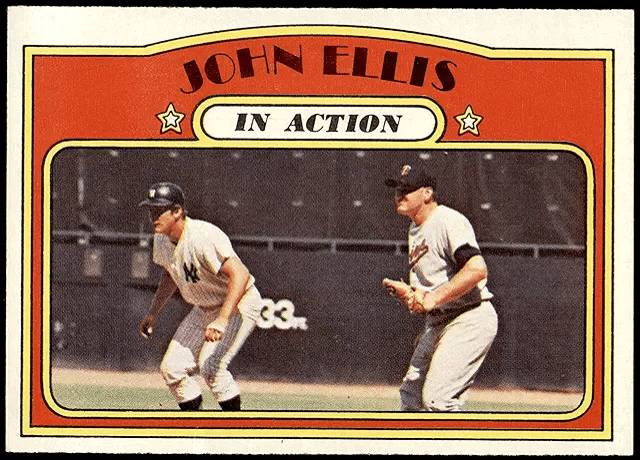
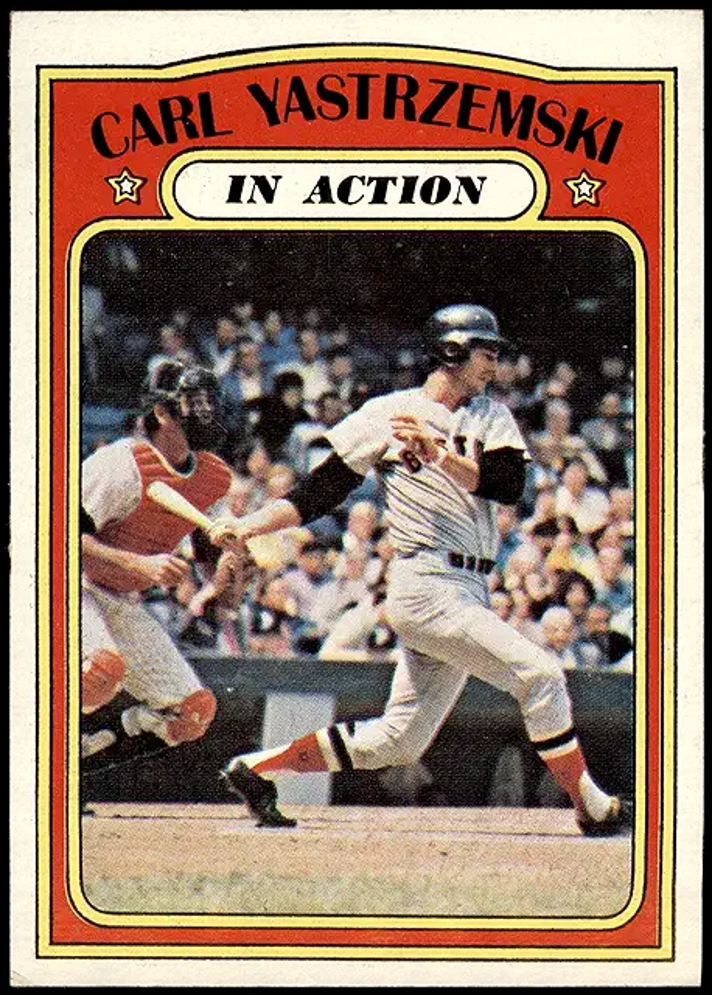
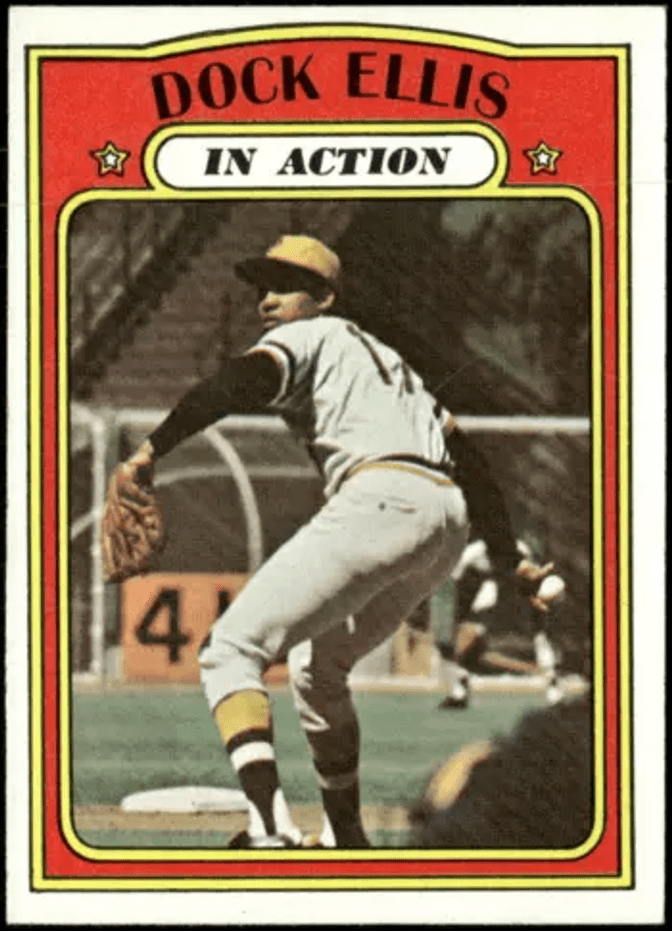
Nearly 10 percent of the set (72 cards) is devoted to “In-Action” cards. These cards showed players in game-action shots … batting, pitching, fielding or running the bases. Many of the action photos are good, but some make it hard to identify which player is supposed to be the center of attention.
On card #48, the Yankees’ John Ellis’ In-Action card shows him leading off first-base. But standing right there, glove-in-hand, and featured more prominently is Twins Hall-of-Fame first baseman Harmon Killebrew.
Each player’s In-Action card immediately follows his regular card in the set. For instance, Billy Martin’s regular card is #33, while his In-Action card is #34. Martin, by the way, is the only manager to be featured on an In-Action card. Naturally, he shown arguing with a man in blue, what else?
The regular subsets of League Leaders (#85-96) and Playoffs/World Series cards (#221-230) are included in the ’72 set. For the first time, the two League Championship Series are relegated to just one card each. However, in keeping with tradition, Topps issued one card for each Fall Classic game, plus a “Pirates Celebrate” card.
A first-time ever “Boyhood Photos of the Stars” subset included 16 cards (#341-348 and #491-498). The fronts of these masterpieces showed players in a black-and-white photo from their youth. Some featured the stars playing ball, such as Willie Stargell, while others were sillier, Wilbur Wood holding a fish and Jim Fregosi playing the accordion.
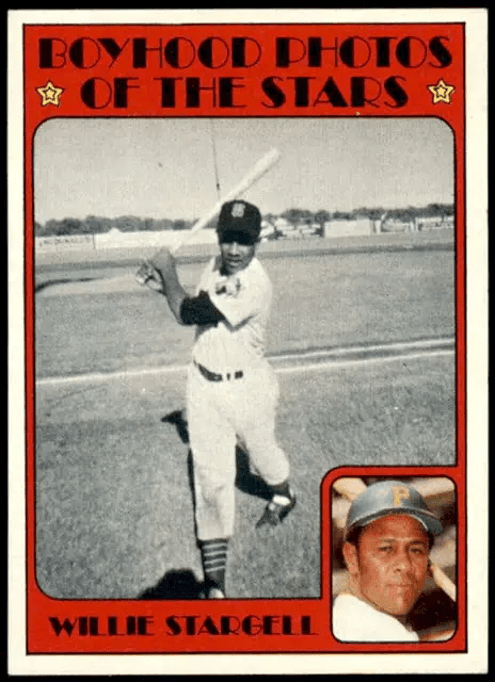
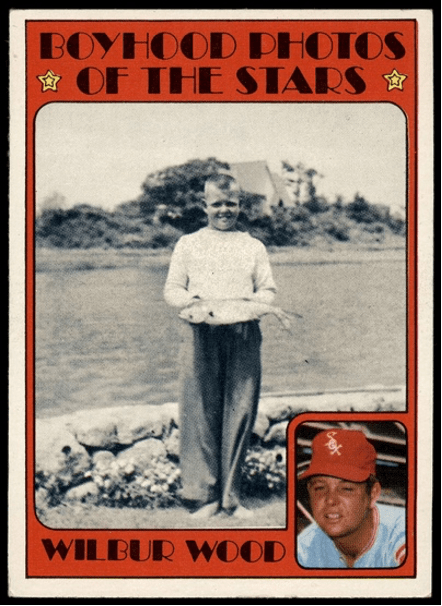
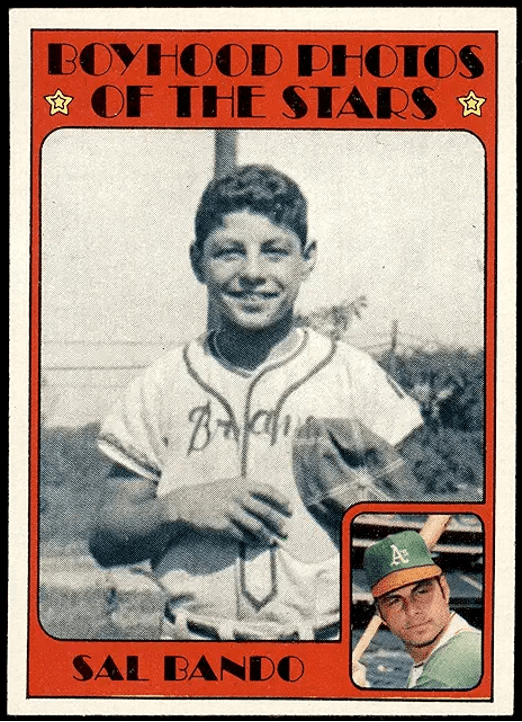
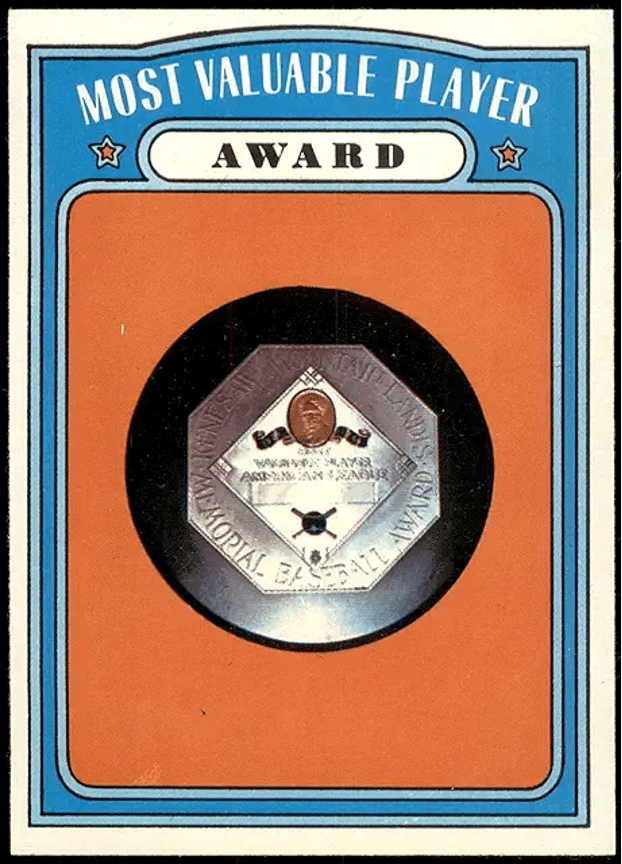
It’s not an understatement to say Topps might have been stretching a bit to fill out the set with the Boyhood Photos. But maybe the most boring cards ever issued – not counting checklists – were photos of awards. Cards #621-626 featured plaques and trophies for Most Valuable Player, Cy Young Award, Rookie of the Year, etc. set against a solid color background. Backs of these cards were informative, but fronts should have at least included the award-winning player from the previous year with his prize.
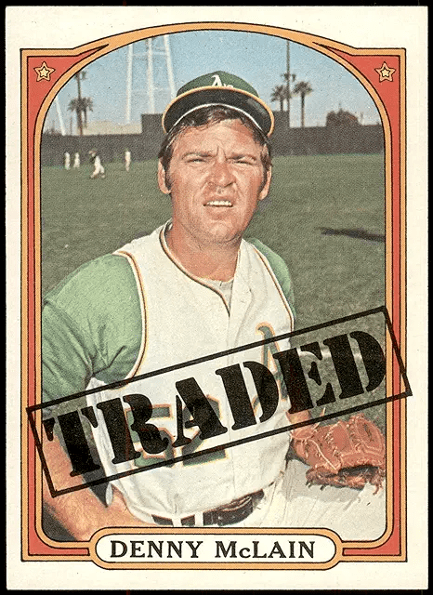
Seven cards (#751-757) in the 7th Series included the forerunners to today’s Traded Sets. Each of these cards showed a player who was traded in the uniform of his new club. The word “Traded” was shown on the front as if rubber-stamped over the photo. Four of the seven were big names: Steve Carlton (Phillies), Joe Morgan (Reds), Denny McLain (A’s) and Frank Robinson (Dodgers). The remaining three were Jim Fregosi, Rick Wise (who was traded for Carlton) and Jose Cardenal.
Topps, of course, would expand this idea with separate 44-card Traded Series in 1974 and 1976. Then in 1981 the first of the now familiar separate 132-card Traded Sets was issued. (In addition to players who were traded, the 1981-91 Topps Traded Sets also included rookies and players missing from the regular set.)
The 1972 set included the first cards of the Texas Rangers. The franchise spent its first 11 years as the Washington Senators, moving to Arlington, Texas after the 1971 season.
Like most Topps sets, variations of some cards exist. The most prominent of these involved four Cubs players in the 1st Series: Juan Pizzaro (#18), Bill Bonham (#29), Glenn Beckert (#45) and Cleo James (#117).
The common variety of each of these players’ cards has the color yellow under the “C” and “S” in the Cubs team name on the front of the card. The variations, which are valued at about 10 times the commons, have green under the “C” and “S”.
The last regular Topps cards of five significant players and managers appear in the ’72 set.
Mets manager Gil Hodges (#465) passed away during spring training in 1972. In addition to leading the Mets to their first World Championship in 1969, Hodges belted 370 home runs as a big league first-baseman. His best years were spent with the Brooklyn Dodgers. His first Topps card was issued in 1951.
Ted Williams spent the last of four years managing the Senators/Rangers in 1972, appearing on card #510. One of the greatest hitters of all-time, the Splendid Splinter made his first appearance on a Topps card in 1954.
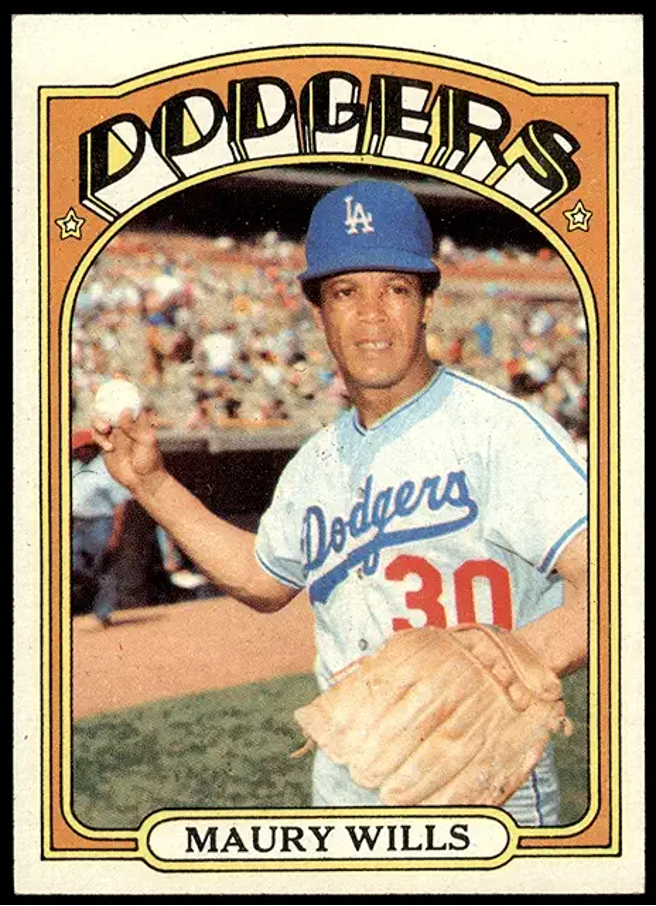
Holding the single-season stolen base record for many years, Maury Wills also appeared on his final regular Topps card (#437) in 1972. Although he had a 14-year major league career, Wills only appeared on six regular Topps cards. (Contractual problems between Wills and Topps weren’t settled until 1967.)
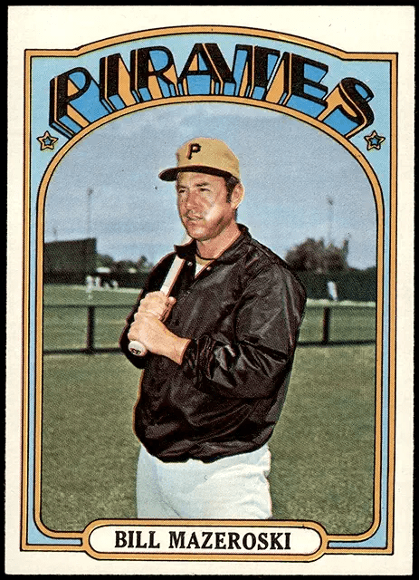
The man who won the 1960 World Series for the Pittsburgh Pirates with a dramatic Game 7 home run, Bill Mazeroksi (#760), finished up his playing career in ’72. Considered one of the finest-fielding second-basemen of all-time, Maz made his initial Topps appearance in the 1957 set.
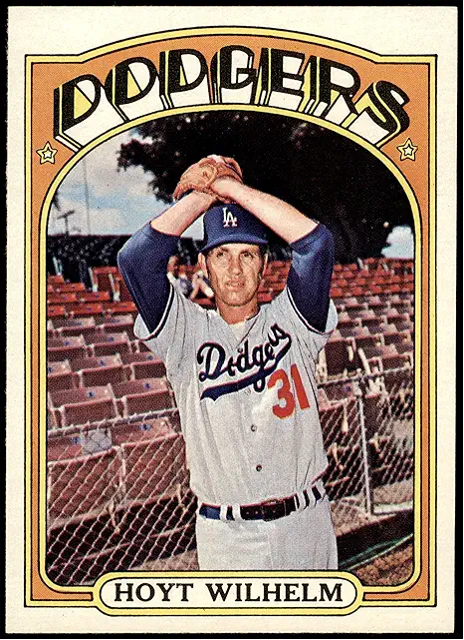
Finally, the man who single-handedly made relief pitching an art, knuckleballer Hoyt Wilhelm (#777), called it quits at the age of 49 in 1972. He was the first reliever elected to the Hall of Fame and still holds the record of pitching in 1,070 games.
Wilhelm is also the answer to the question: Who hit a home run in his first major league at-bat and never hit another during a 20-year career?
Even Topps realized a 787-card set was unnecessary. The following year’s set shrunk 16 percent to 660 cards. And it would be 10 years before the company came close to an 800-card set again.
For many years, I personally didn’t care for the 1972 set. However, it has grown on me, especially once I realized the size and numerous subsets are what make the eye-popping ’72s unique.
• • • • • •
See related article on BaseballCardFun.com entitled:
“1972’s Man in the Background”
Click Link Here
• Originally Published in Sep. 1992 “Baseball Hobby News” •
THIS ARTICLE FROM “BASEBALL HOBBY NEWS” MAGAZINE IS REPRINTED WITH THE PERMISSION OF BOTH THE EDITOR/PUBLISHER AND THE AUTHOR. IT HAS BEEN RETYPED, BUT NO CONTENT HAS BEEN CHANGED (EXCEPT FOR VERY MINOR ADJUSTMENTS, CORRECTIONS TO TYPOGRAPHICAL ERRORS AND CHANGES TO GRAPHICS). COMMENTS OR INFORMATION IN THE ARTICLE MAY BE OUT-OF-DATE.
To keep up-to-date on additions to BaseballCardFun.com, subscribe below*
* Your email address will never be shared and is only used to announce new articles
 BaseballCardFun.com