
The history of Topps baseball card sets
BY MARK A. LARSON
It was the year of the “Miracle Mets.” It was the year of baseball’s second four-team expansion in less than a decade. It was the year Mickey Mantle called it quits. It was the centennial year of professional baseball. It was the first year of divisional play. It was the only year for the Seattle Pilots. It was the year Jim Bouton chronicled in his controversial book “Ball Four.”
It was 1969 … the year Topps became thoroughly lazy and put little creative effort into its annual baseball card set.
Led by youthful pitchers Tom Seaver (25-7, 2.21 ERA) and Jerry Koosman (17-9, 2.28 ERA), the Mets finished the season with a record of 100-62. The team went on to beat the Braves in the playoffs and the Orioles in the World Series, going 7-1 in post-season play. Their regular season winning percentage of .617 was a far cry from the team’s first seven seasons.
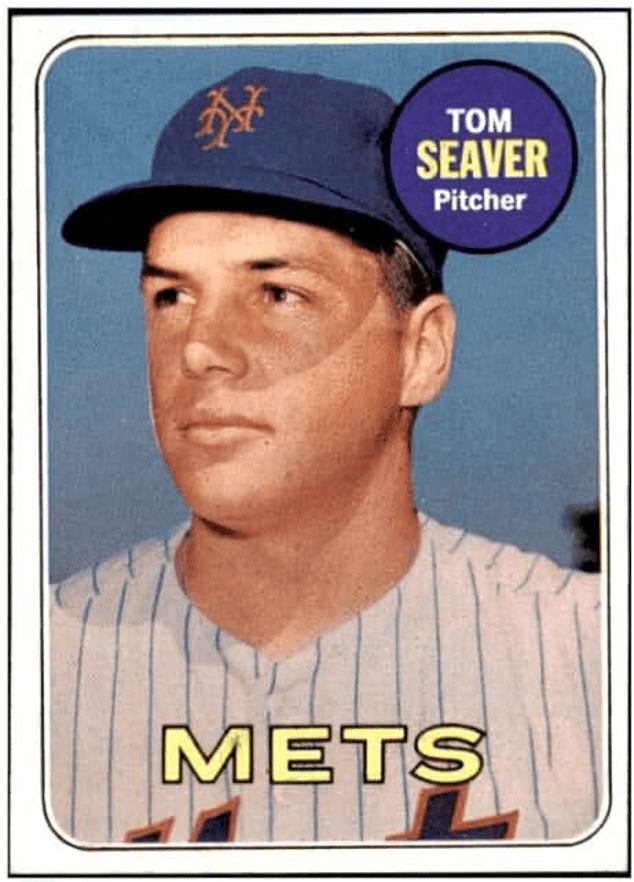
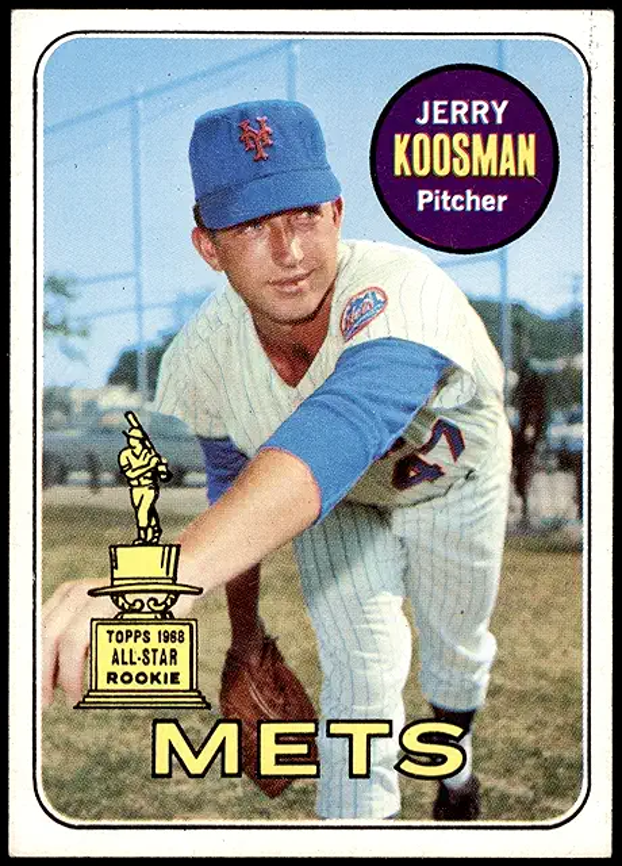
Between 1962 and 1968, New York had an average record of 56-105 (.348 winning percentage). It finished in last place five times and second-to-last the other two seasons, averaging 41 games out of first place. The Mets were the first expansion team to make it to the Fall Classic and are still the only one of the four original 1961-62 expansion franchises to do it.
Two members of baseball’s 500-home run club won MVP honors in 1969 – Harmon Killebrew of the Minnesota Twins and Willie McCovey of the San Francisco Giants. Killebrew clobbered 49 homers and garnered 140 RBIs. McCovey swatted 45 four-baggers, hit .320 and had 126 RBIs. Tom Seaver was the National League’s Cy Young Award winner, while the A.L. Award was shared by Detroit’s Denny McLain and Baltimore’s Mike Cuellar.
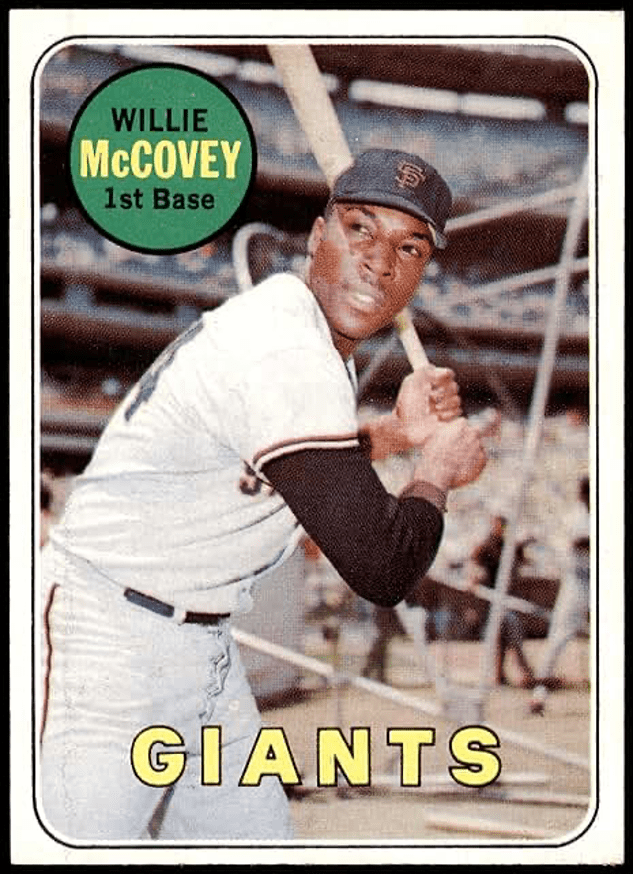
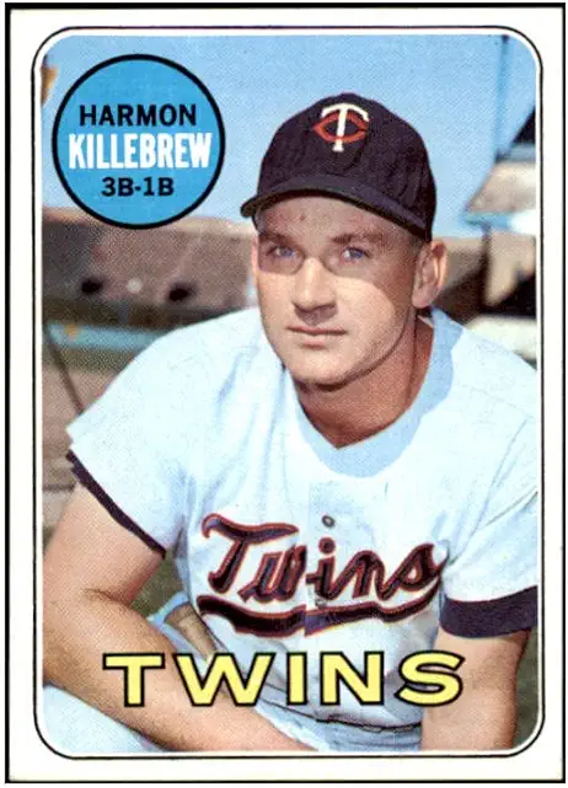



One word describes the 1969 Topps baseball card set: Blah.
The design of the ’69 cards seems to be a hybrid of the three previous sets. The fronts incorporate the team name across the bottom, much like the ’67s. Yet the ’69s were done in yellow for every team as opposed to color-coding each team in 1967. The circle on the front of the 1969 cards is copied directly from the previous year’s set. Backs are almost identical in color and design to cards from the 1966 Topps set.
Clearly, Topps’ design department did not work overtime on the 1969 set. But similarities between the ’69s and other sets from the late 1960s did not stop with design. Of the 664 cards in the set, 80 incorporate photos already used in the 1967-68 sets. The first series of 109 cards alone includes 25 of these “repeat” photos.
Most of the 1969 repeat photos were identical to previous years. Others were cropped (framed) differently, but they were indeed from the same negative. In a case or two, Topps used a repeat photo and simply airbrushed the cap.
Speaking of airbrushing, 93 cards – one in seven – in the set were altered in this manner. In other words, about a quarter of the 1969 set is made up of outdated photos … either they were used before or they showed a player with a previous team. However, much of the airbrushing is understandable in light of the fact so many players changed teams due to expansion. The reason for the repeat photos? A mystery.
(An extensive article by this writer on the 1969 Topps repeat photo cards appeared in the April 1989 issue of Baseball Hobby News.)
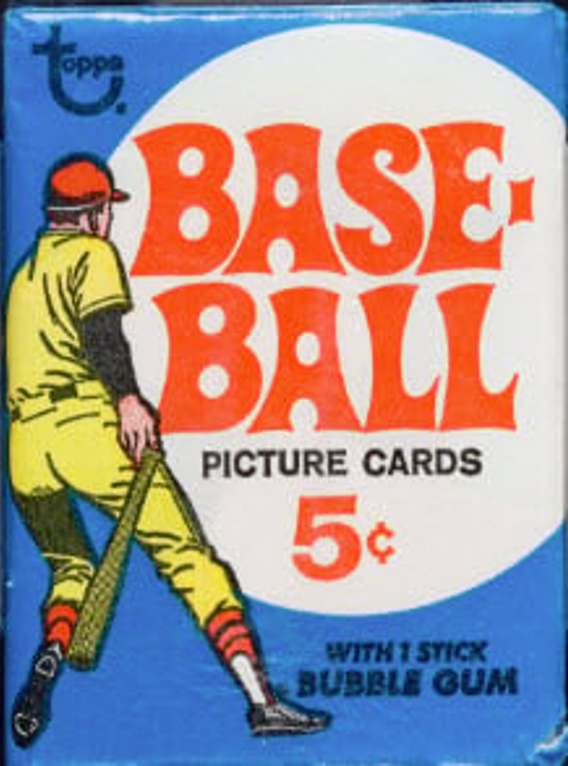
Other odds and ends concerning the 1969 Topps set:
• For the first time since 1955 Topps did not issue team cards. They did, however, return in the 1970 set.
• All-Star cards (#416-435) appear for the second year in a row after a five-year hiatus between 1963-67.
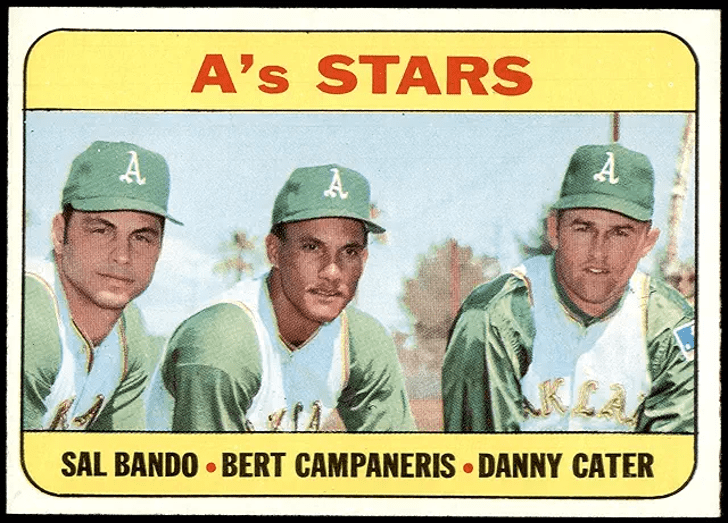
• 1969 marked the 13th consecutive year Topps issued multi-player star cards. It was also the last. The four cards of this type in the ’69 set are: “Bird Hill Aces” (#532) with Baltimore’s Tom Phoebus, Jim Hardin, Dave McNally and Mike Cuellar; “A’s Stars” (#556) with Sal Bando, Bert Campaneris and Danny Cater; “Giants Heroes” (#572) with Willie McCovey and Juan Marichal; and “Ted Shows How” (#539) with Ted Williams and Mike Epstein.

• Speaking of Ted Williams, in 1969 he appeared on his first Topps cards since 1958 (even though he played through 1961). Williams returned to baseball as manager of the Senators and had his own card (#650), plus the aforementioned one with Epstein. Between 1959-61, Williams had an exclusive contract with Fleer.
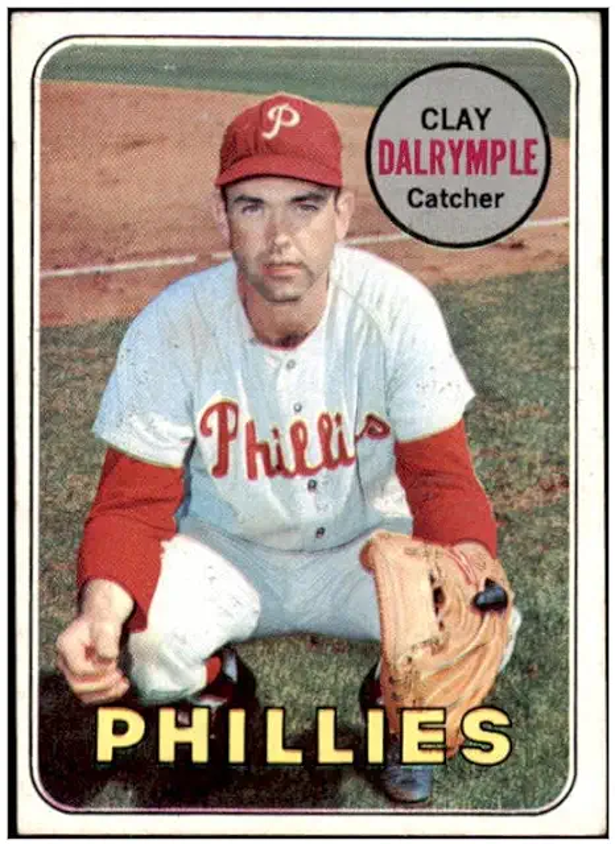
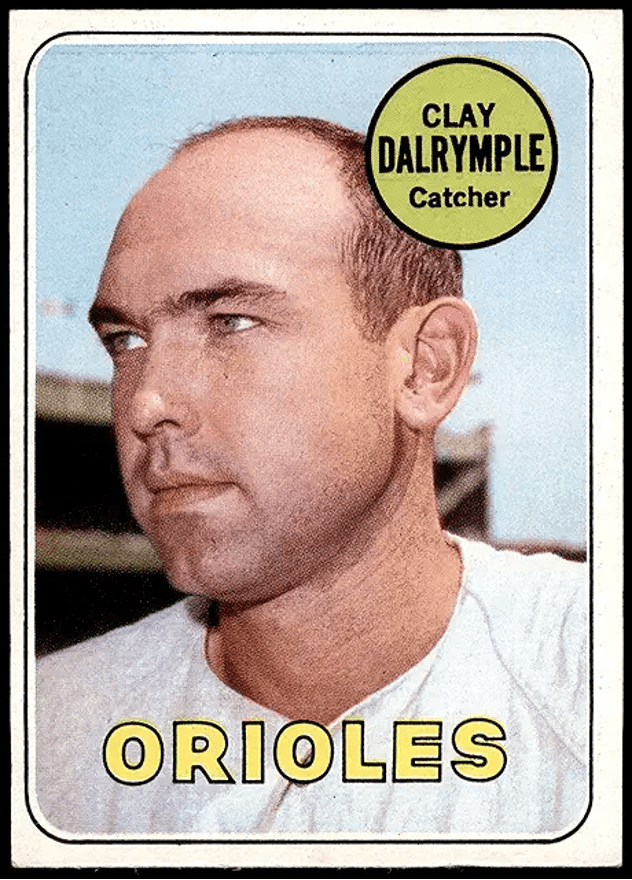
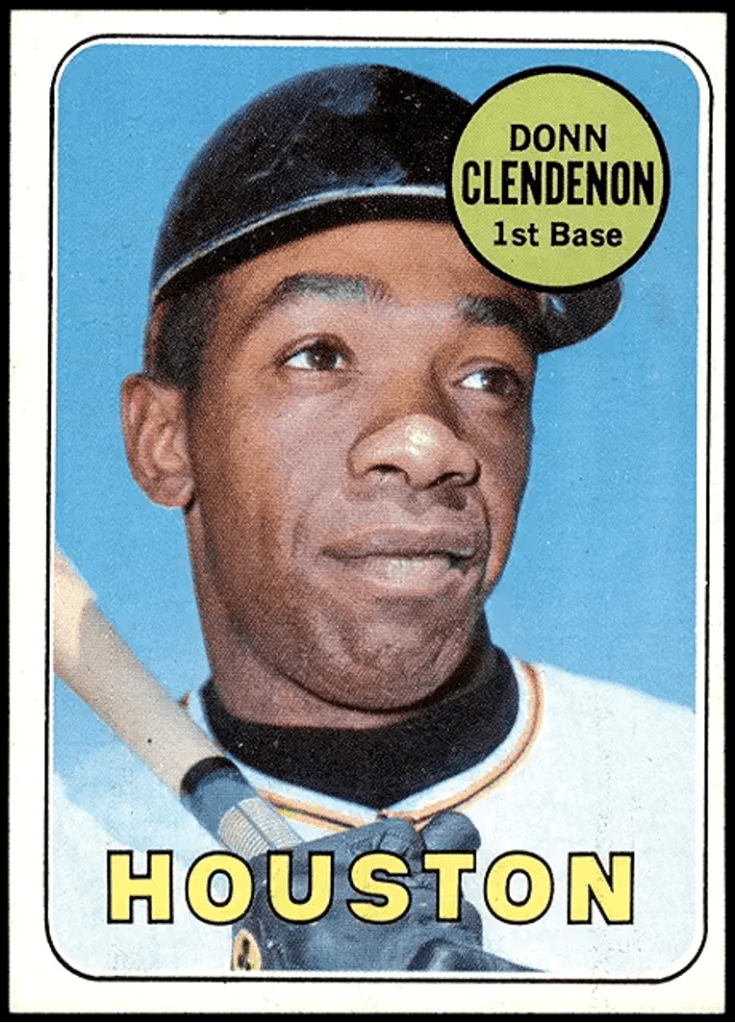
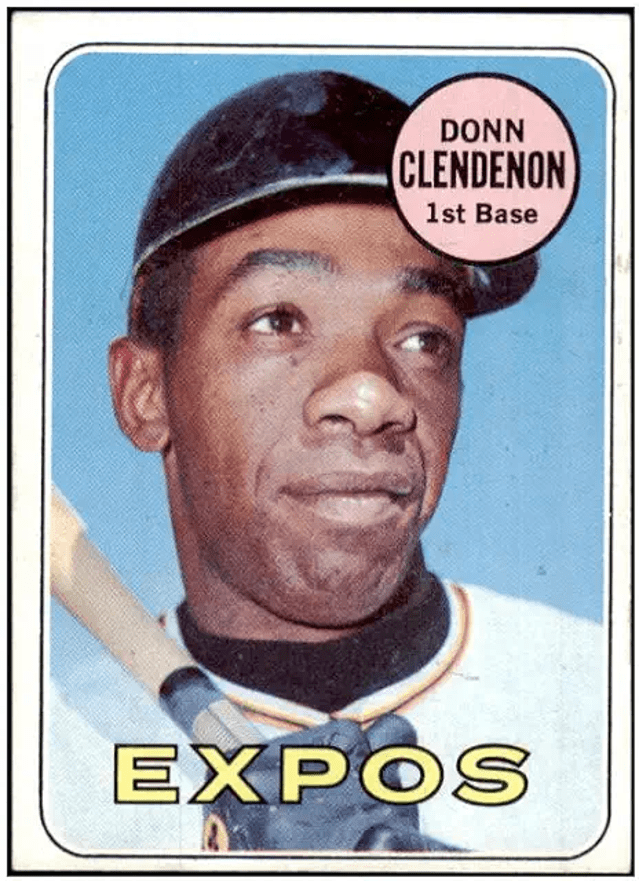
• Two major variations of both Clay Dalrymple’s (#151) and Donn Clendenon’s (#208) cards were issued in the 1969 set. Dalrymple has one card showing him with Philadelphia, the other with Baltimore. He was traded Jan. 20, 1969. Clendenon was traded two days later and appears on both a Houston and Montreal card. The Dalrymple Phillies and Clendenon Expos cards are more scarce and command about 15 times the price of their other cards.
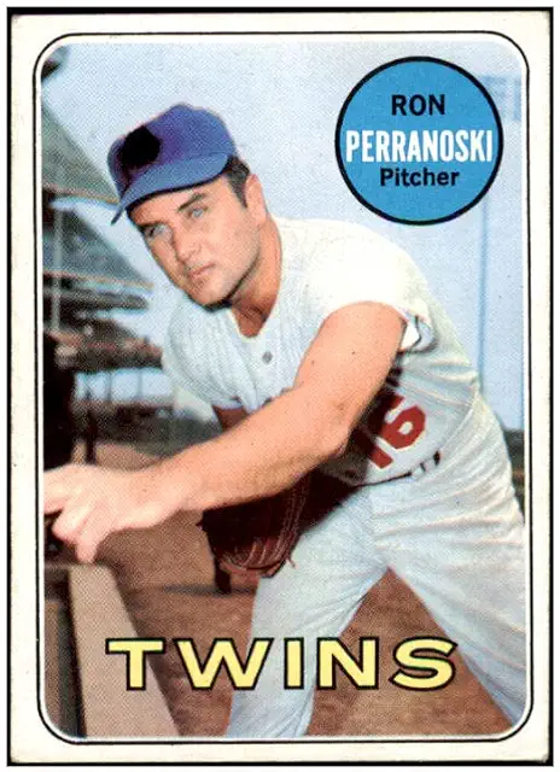
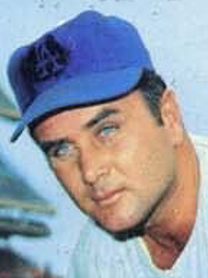
• Ron Perranoski’s card (#77) contains an unusual variation. Perranoski was traded from Los Angeles to Minnesota in the fall of 1967. Yet Topps in all their slothfulness still did not have a current photo of him in 1969. So the company figured the logical thing to do was show him in a Dodgers uniform with the logo on the cap airbrushed off. But it was a botched airbrush job.
Collectors could still see a faint “L.A.” showing through. Later, Topps completely obliterated the L.A. creating two Perranoski variations. The version with the L.A. logo visible is more scarce and thus worth 15 times the common card.

• Tommie Aaron’s card (#128) is a repeat of an ancient Topps photo. It was initially used on Aaron’s first card in the 1963 set.
• Catcher Larry Haney’s photo (#209) is also a repeat – this time from the 1968 set – except Topps reversed the negative to try to fool collectors. Therefore, Haney, who is in a typical crouch position, appears to be a left-handed backstop.
• Aurelio Rodriguez’s card (#653) is a case of mistaken identity. It’s not Rodriguez. Often Topps confuses players and mixes up their photos. Yet, in this case Topps did something unique. The person pictured isn’t a player, but an Angels’ batboy.
• Bill Davis (#304) appears on his fifth consecutive Topps multi-player rookie card … the most ever by one player. (An earlier article in this series mistakenly identified Lou Piniella’s three multi-player rookie card appearances as the record.) This was Davis’ last card. He never had a card just of himself.
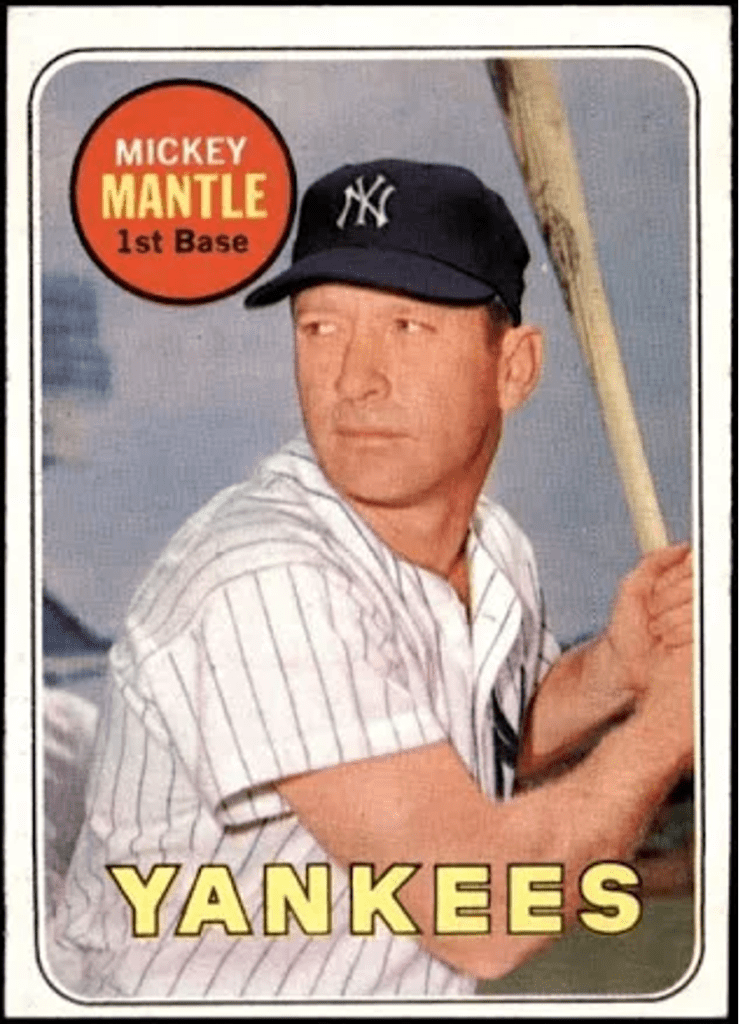
• Mickey Mantle’s last regular Topps card (#500) was included in the ’69 set. Mantle announced his retirement in the spring of that year. The Mick’s card is also noteworthy in that it is one of 23 in the 5th series (#426-512) to have a “white letter” variation. The scarce variations have the player’s first name, last name and/or position in white letters on the front, instead of some other color … the more common variety.
Be careful not to jump to a conclusion if you find a card in this series with white lettering. Some cards are found only with white lettering and therefore do not command a premium value. One of the annual price guide books will help you identify individual variations.
In addition to Mantle, Hall-of-Famers Willie McCovey (#440) and Gaylord Perry (#485) also have white letter variations of their ’69 cards. The scarce white letter varieties are worth 3-10 times the price of the regular card of that player.
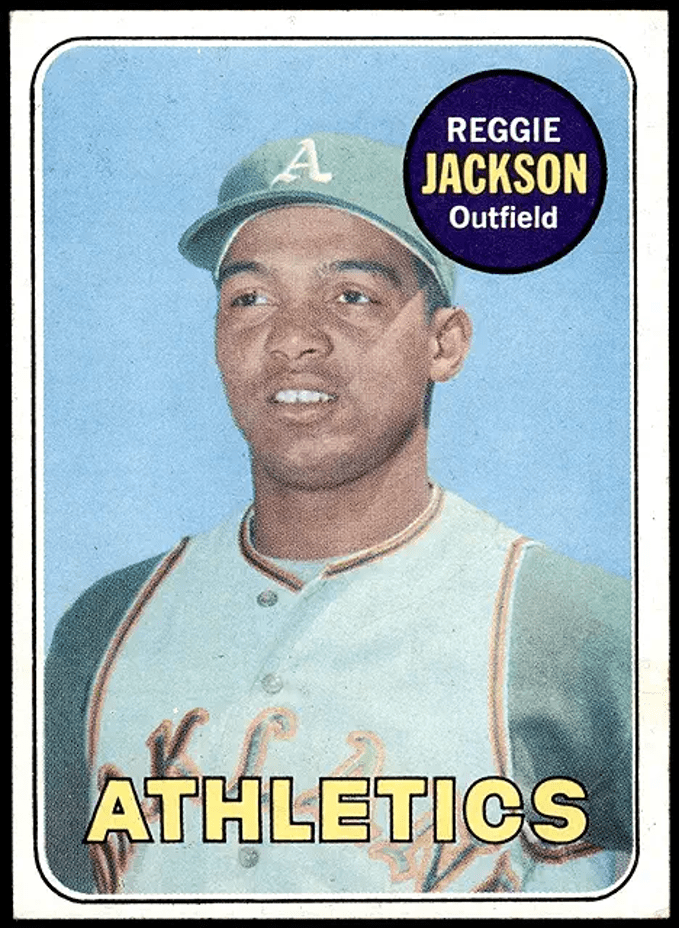
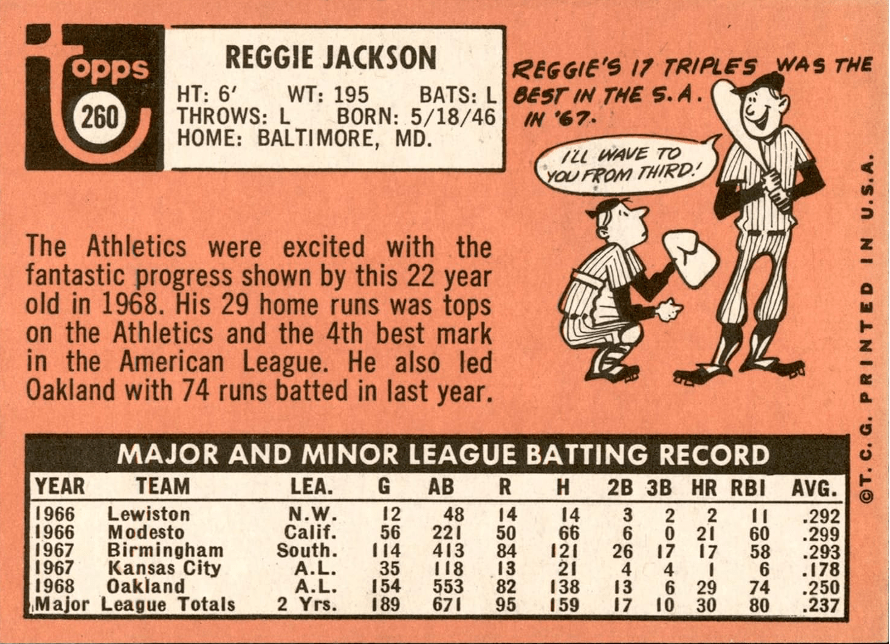
• Four major players appeared on a Topps card for the first time in the 1969 set. Reggie Jackson (#260) is the most well-known, followed by Rollie Fingers (#597), Graig Nettles (#99) and Al Oliver (#82). Jackson’s rookie card is highly sought-after and now goes for more than $500 in top condition.
Recycled photos, airbrush jobs galore and an uninspired design prove Topps was quite obviously coasting when it put together the 1969 set. Nevertheless, the company would bounce back a year later with its first issue of the new decade.
• • • • • •
See related articles on BaseballCardFun.com entitled:
“BASEBALL HOBBY NEWS – 1969 Topps: Baseball Card Deja Vu” Click Link Here
“BASEBALL HOBBY NEWS – 1969 Topps Repeat Photos Checklist” Click Link Here
“BASEBALL HOBBY NEWS – Rookie Bill Davis: A Tale of Two Photos” Click Link Here
• Originally Published in June 1992 “Baseball Hobby News” •
THIS ARTICLE FROM “BASEBALL HOBBY NEWS” MAGAZINE IS REPRINTED WITH THE PERMISSION OF BOTH THE EDITOR/PUBLISHER AND THE AUTHOR. IT HAS BEEN RETYPED, BUT NO CONTENT HAS BEEN CHANGED (EXCEPT FOR VERY MINOR ADJUSTMENTS, CORRECTIONS TO TYPOGRAPHICAL ERRORS AND CHANGES TO GRAPHICS). COMMENTS OR INFORMATION IN THE ARTICLE MAY BE OUT-OF-DATE.
To keep up-to-date on additions to BaseballCardFun.com, subscribe below*
* Your email address will never be shared and is only used to announce new articles
 BaseballCardFun.com