
The history of Topps baseball card sets
BY MARK A. LARSON
The year 1968 was a thoroughly lousy one. The nation was heading toward anarchy, America’s national pastime had lost its offensive punch, and Topps’ annual baseball card set was a major letdown. That set is best known for the big bucks Nolan Ryan rookie.
Many people consider 1968 to have been the single worst year in American history since the Civil War. The Vietnam War intensified and it became increasingly clear it was a no-win situation. President Lyndon Johnson could see he was doomed politically and decided not to run for re-election. Martin Luther King, Jr. was gunned down in Memphis. Violence ricocheted throughout American cities. Robert F. Kennedy was assassinated in Los Angeles. Later, bloody riots shook the Democratic Convention in Chicago. The country seemed to be unraveling.
In baseball, it was the year of the pitcher and there were many who feared for the offensive future of the game. The American League’s overall batting average in 1968 was a pathetic .230. (Oakland led the league in hitting with .240.) In the National League it was .243. League ERAs were an astoundingly low 2.98 in the A.L. and 2.99 in the N.L.

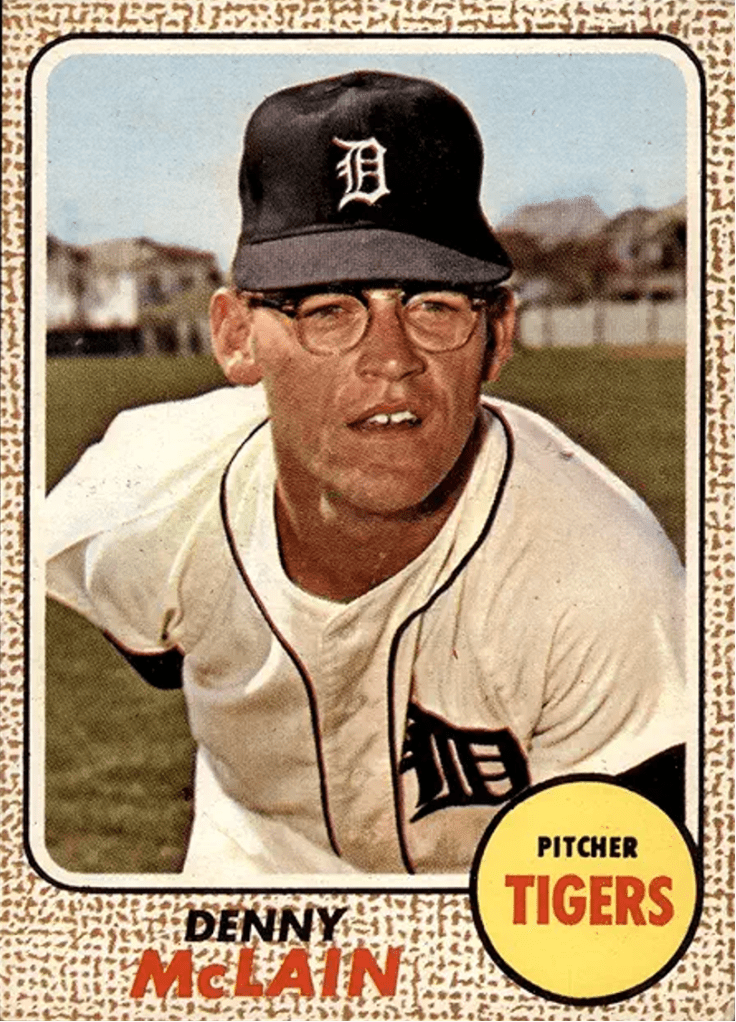
Boston’s Carl Yastrzemski was A.L. Batting Champion. He hit just .301 – the only player in the league to top .300. Denny McLain of the Tigers was MVP and Cy Young Award winner in the A.L. He won 31 games. Luis Tiant led the league with a 1.60 ERA. He was one of five A.L. pitchers to finish the season with a sub-2.00 ERA.
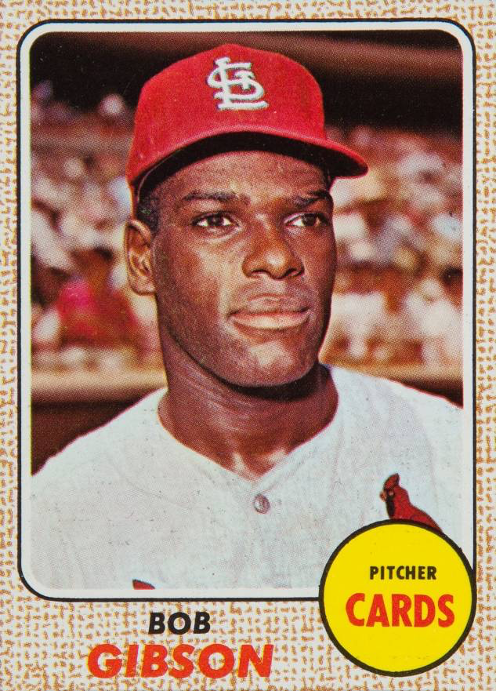
In the National League, Cardinals pitcher Bob Gibson’s ERA was an incredible 1.12. Like McLain, he was also named both MVP and Cy Young Award winner. The two pitchers faced each other in the ’68 World Series, as Detroit beat St. Louis in seven games.
After five years of excellent Topps baseball card sets – at least design-wise – the 1968 effort fell far short of the high level maintained since 1963. The ’68 set was uninspired. And when compared to the glorious design of the 1967s, it looks even more pitiful.
The 1968 set has been described as having a front border that resembles a burlap sack … a sort of brown mesh look. Truth be told, the first series has one design and the second through seventh series have another.

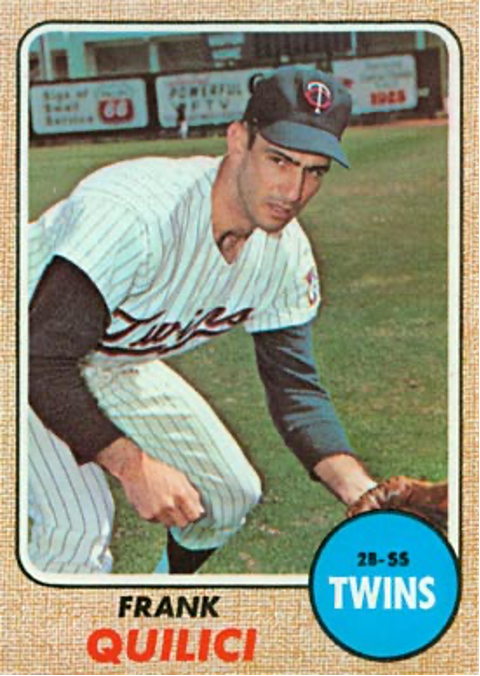
The first series has a brown dot design that is quite distinguishable from the later, finer mesh pattern. Why Topps chose to make this change is anyone’s guess. Making a change in card design after one series was not without precedent, though. The previous year, Topps made a very minor change in the 1967 cards when the 2nd series rolled around.
The 1st series of ’67s does not contain a bullet (large dot) between the player’s name and position at the top of the front of the card. All later cards had a bullet separating name and position. But this minor change was much less noticeable than the ’68 adjustment.
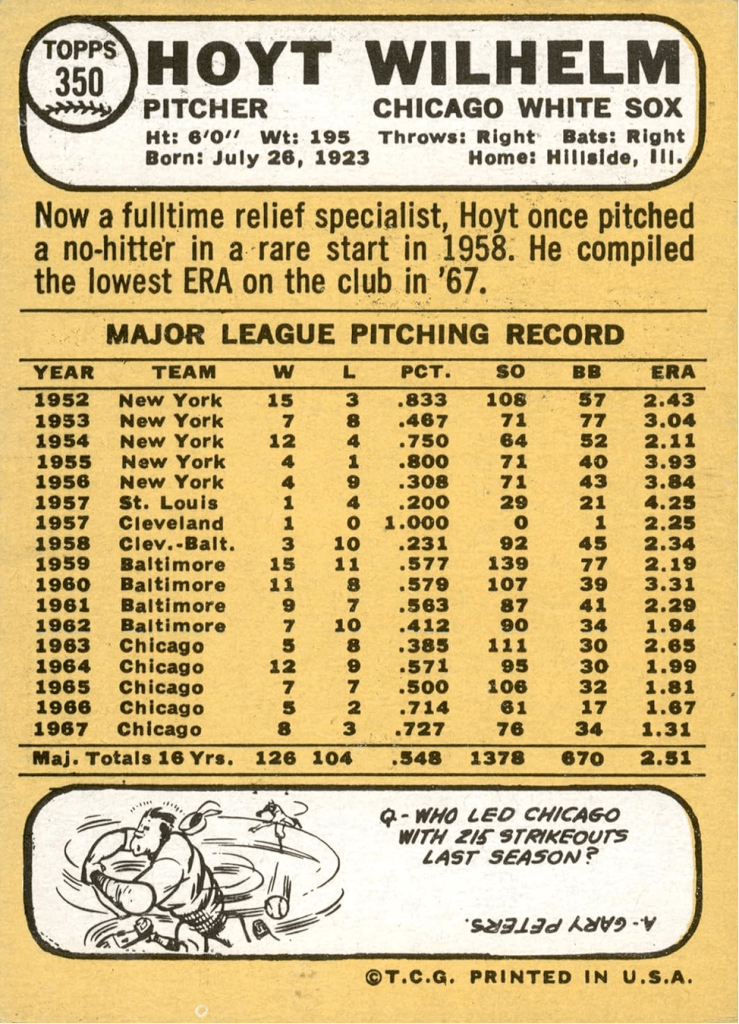

The backs of the ’68 cards were basically a rehash of the 1967s, but much less inspiring. Instead of green, Topps used a yellow-on-white cardboard color scheme in a vertical format. The only other change being the cartoon was moved to the bottom, reduced to one panel and made into a question-and-answer format.
The question was at the top of the cartoon panel, with the answer being upside down at the bottom. Most questions pertained to the previous season. The cartoons were not nearly as creative as those appearing on the ’67s.
Airbrush mania struck the ’68 set, adding to its ugly look. Fifty of the 598 cards in the set contain airbrushed caps. Most of these airbrush jobs were on Oakland A’s and Houston Astros players’ cards. The A’s moved from Kansas City during the winter of 1967-68 and Topps figured they needed to cover up the old “KC” logos. Topps had a problem with obtaining the rights to use the Astros’ logo in 1968 and therefore covered it up too.
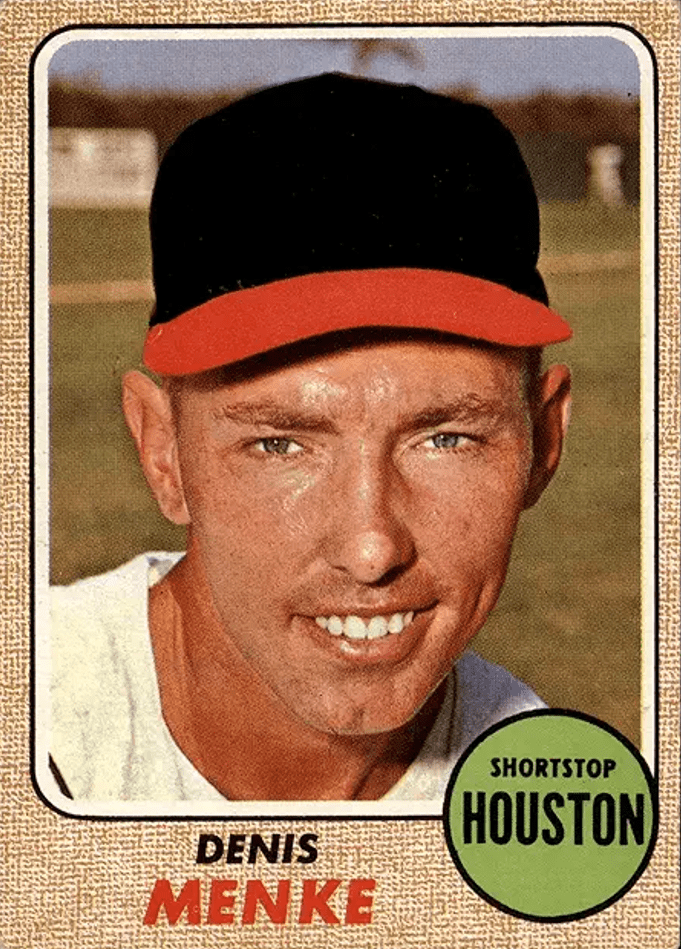
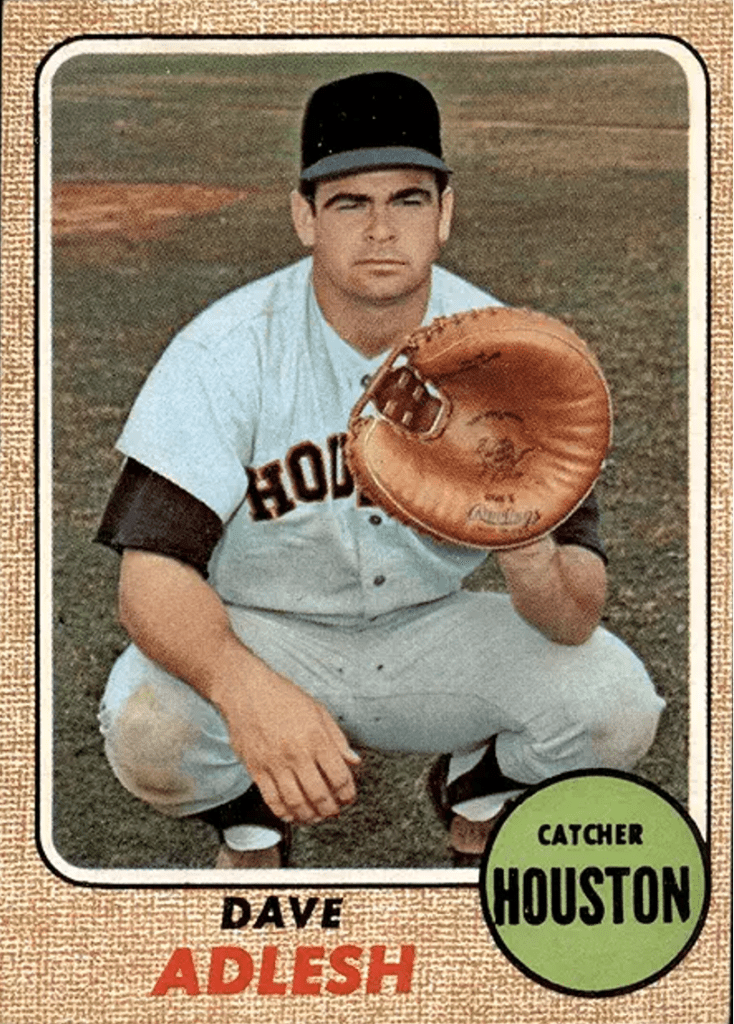
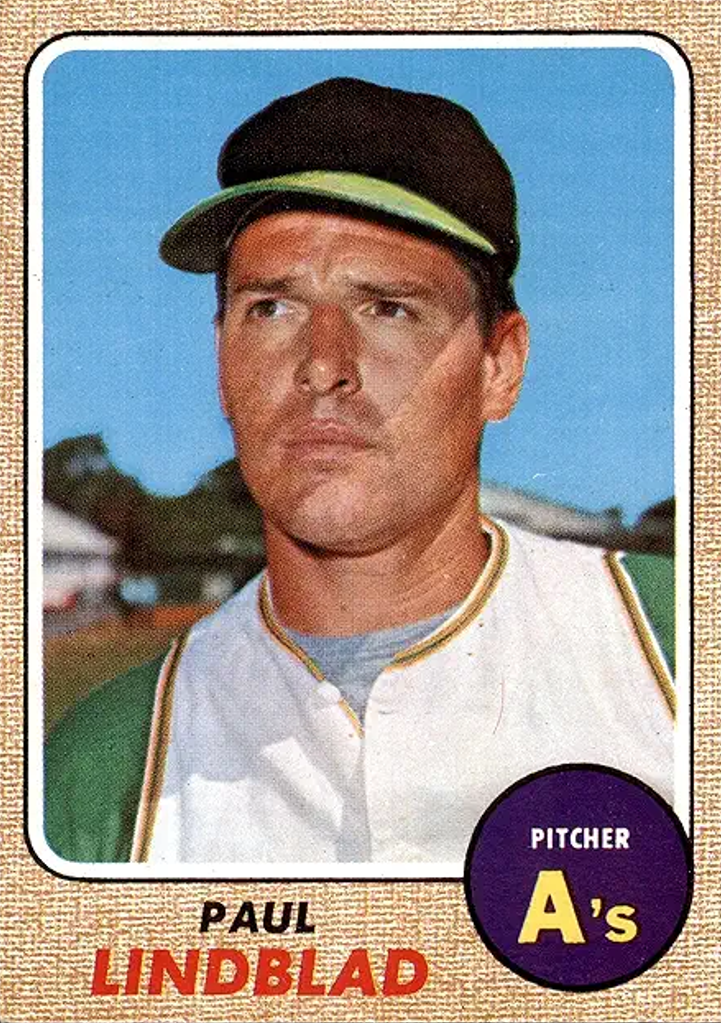
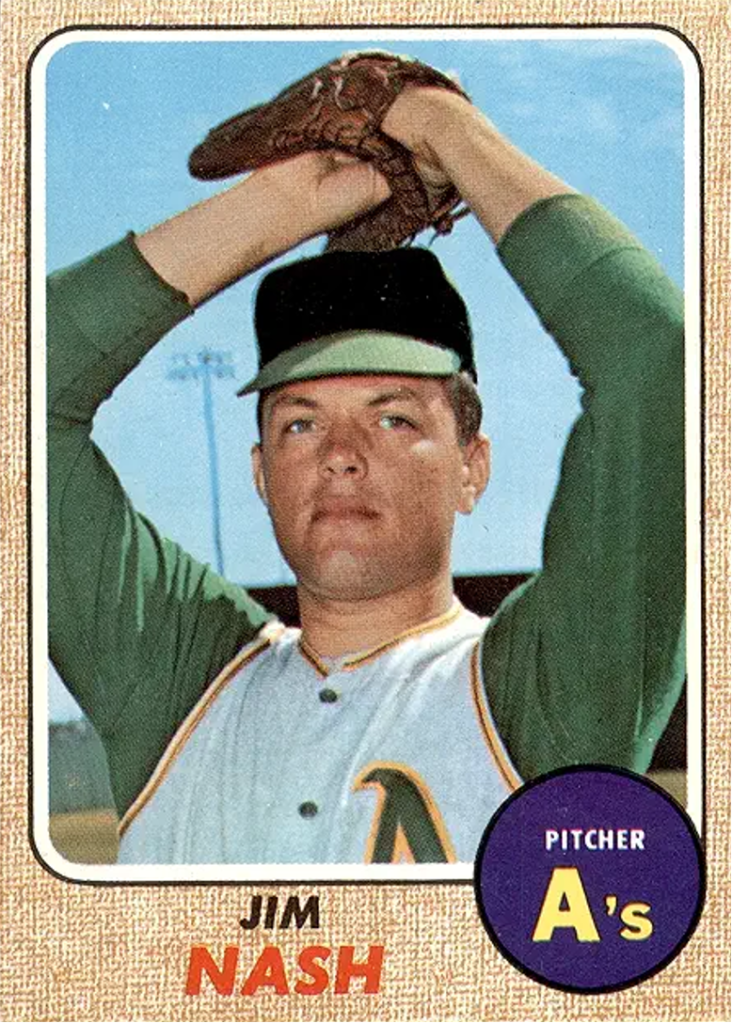
Airbrushing is somewhat understandable in situations like those involving Oakland and Houston. Yet, Topps often didn’t even try to blend cap colors when airbrushing. Many players’ caps contain amateurish solid black colored-in fronts that couldn’t even fool a five-year old into thinking they were real. Topps used airbrushing right into the 1980s. And even though there are individual cases where the job looks horrible, taken as a whole the 1968 set is perhaps the worst for this technique.
(Speaking of airbrushing, if one studies the popular 1989 Upper Deck rookie card of Ken Griffey, Jr., it appears his cap was airbrushed … perhaps to cover up a minor league logo. Check it out.)
No new card concepts were introduced in the 1968 Topps set. The first dozen cards (#1-12) feature League Leaders from the previous season. The World Series subset (#151-158) is also included.
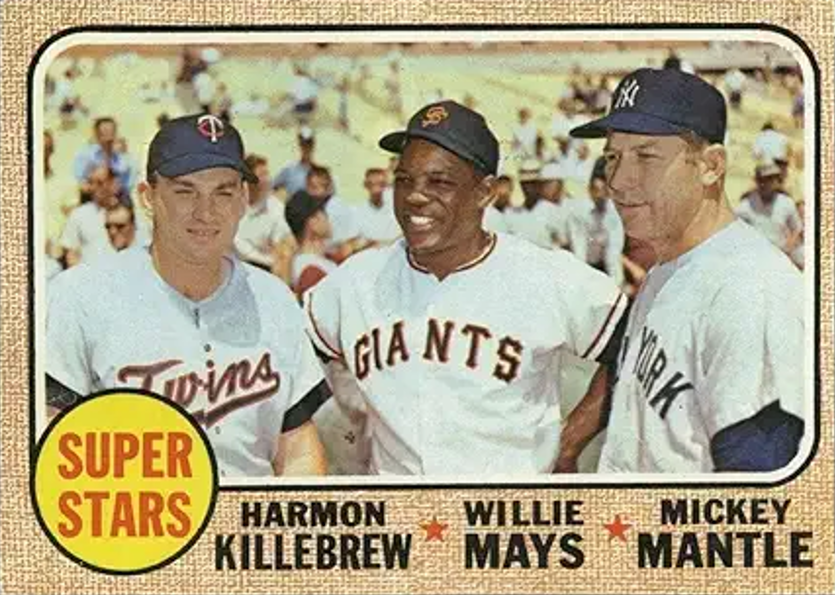
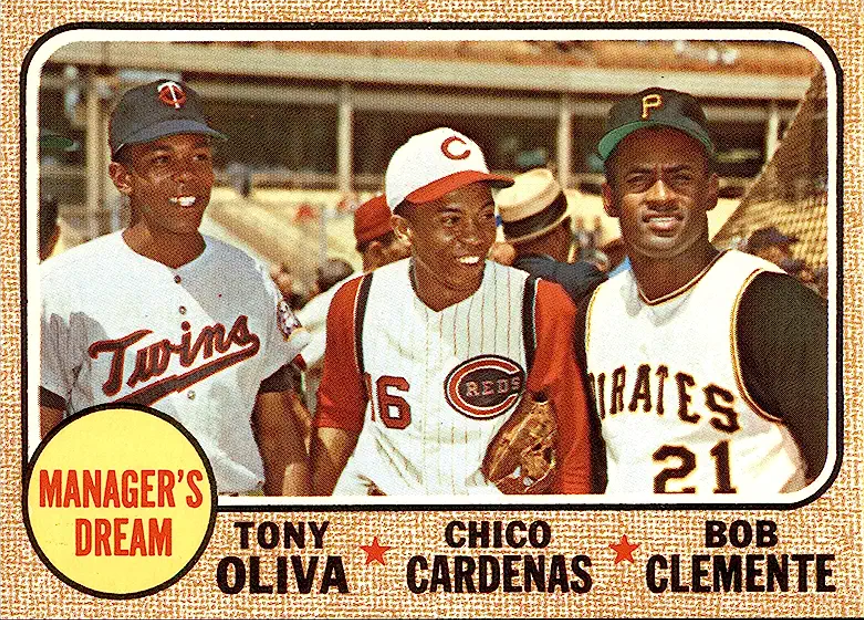
Only three multi-player star cards appear: “Manager’s Dream” (#480) with Tony Oliva, Chico Cardenas and Bob Clemente; “Super Stars” (#490) with Harmon Killebrew, Mickey Mantle and Willie Mays; and “Bird Belters” (#530) with the Orioles’ Frank and Brooks Robinson. “Super Stars” is a very popular card and now goes for about $90.
The last regular Topps cards of sluggers Eddie Mathews (#58), Rocky Colavito (#99) and Roger Maris (#330) appear in the ’68 set. Between them, the three power-hitters blasted 1,161 home runs during their careers. Unfortunately, each of the trio ended his career with a whimper, not a bang. They only hit a combined 16 home runs in 1968.
Two big rookie cards and two important second-year cards help to boost the popularity of the otherwise bland ’68 set. The Nolan Ryan/Jerry Koosman rookie card (#177) is now $1,400, while Johnny Bench’s first card (#247) is $355. Second-year cards of Tom Seaver (#45) and Rod Carew (#80) go for $210 and $150 respectively. It is the first card alone for both Seaver and Carew.
Finally, there is one more curiosity about the 1968 Topps set. Team cards were included as in past years. However, for some reason only 13 of the 20 major league teams are represented in the set. Missing teams are: the Giants, Cubs, Red Sox, Yankees, Indians, Senators and Astros. Houston was the only team not to have a card in the 1967 set. This, again, probably had something to do with licensing difficulties. As for the other half-dozen teams missing from the ’68 set … your guess is as good as mine.

• • • • • •
See related article on BaseballCardFun.com entitled:
“BASEBALL HOBBY NEWS — Ryan Rookie Card Spurs Interest in Otherwise Dull 1968 Set”
Click Link Here
• Originally Published in May 1992 “Baseball Hobby News” •
THIS ARTICLE FROM “BASEBALL HOBBY NEWS” MAGAZINE IS REPRINTED WITH THE PERMISSION OF BOTH THE EDITOR/PUBLISHER AND THE AUTHOR. IT HAS BEEN RETYPED, BUT NO CONTENT HAS BEEN CHANGED (EXCEPT FOR VERY MINOR ADJUSTMENTS, CORRECTIONS TO TYPOGRAPHICAL ERRORS AND CHANGES TO GRAPHICS). COMMENTS OR INFORMATION IN THE ARTICLE MAY BE OUT-OF-DATE.
To keep up-to-date on additions to BaseballCardFun.com, subscribe below*
* Your email address will never be shared and is only used to announce new articles
 BaseballCardFun.com