
The history of Topps baseball card sets
BY MARK A. LARSON
A trip down memory lane.
That’s probably the No. 1 reason many baseball card collectors get back in the hobby years after they gave up collecting.
Baseball cards reek with nostalgia. For most collectors, one look at the baseball cards of their youth and their minds are a million miles away … focused on the sweet summer days of childhood. Days when baseball and baseball cards were the primary focus of their lives.
The 1967 Topps set has always been my personal trip down memory lane. For it was in April ’67 that I obtained my first baseball cards. I was eight years old, nearing the end of second grade.
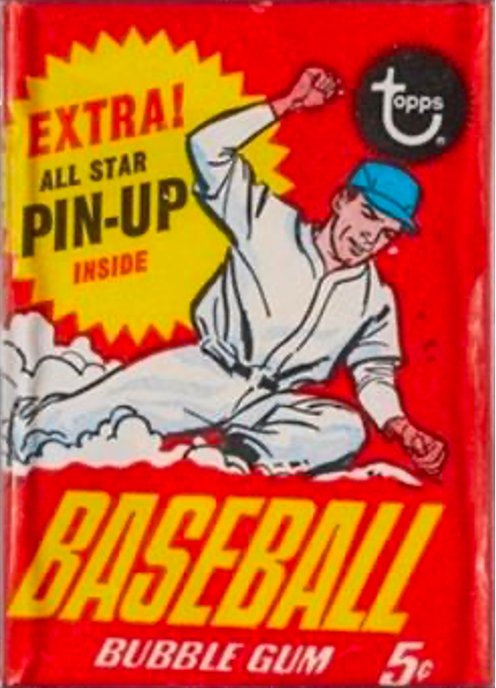
One day, a classmate gave me a couple baseball cards. I had seen baseball cards before, but never owned any. I didn’t even know where you got them. Soon I found out you could buy them at the store … five for a nickel, plus you’d get a piece of gum and a fold-out poster. I was immediately hooked. I found two local stores that carried them – one a pharmacy, the other a small grocery.
Throughout the spring and summer of 1967, while people 10-20 years my senior were celebrating the “Summer of Love” by listening to the Beatles’ “Sgt. Pepper’s Lonely Hearts Club Band” album, smoking weird things and embarking on some strange trips, I was in my own never-never land. Mine consisted of learning about baseball by buying cards and watching one of the most exciting pennant races ever.
To this day, when I see certain cards from the 1967 Topps set, my mind races back 25 years. With precise clarity I can recall the most minor nuances about my baseball card collection:
• WHITEY FORD (#5): I remember doing what now seems like a travesty to Ford’s card. I wrote “retired” on the back when the southpaw hung his spikes up for the last time early in the ’67 season.
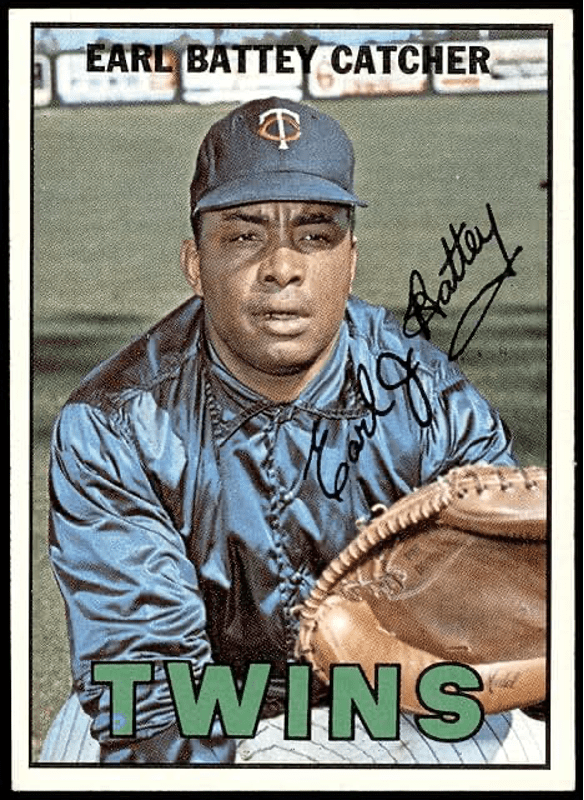
• EARL BATTEY (#15): I had been collecting for about a month, but had not yet gotten a player from my favorite team, the Twins. Then suddenly one spring evening, I was walking home from the “Country Boy” store in New Brighton, Minnesota opening my packs when there he was in all his glory. My first Twin. It was Earl Battey, squatting down in a catching pose wearing a blue windbreaker. Talk about excitement. I was in heaven. Things couldn’t get any better than this, I thought.
That moment is etched on my mind forever. A quarter of a century later, I can take you to the very spot where I was standing when this momentous event in a young boy’s life occurred.
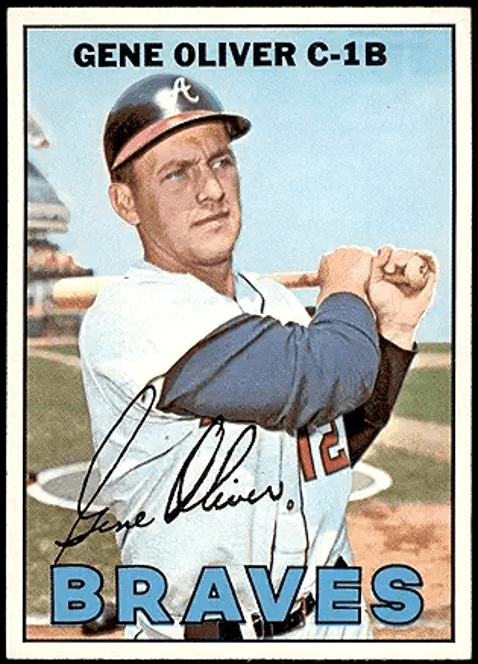
• GENE OLIVER (#18): I had more doubles of Gene Oliver than any other player in the ’67 set. (I was getting a quick, first-hand lesson on Topps’ distribution system.)
• ORLANDO CEPEDA (#20): One of the most agonizing decisions of my youth occurred about a year after I obtained the ’67 Cepeda card. One of my collecting friends desperately wanted this card. (Cepeda was MVP in the National League in 1967, having hit .325, with 25 home runs and 111 RBIs, while leading the Cardinals to the World Championship.)
My buddy’s older brother had given him some Topps cards from the 1950s, including a 1958 All-Star card of Ted Williams. After intense negotiations, I finally agreed to trade Cepeda straight up for the Williams card. It was painful because I never traded cards I didn’t have duplicates of … until this deal.
Turns out, I later got the Cepeda back in another swap for next-to-nothing. Plus, both cards stayed in my collection for years to come. The 1967 Cepeda now goes for about $7, while the Williams is 10 times that amount. The agony has turned to ecstasy.
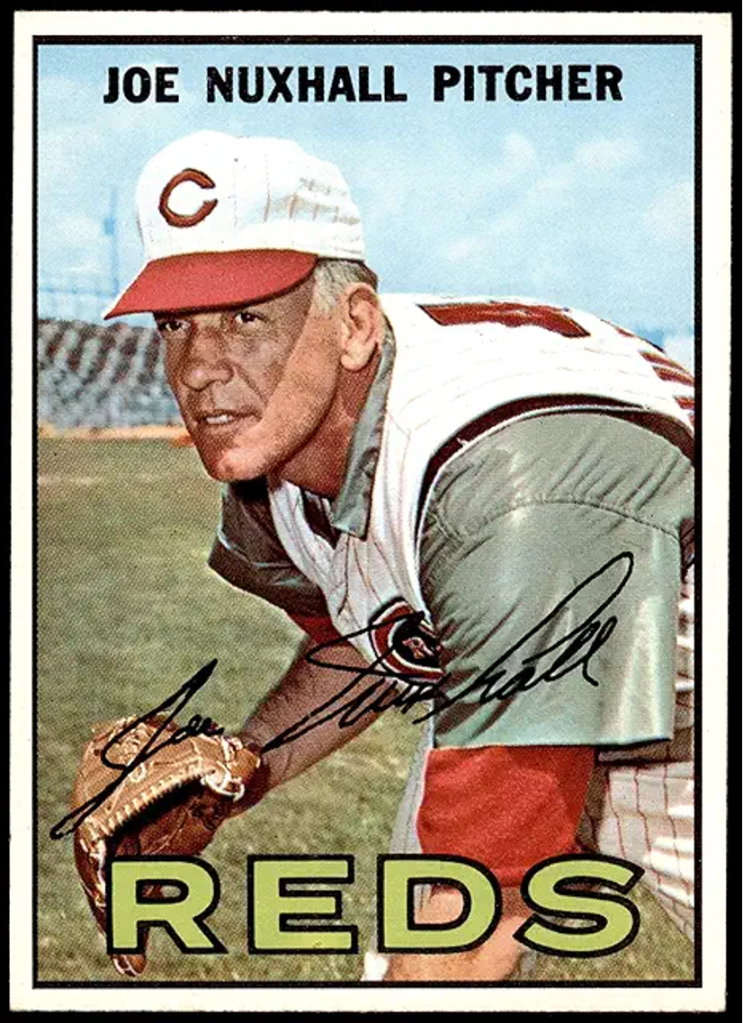
• JOE NUXHALL (#44): When I obtained Nuxhall’s card, I couldn’t figure out why he played in one game in 1944 at age 15 and then didn’t appear in another big league contest until 1952. Later, I learned Nuxhall was the youngest player ever, having been signed during World War II when many major leaguers were in the military.
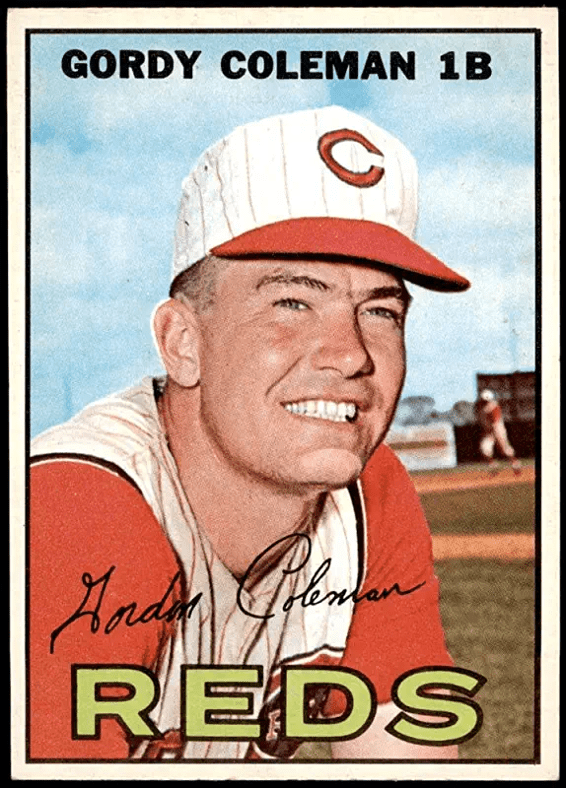
• GORDY COLEMAN (#61): This card is currently “worth” only about a buck. Yet, to me, it’s worth a million. After all, this was my very first card. Smiling, Cincinnati first-baseman Gordy Coleman’s ’67 Topps card is a priceless memory.
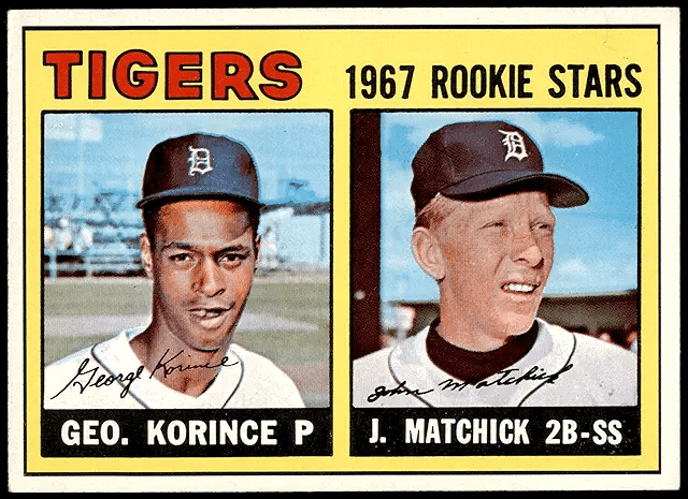
• TIGERS ROOKIES (#72): Along with Gordy Coleman, this was one of my first ‘67s. Funny thing is, Topps made a monumental mistake by incorrectly showing a photo of James Murray Brown, instead of George Korince – one of the players identified on the card. Later, on the Tigers Rookies card (#526) in the 6th series, Topps corrected the mistake and admitted its error on the card’s back (referring back to card #72).
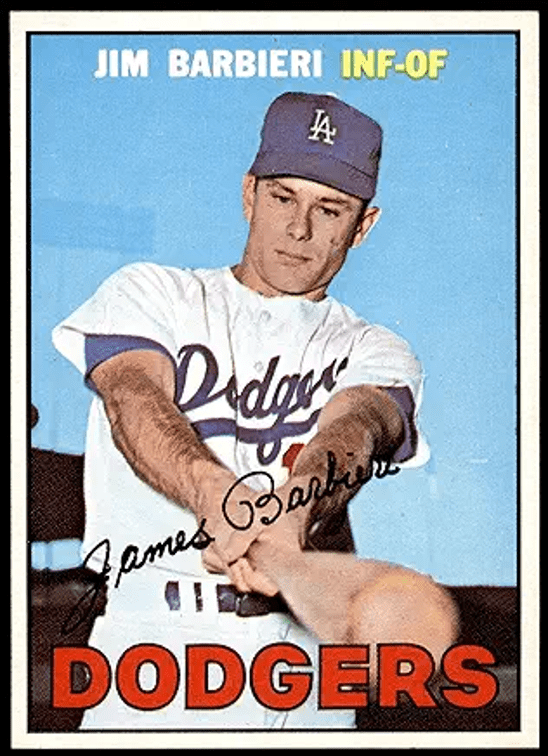

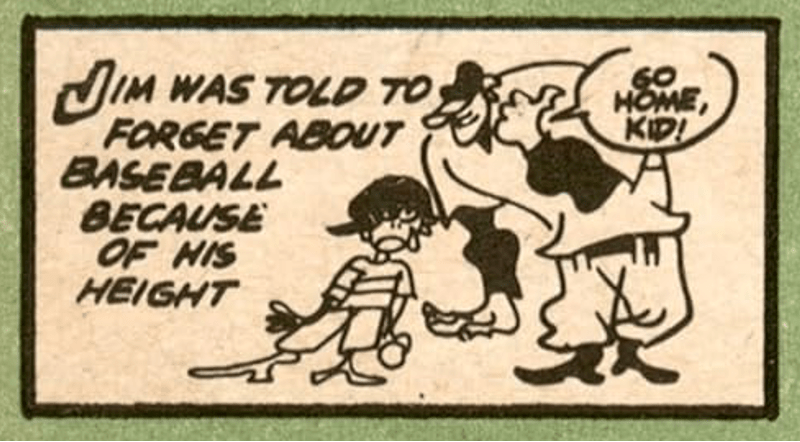
• JIM BARBIERI (#76): This card remains in the crevices of my mind because of the cartoon on the back. The 1967 set was perhaps Topps’ last truly great year for cartoons. One of the two cartoon panels notes: “Jim was told to forget about baseball because of his height.” It shows a big lout snidely saying to a little leaguer, “Go home, kid!” (By the way, Barbieri was 5’7”.)
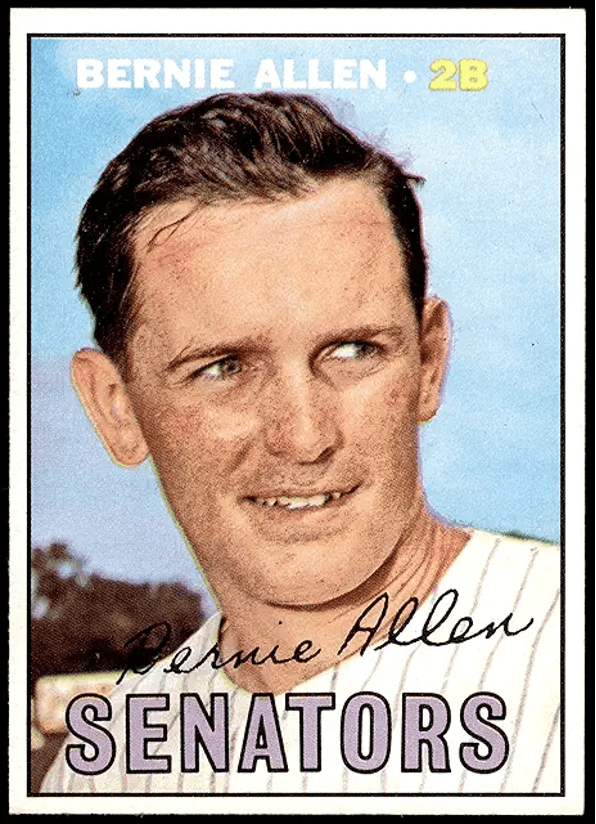
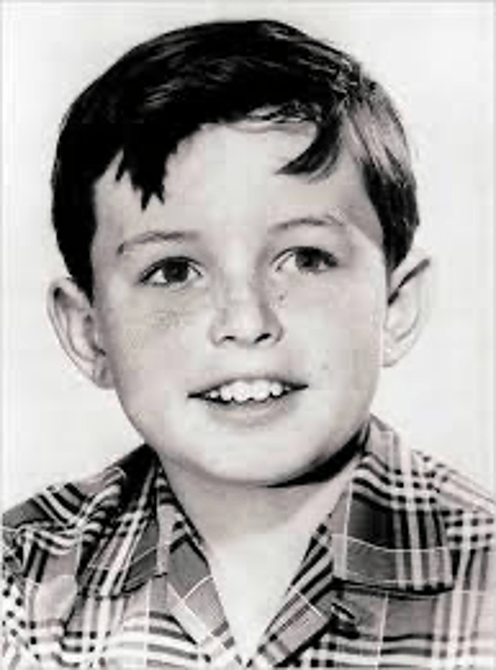
• BERNIE ALLEN (#118): This card shows the Senators’ second-baseman doing his “Beaver Cleaver” impersonation. Gee, Wally, Allen looks just like Jerry Mathers.
• TOM EGAN (#147): “Why does Egan, an Angels’ backstop, have a black splotch on his cap,” I wondered back in ’67? This was my initiation into Topps airbrushing techniques. Fortunately, airbrushing is rarely used in the 1967 set. But wait until 1968 and 1969.
• ED CHARLES (#182): The 1967 set is known for its clean, crisp photos, vivid colors and simple, but beautiful card design. The Ed Charles card is a great photo of that era’s colorful Kansas City A’s uniform – considered quite outlandish for its time.
• METS MAULERS (#186): This was just one of 13 different multi-player star cards included in the set. Each of these cards featured two stars of a particular team … usually the two best hitters. The interesting thing about “Mets Maulers” is that New York had such a rotten team in the mid-1960s that its “Maulers” were Ed Kranepool and Ron Swoboda.
Kranepool had a grand total of 16 homers and 57 RBIs the previous year, both career highs. Swoboda, meanwhile, hit a robust .222, with eight homers and 50 RBIs. Fact is, the Mets themselves were mauled 95 times in 1966. And they were even worse in 1967.
• JAY JOHNSTONE (#213): Johnstone’s card is unique in that it shows the outfielder in perhaps Topps’ last shot of a player in a Los Angeles Angels uniform. This had to be an old musty photo, since the Los Angeles Angels became the California Angels two years earlier when they moved to Anaheim.

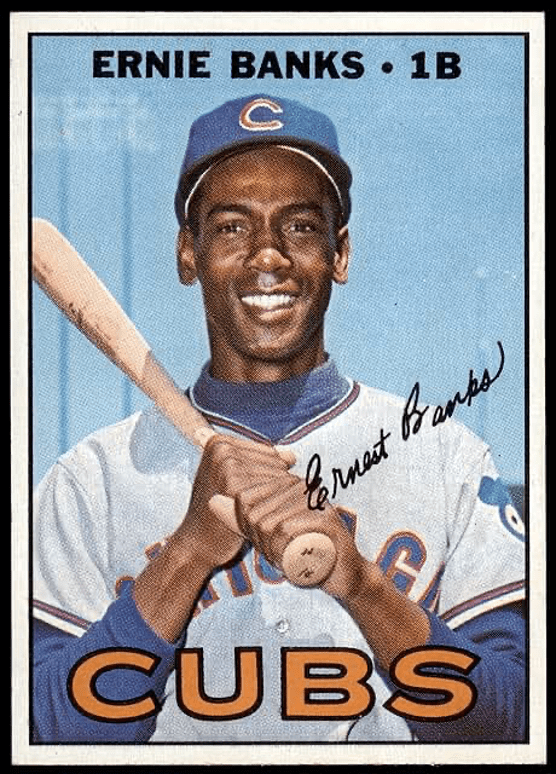
• ERNIE BANKS (#215): One of the best-looking cards of all-time. It features “Mr. Cub” in a straight-on photo with a bat on his shoulder. A great example of the excellent photography used throughout the 1967 set.
• LEAGUE LEADERS (#236): This N.L. Pitching Leaders card features four future Hall-of-Famers: Sandy Koufax, Juan Marichal, Bob Gibson and Gaylord Perry. This card, along with two others in the League Leaders subset, are the only ones to show Koufax on a 1967 card. The Dodgers’ southpaw retired after the 1966 campaign and Topps did not issue a regular end-of-career card of him in ’67, much to the disappointment of this young collector.
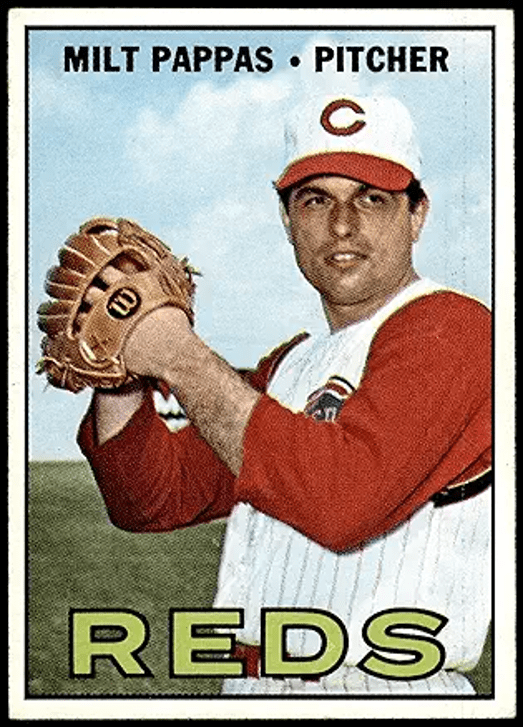
• MILT PAPPAS (#254): Each regular card in the 1967 set included a facsimile autograph of the player on the front. Pappas’ card does not. Who knows why?
• TWIN TERRORS (#334): Another multi-player card, this one includes Minnesota sluggers Bob Allison and Harmon Killebrew. For some reason, the “Twin Terrors” title on the front is done in purple, while the rest of the Twins’ players’ cards had the team name in green. (All other multi-player card titles match the rest of their team name colors.)
• LEON WAGNER (#360): As a kid, I was always impressed by the stats on the back of “Daddy Wags” card showing he had 51 home runs and 166 RBIs at Danville in 1956.
• HARMON KILLEBREW (#460): First, we have Twins team names done in green. Then we have “Twin Terrors” in purple. Now, we have Killebrew’s card showing “Twins” in yellow. Was the guy at Topps who designed Minnesota’s cards color-blind?
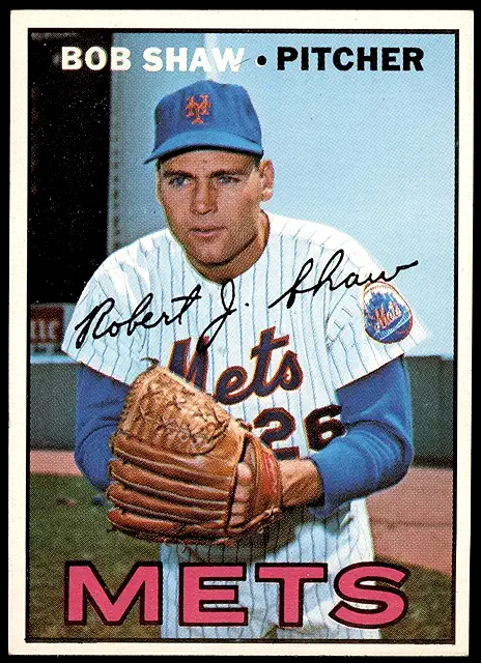
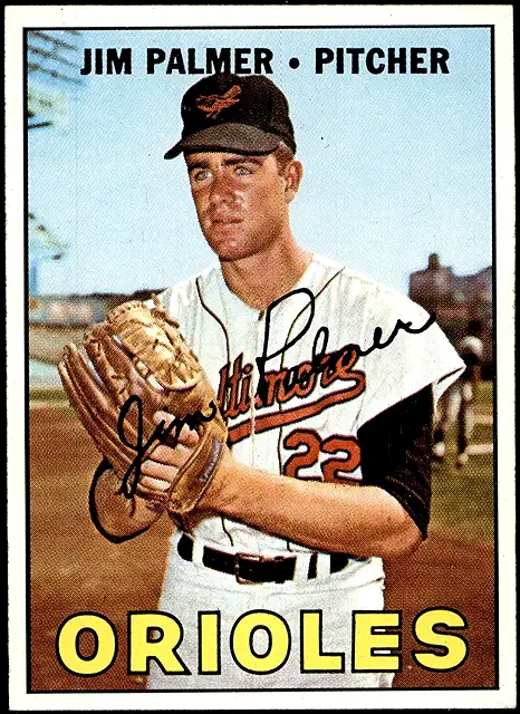
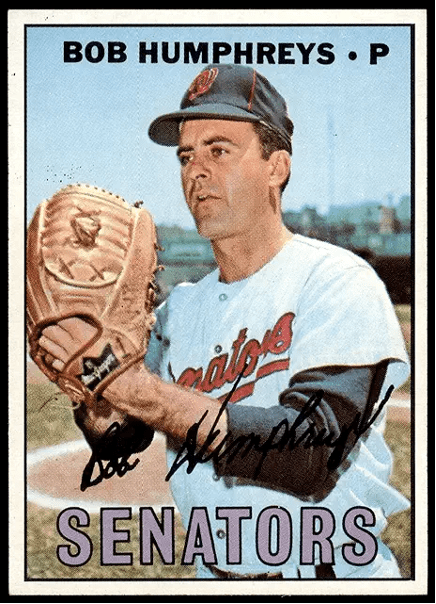
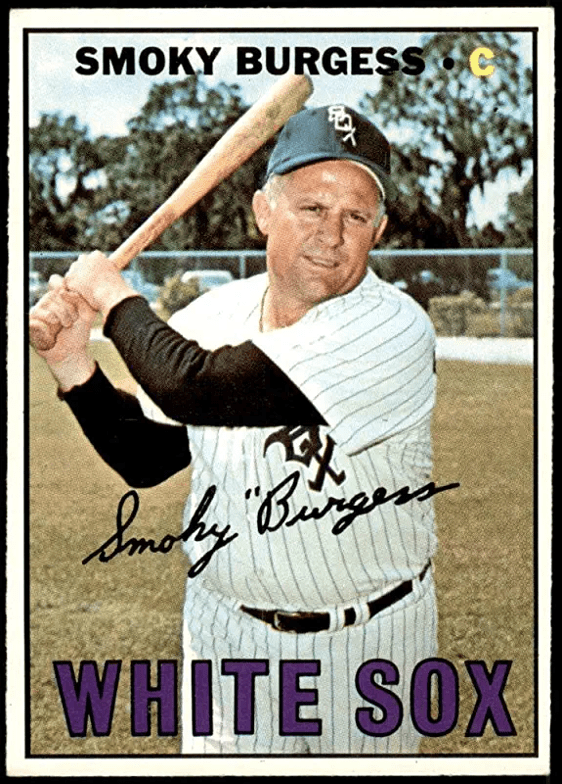

• 6TH SERIES: Like most areas of the country, by the time the 6th and 7th series came around retailers in my hometown had cut back on baseball cards. I remember having only five cards from the 6th series: Bob Shaw (#470), Jim Palmer (#475), Bob Humphreys (#478) Smoky Burgess (#506) and Jim King (#509). Obviously, I only bought one pack.
Since retailers reduced the number of cards ordered toward the end of the summer, Topps, in turn, curtailed production. Thus, the 6th series is much harder to find than the previous five.
• 7TH SERIES: The last series was at least twice as hard to find as the 6th.
I didn’t purchase any 7th series cards in 1967. That was too bad since Topps’ 1967 7th series is considered one of the three toughest to complete during the decade of the 1960s. Cards were not printed in equal numbers. Therefore, “single-prints,” “double-prints,” and perhaps even “triple-prints” were created.
Cards of Chuck Estrada (#537) and Dave Ricketts (#589) are relatively easy to find compared to many others. This is because Estrada and Ricketts are among those that were double-printed – produced in at least twice the quantity of the average card in the 7th series. (Topps often double-printed cards to fill out an odd-numbered sheet.) The double-printing and single-printing doesn’t really become noticeable until it happens with a series that is already extremely limited in quantity … making single-printed cards very tough to find.
At 609 cards, the 1967 set was the largest to date for Topps. It was the first set since 1953 to feature a vertical back, and the first since 1954 to use a green-on-white back design.
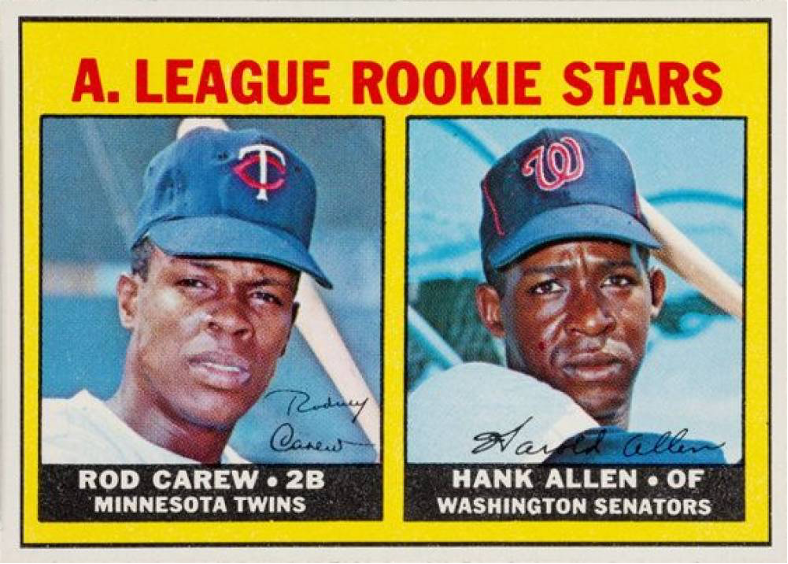
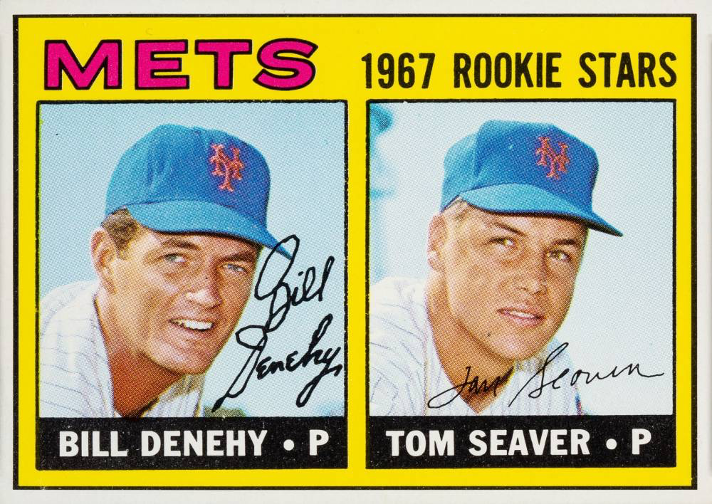
The ’67 set is one of the most popular in the past three decades. Many collectors consider it Topps’ finest effort in terms of design, style and color. The combination of popular design, challenging 7th series cards and the inclusion of both Rod Carew’s and Tom Seaver’s rookie cards in the last series make the ’67 set the most expensive in the past 30 years at $5,000.
For this collector, the 1967 set will always be a cut above the rest, if for no other reason than its ability to whisk me back to a time when buying cards, chewing bubble gum, trading with friends and following my favorite baseball team was paramount compared to all of life’s other activities.
• • • • • •
See related article on BaseballCardFun.com entitled:
“End of the Line — 1967”
Click Link Here
• Originally Published in Apr. 1992 “Baseball Hobby News” •
THIS ARTICLE FROM “BASEBALL HOBBY NEWS” MAGAZINE IS REPRINTED WITH THE PERMISSION OF BOTH THE EDITOR/PUBLISHER AND THE AUTHOR. IT HAS BEEN RETYPED, BUT NO CONTENT HAS BEEN CHANGED (EXCEPT FOR VERY MINOR ADJUSTMENTS, CORRECTIONS TO TYPOGRAPHICAL ERRORS AND CHANGES TO GRAPHICS). COMMENTS OR INFORMATION IN THE ARTICLE MAY BE OUT-OF-DATE.
To keep up-to-date on additions to BaseballCardFun.com, subscribe below*
* Your email address will never be shared and is only used to announce new articles
 BaseballCardFun.com