
The history of Topps baseball card sets
BY MARK A. LARSON
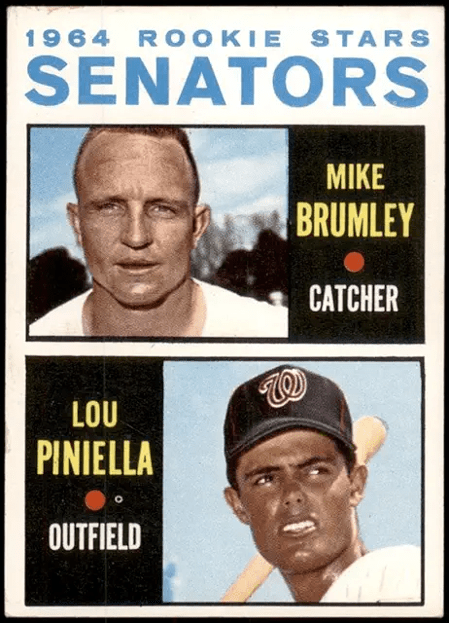
Perhaps nothing distinguishes the 1964 Topps baseball card set better than the big block letters on the top of the front of the cards spelling out the team’s nickname.
This style of lettering was used for the first time in 1964 and made sorting cards by team very easy. Large team names at the top of the card also appeared on later Topps sets in 1971, 1972, 1975, 1986 and 1988. But none were so bold as the ’64s.
In 1964 there was a special rub to the back of the cards … literally. Instead of the cartoons typically found on Topps card backs, in 1964 there was a spot at the bottom of most cards with a question and answer format. The question was printed on the card, but in order to reveal the answer Topps instructed collectors to “Rub nickel or dime over blank box for magic answer.” After rubbing for a few seconds, the answer would mysteriously appear.
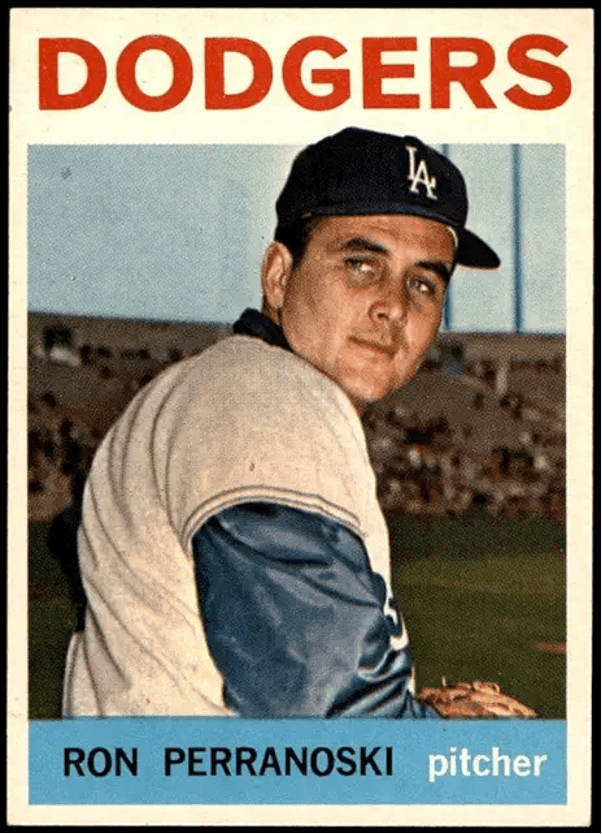
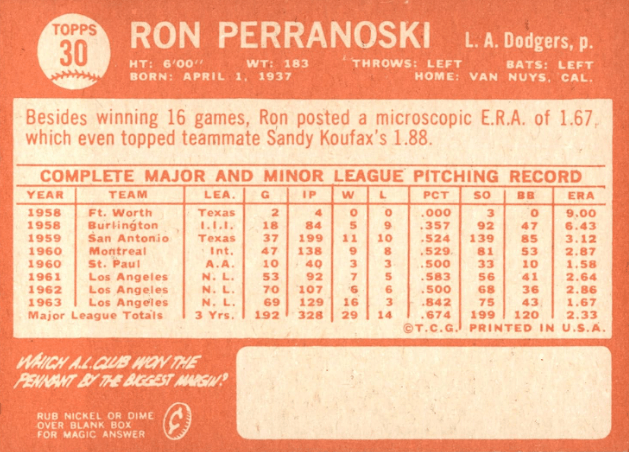
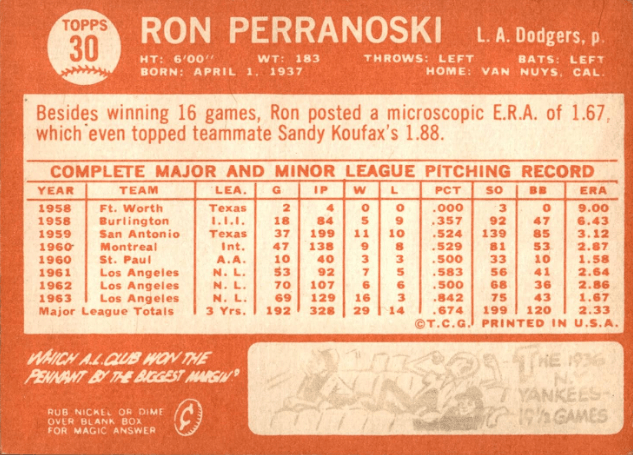

A typical question would be like the one found on Dodgers pitcher Ron Perranoski’s card (#30): What A.L. club won the pennant by the biggest margin? Answer: The 1936 NY Yankees – 19 ½ games.
Card backs consisted of white cardboard stock with orange background and lettering. This was the first time Topps used the color orange on card backs. Unfortunately, the orange lettering made it difficult to read. The previous year, Topps used white cardboard with a yellow background and black lettering, which was much easier on the eyes.
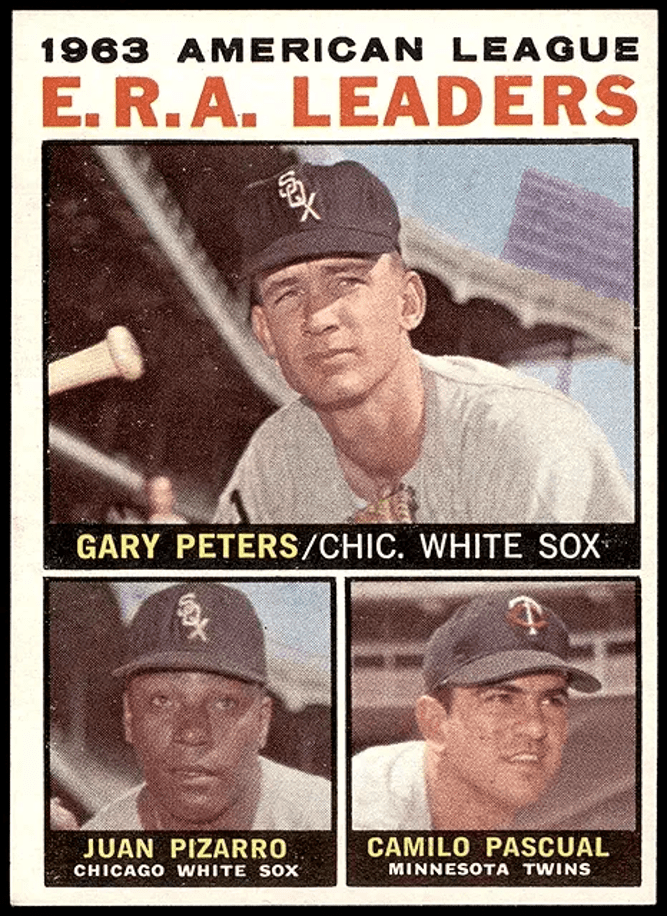
Like the ’63s before it, the 1964 set leads off with League Leader cards (#1-12). However, for the first time Topps included RBI leaders as a major statistical category. Prior to 1964, only batting average, home runs, wins, strikeouts and ERA leaders in each league were given cards.
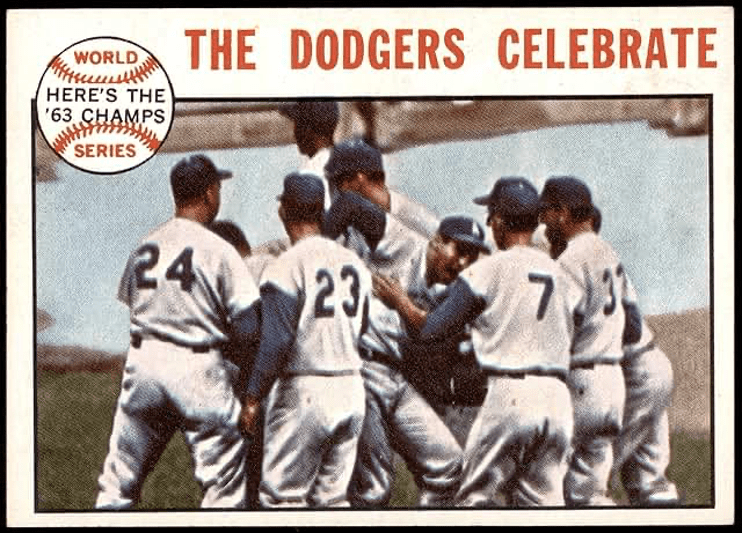
World Series cards (#136-140) were included in the set as well. Yet, for some reason Topps used touched-up photos that look almost like paintings for these five cards.
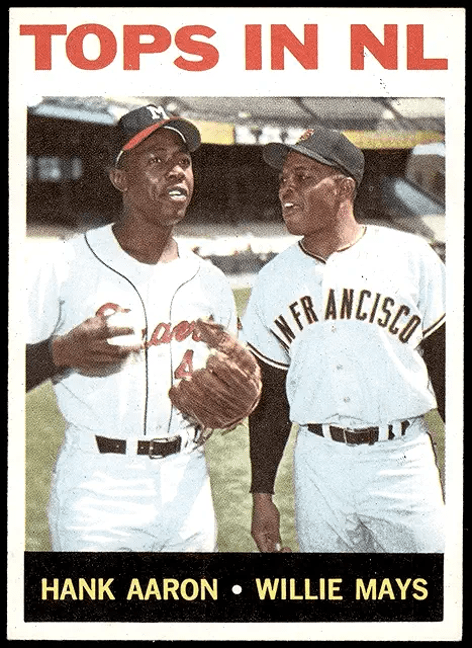
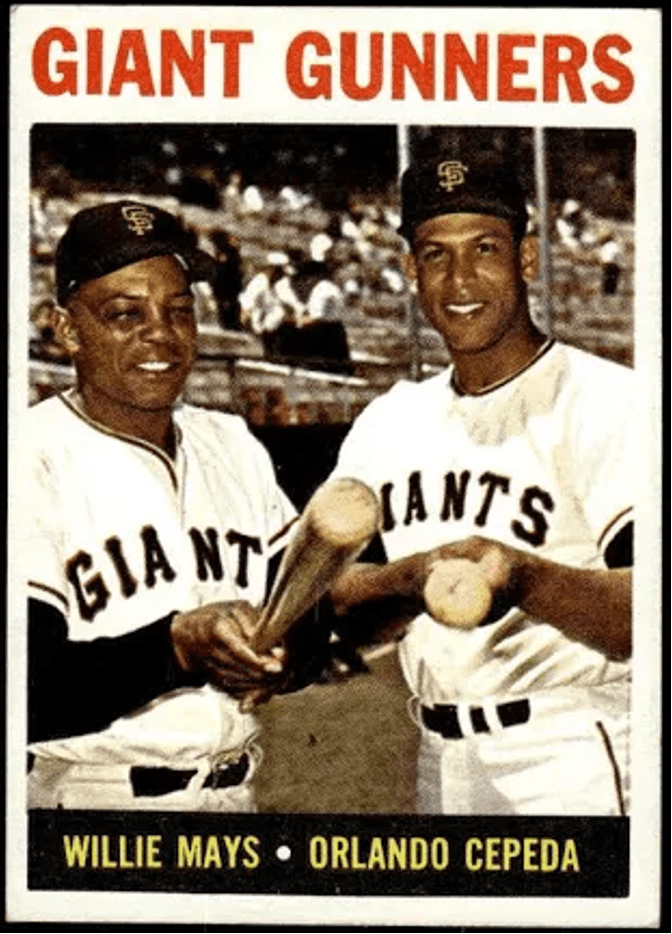
Ten specialty cards featured more than one player. These multi-player star cards included “Tops In NL” (#423) with Hank Aaron and Willie Mays, which is the best. In addition to “Tops In NL,” Mays also appears on “Giant Gunners” (#306) with Orlando Cepeda. He’s the only player to appear on two such cards in 1964. Many of the other cards feature lesser-known players and some were just plain stupid.
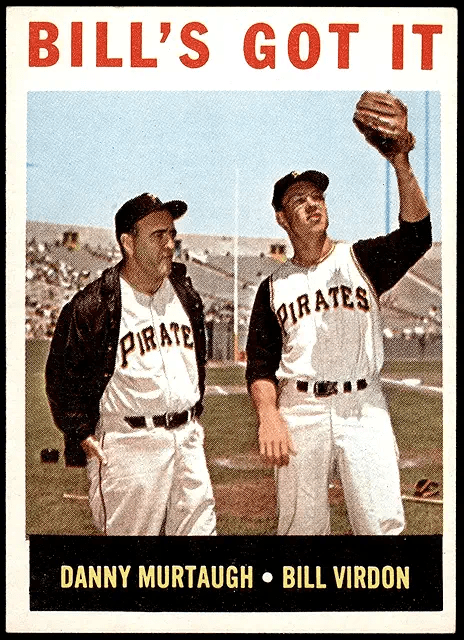
For instance, “Angel Backstops” (#61) had a photo of Bob Rodgers (now the team’s manager) and Ed Sadowski – not exactly superstars. Card #268 is called “Bill’s Got It” and shows Pirates manager Danny Murtaugh standing next to Bill Virdon who supposedly is trying to catch a pop-up. “Hitting Area” (#162) has Dick Sisler explaining to Vada Pinson that the fat part of the bat is the best area to hit the ball with. (Somehow I think Pinson may have already known this since he hit .313 the year before and led the league with 204 hits.)
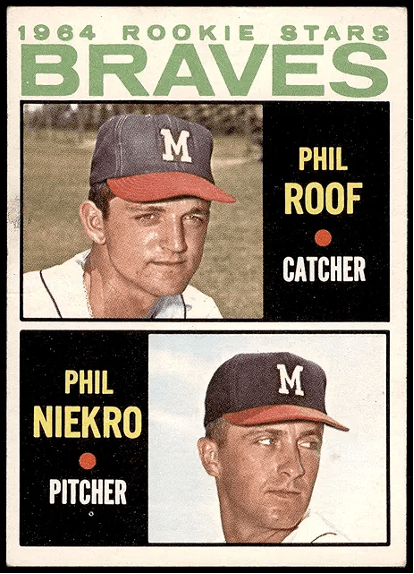
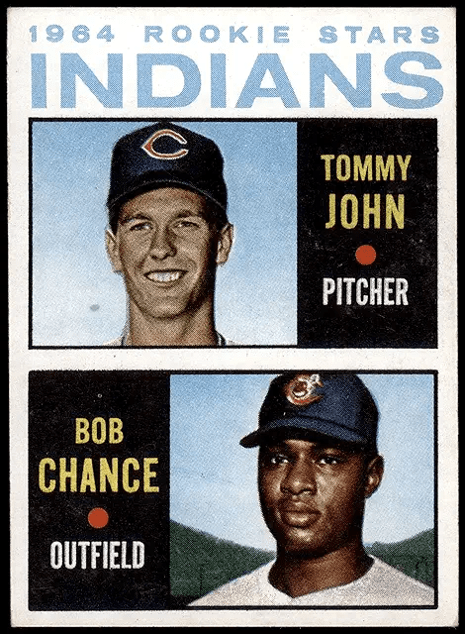
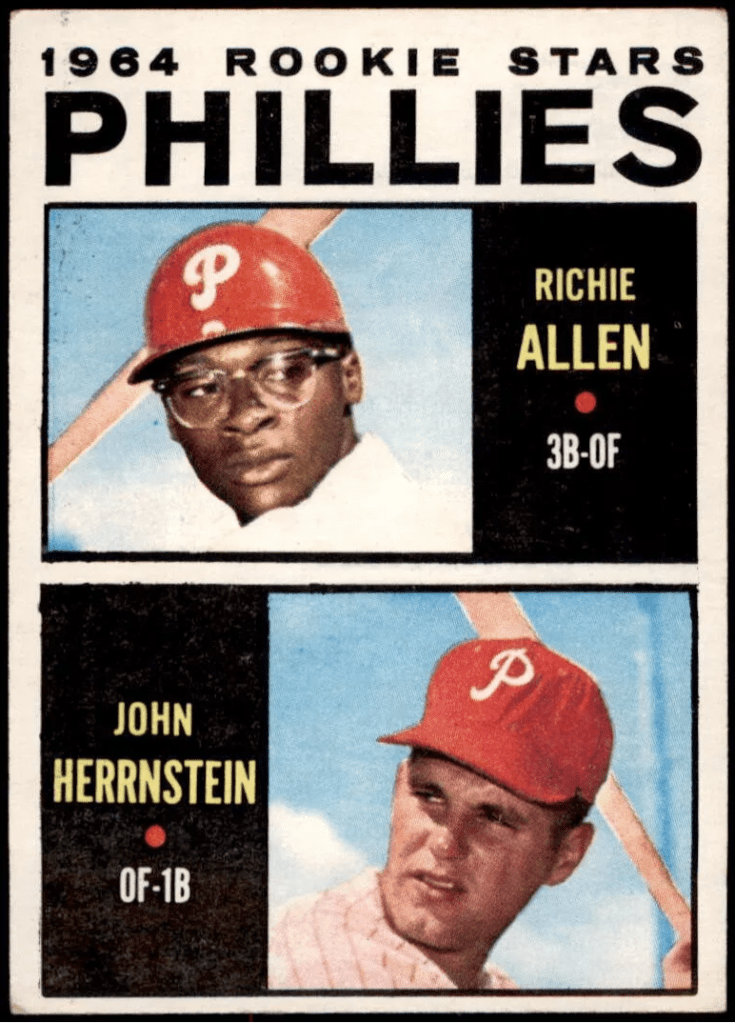
For the first time, Topps issued special rookie cards that had just two players on them. In the 1962 and 1963 sets, multi-player rookie cards included four or five players.
In 1964, Topps issued 56 two-player rookie cards. Among the more valuable are: Phil Niekro (#541) at $160; Tommy John (#146) $55; Richie Allen (#243) $14; Tony Conigliaro (#287) $24; and Lou Piniella (#167) $21.
This was the first of three appearances for Piniella on a two-player rookie card. In 1964 he is shown with the Senators. He pops up again in the 1968 set with the Indians, and one more time in 1969 with the Pilots. Several players appeared on more than one multi-player rookie card, but Piniella’s three is rare.
Ken Hubbs’ card (#550) is interesting in that he died in a plane crash on Feb. 15, 1964, but was still included in the set. In an unprecedented move, Topps issued his card with a black band across the top and bottom of the front of the card. Instead of the Cubs’ team name at the top it says “In Memoriam.” The back mentions his death.
The cards of Don Demeter (#58) and Gus Triandos (#83) are also interesting. Demeter is shown in a Phillies uniform and cap, but the team name at the top of his card says Tigers. Conversely, Triandos is wearing a Tigers uniform and cap with the Phillies team name at the top of his card. If you guessed that the two were involved in a trade for each other, you’re right.
Philadelphia traded Demeter along with Jack Hamilton to the Tigers for Triandos and Jim Bunning on Dec. 4, 1963. What makes those two cards so unusual is that Topps’ normal practice in the 1960s was to airbrush out the team logos or show the player without a cap, if a trade was made shortly before press-time.
Three Baltimore players also had unique cards. The cards of Dave McNally (#161), Hank Bauer (#178) and Joe Gaines (#364) show them wearing the short-lived Baltimore Orioles “B” cap. Traditionally, the Orioles have had a bird logo on their caps.
Finally, Duke Snider appears on his last regular Topps card (#155) wearing a Mets uniform. Snider returned to New York to play for the Mets in 1963. On April 14, 1964 he was sold to San Francisco where he played briefly and then retired.
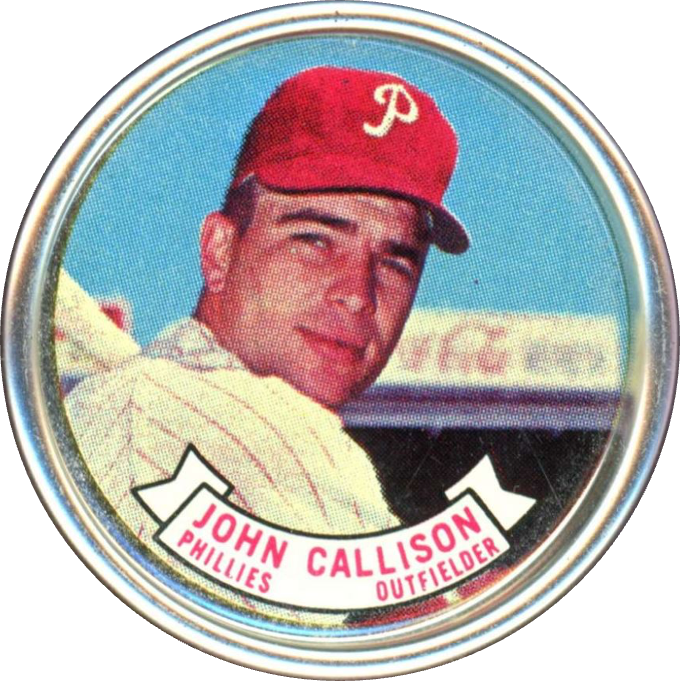
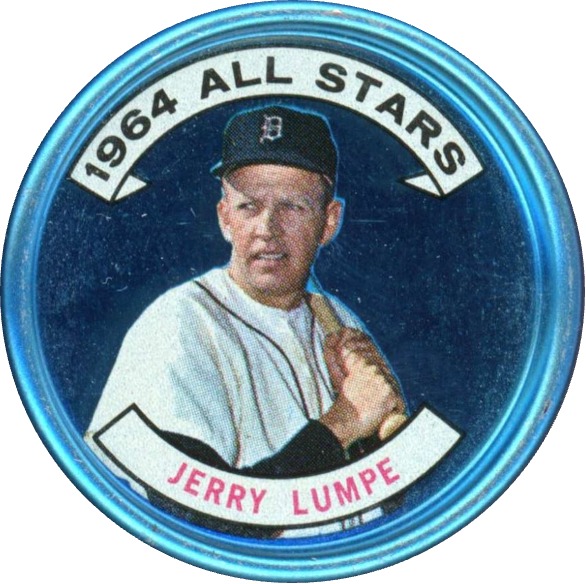
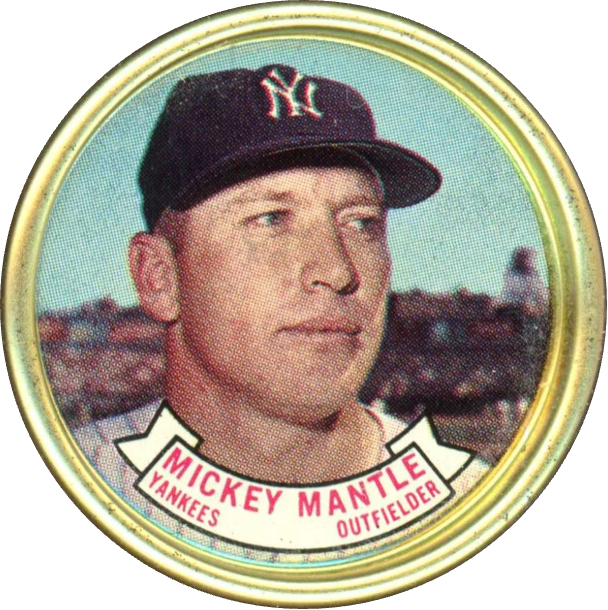
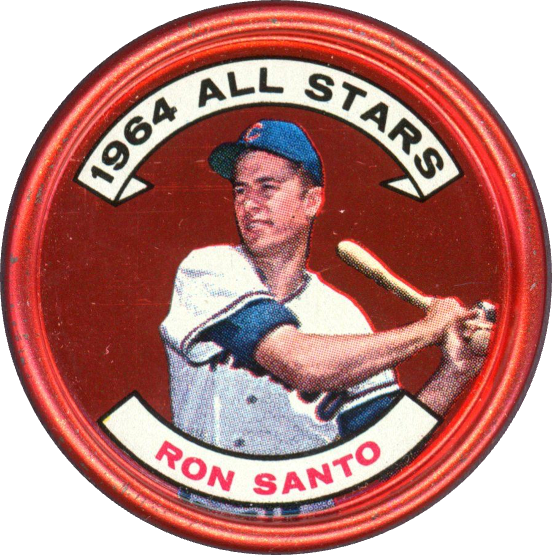
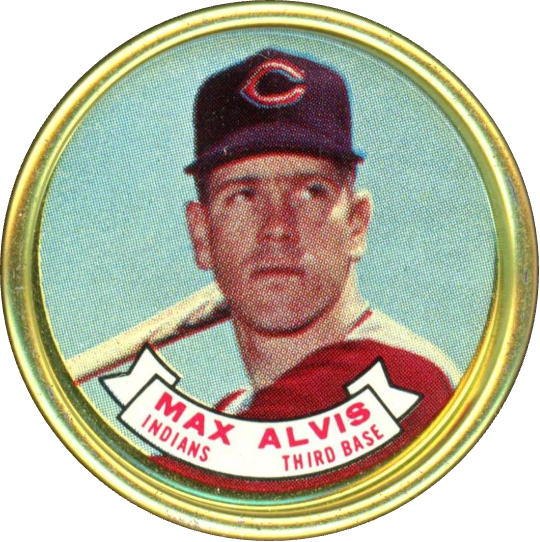
In addition to the regular cards, wax packs of Topps’ 1964 set also included one of their best – and most popular – inserts of all-time … baseball coins. The metal coins came one to a pack and measured 1 ½ inches in diameter. Fronts included a full-color photo and the player’s name, team and position. Backs included the coin’s number, the player’s name, height, weight and a brief write-up.
The set had 164 different coins – 120 regular coins and 44 “All-Star” coins. A full set of coins is valued at about $750, with Mickey Mantle, Carl Yastrzemski and Pete Rose commanding the highest individual values. A full near mint set of the 1964 baseball cards is about $2,700.
• • • • • •
See related article on BaseballCardFun.com entitled:
“Three ’64 Topps Takeaways”
Click Link Here
• Originally Published in Jan. 1992 “Baseball Hobby News” •
THIS ARTICLE FROM “BASEBALL HOBBY NEWS” MAGAZINE IS REPRINTED WITH THE PERMISSION OF BOTH THE EDITOR/PUBLISHER AND THE AUTHOR. IT HAS BEEN RETYPED, BUT NO CONTENT HAS BEEN CHANGED (EXCEPT FOR VERY MINOR ADJUSTMENTS, CORRECTIONS TO TYPOGRAPHICAL ERRORS AND CHANGES TO GRAPHICS). COMMENTS OR INFORMATION IN THE ARTICLE MAY BE OUT-OF-DATE.
To keep up-to-date on additions to BaseballCardFun.com, subscribe below*
* Your email address will never be shared and is only used to announce new articles

