

BY TROY KIRK
When you open a pack of baseball cards and look through your new treasures, what is the worst card you can find? A lot of people would say it’s a checklist card.
Checklist cards are almost universally hated, yet many of them have become very valuable. For example, the 1963 Fleer checklist card is the most valuable card in the set, according to the price guides. Checklists from Topps sets of the 1950s and 1960s are almost always listed at higher prices than commons. If checklist cards are so bad, why are they priced so high?
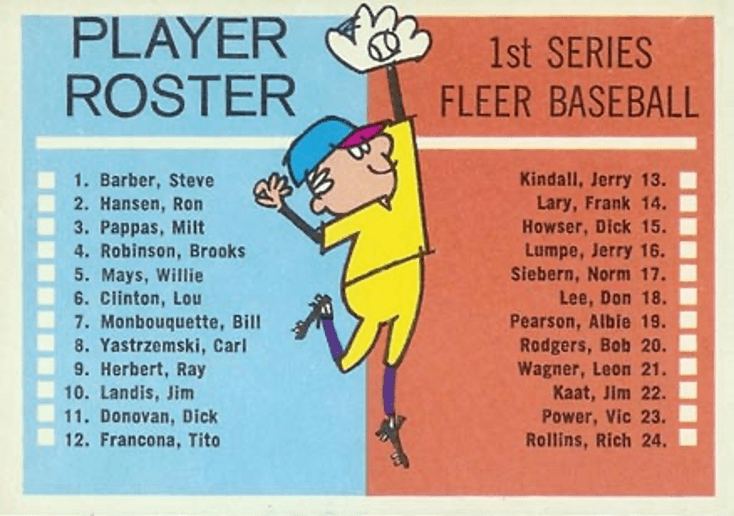
The main reason that old checklist cards are valued so highly today is because the kids who originally purchased the cards used them as they were intended – they wrote on them. Checklists were originally created for two purposes – to show card buyers a list of the available cards in the set to encourage them to buy more, and to be used for checking off the cards they already had. Because many older checklists are found with checkmarks on them, the few remaining unmarked ones command a higher value.
The fact that checklists are given high values in the price guides hasn’t helped their popularity much. Most collectors still hate them and would rather have just about any other card, if given the choice. To complete a set of cards in excellent to mint condition, though, that loathsome checklist card must be found in an unmarked state.
Checklist cards have had a place in card collecting from the beginning. Checklists were found on the backs of the Allen and Ginter cigarette cards from the 1880s to show the names of the available players. Many other card sets from the late 1800s through the early 1950s displayed checklists on their backs, if the set was small enough. With the larger sets, collectors had to guess at who the subjects might be, though they were sometimes told how many different cards were in the set.
It wasn’t until 1956 that a baseball card was created for the sole purpose of containing a checklist. Topps issued two checklist cards with its 1956 set, and these are very difficult to find in an unmarked condition today. Topps didn’t even think enough of the checklist idea to assign them their own card numbers that year, lowering their status as members of the set.
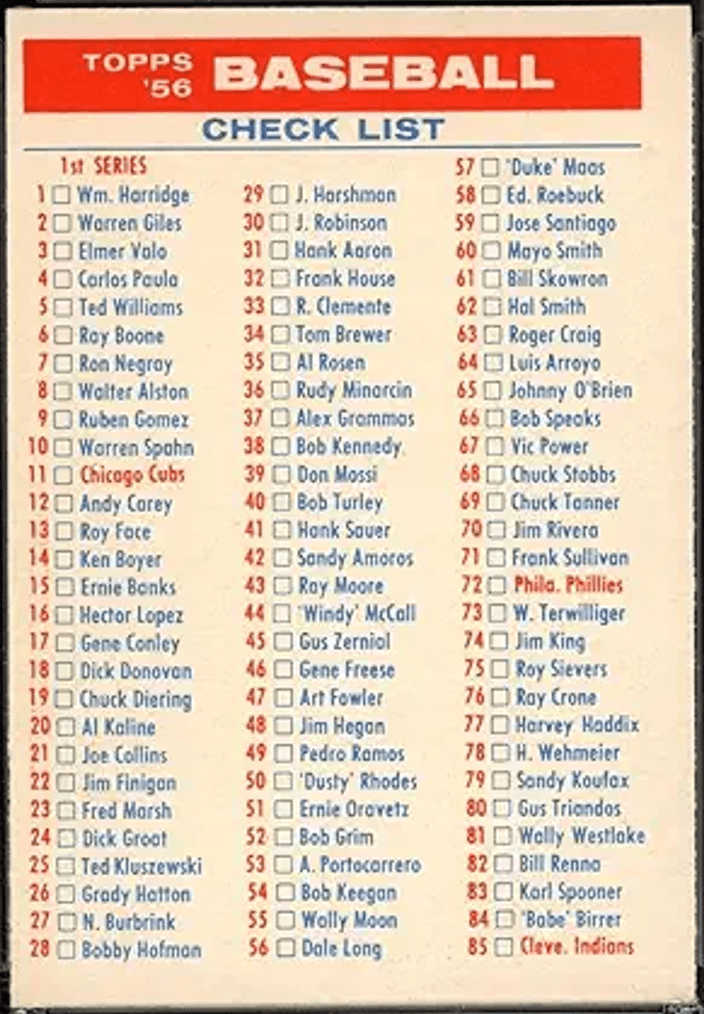

1956 Topps
The Topps checklists differed from the earlier checklists in one crucial way. The Topps checklists contained little boxes next to the player name to be used to check off the card when it was found, while earlier ones didn’t. Though there are marks on some of the pre-Topps checklists, they are not prevalent. The vast majority of early Topps checklist cards, however, have been marked in the checkoff boxes.
Apparently the checklist cards from 1956 paid off for Topps, because they have issued checklists in every major set since. In some sets, Topps has attempted to liven up the checklist cards. In several instances, a team or manager photo is on the front and a checklist is on the back. The 1961 checklists show game-action photos from unspecified games. Each of the 1967 checklists show the head of a different superstar player. For other sets, Topps simply put out a card with a bland list of player names for a particular series.
There are many variations found on Topps checklist cards from the 1950s through the early 1970s when Topps cards were issued by series. When Topps issued a series of cards, they would usually include two checklist cards in each series – one for the current series and one for the next series. This was to show the card buyers a list of the cards they still needed in the current series, and to entice them as to what was coming in the next series.
Because of this, many checklist cards were printed on two different press sheets. For example, the second series checklist could be found in packs of both first and second series cards.
Often minor changes were made to the checklist card when it was printed for the second time. Sometimes Topps would change the name of a player, or would correct a misspelling for a player name. Minor cropping differences were frequent. Checklist variations seldom affect the price of the cards very much, but they are interesting.
Fleer, Donruss and Upper Deck have included checklist cards with all of their regular sets, though Optigraphics has chosen not to issue them with their Score and Sportflics cards. (It would be pretty hard to check off a checklist box on the magic motion side of a Sportflics card.)
The checklist cards of the 1980s and 1990s have not seen the same marking problems as those issued earlier, mainly because of the influx of many adult collectors and the condition consciousness seen in baseball card collecting today. It is relatively easy to find an unmarked checklist from the 1980s, and checklist cards from recent years are priced as commons.
Until recent years, checklists served a real purpose in informing collectors about the available cards in a set. With the many price guides and other sources of checklist information available today, the information value of checklist cards is not as important as it once was. Only the very young or novice card collectors mark their checklists these days, rendering that purpose useless.
It is possible that Optigraphics is correct in realizing that checklist cards no longer serve a useful purpose to collectors. It may well be that they will disappear from most sets in the coming years.
TOPPS CHECKLISTS THROUGH THE YEARS:
• The 1956 and 1957 checklists were unnumbered.
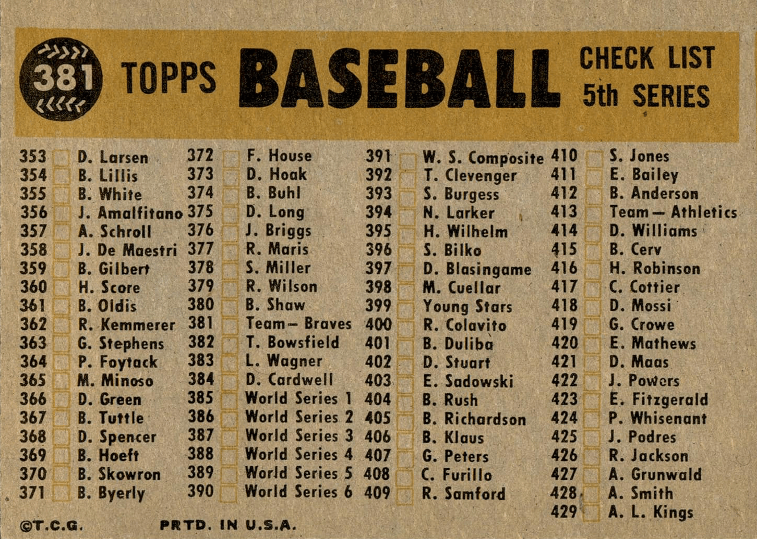
• 1958-60: Checklists appeared on the back of team cards. In all three years, checklists were in numerical order. In 1958, some of the checklists were also in alphabetical order.
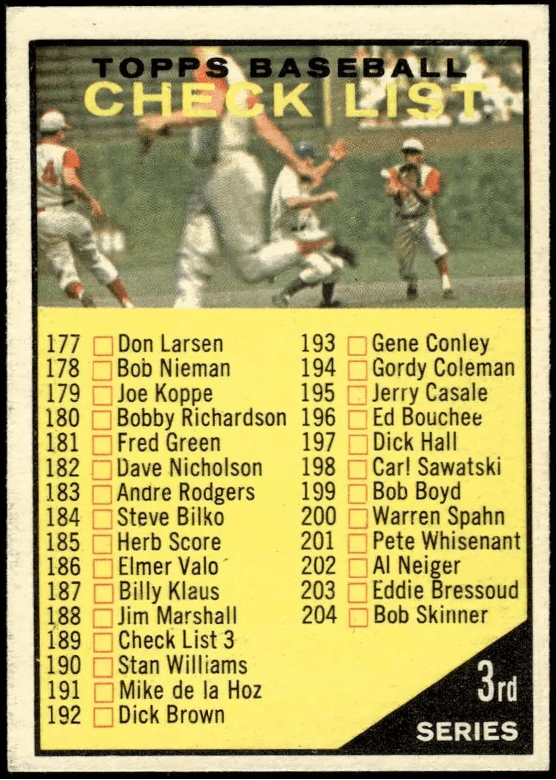
• 1961-1989: Checklists by themselves in numerical order.
• 1961: Checklists contain a small game action photo on the front and back. The front action photos are different for each card, but the action photos on the backs are all the same.
• 1966: Checklist #101 has one of the most interesting variations of all checklists, with card #115 listed as either Hall-of-Famer Warren Spahn or Bill Henry. Card #115 was only issued as Henry.
• 1967-1969: Checklists were found with a small unidentified superstar player head on the checklist fronts. Regular cards for the player shown were almost always found in the series that featured their head. The one-ear and two-ear 1967 variation of Juan Marichal and the neck and no-neck Willie Mays are interesting. The 1969 checklist #214 has no superstar player head, but includes the Deckle Edge insert card checklist instead.
• 1971: For the first time in its history, Topps included a checklist card with the sole purpose of checklisting an insert set, card #161, which was the 1971 Coins checklist.
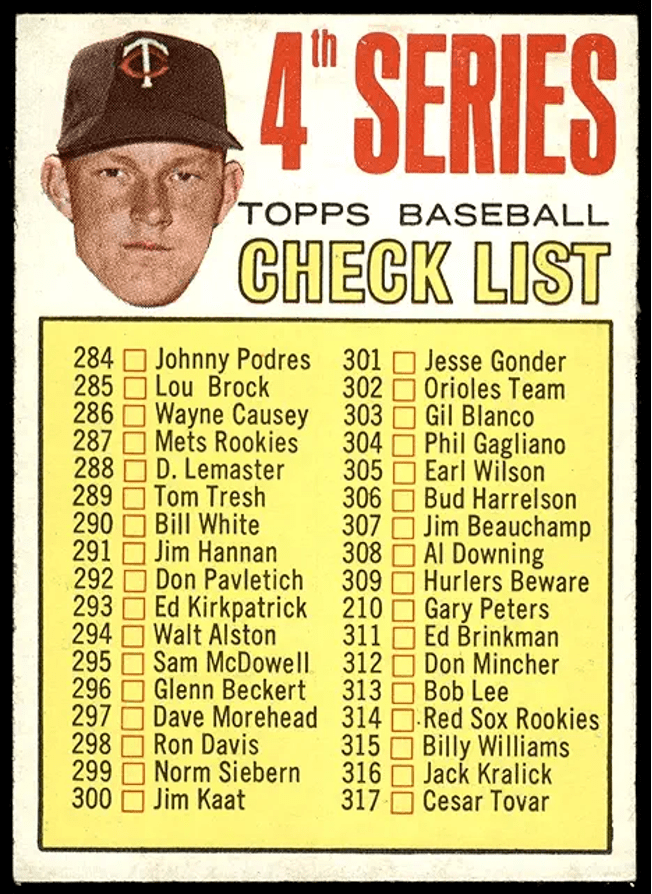
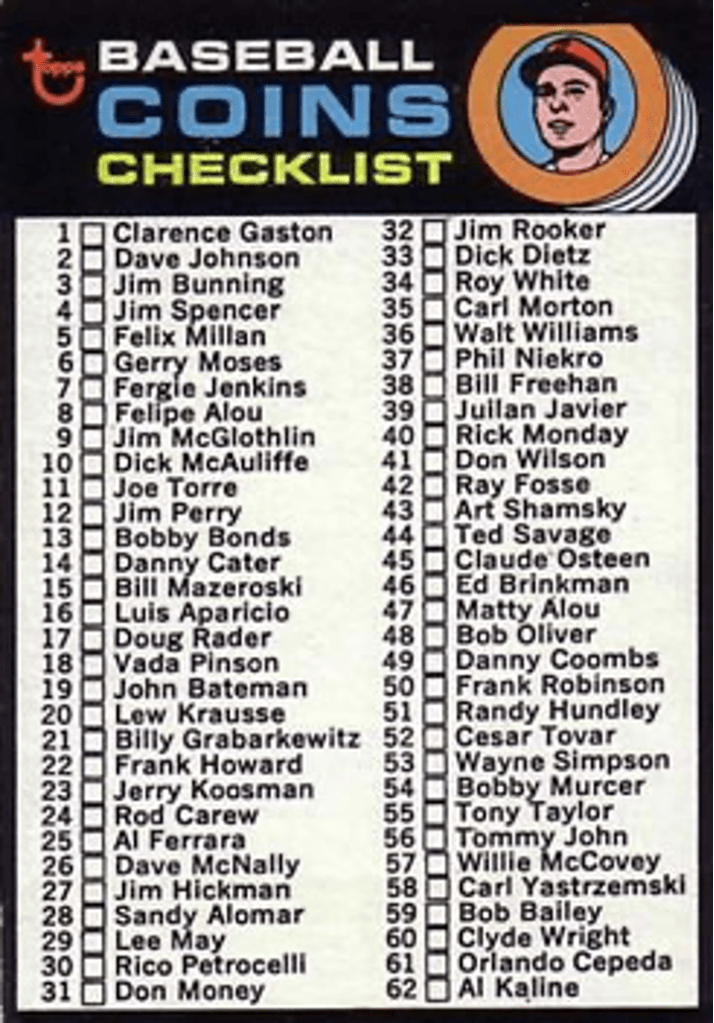
• In 1973 and 1974, Topps included team checklists in addition to their regular checklists. The team checklists featured player autographs for a particular team on the front, and an alphabetical checklist for that team on the back.
• In 1974 and 1976, an unnumbered Traded card checklist was also included. (Traded cards were included in regular packs in 1974 and 1976.)
• 1975-1981: Alphabetical team checklists were found on the back of team cards.
• 1982-1984: Alphabetical team checklists were found on the back of team leader cards.
• 1985-1989: Alphabetical team checklists were found on the back of manager cards.
• 1990-1991: Topps ends a streak of 34 consecutive years of checklists in numerical order (1956 to 1989). Checklists were issued in alphabetical order by team, with about five teams per checklist.
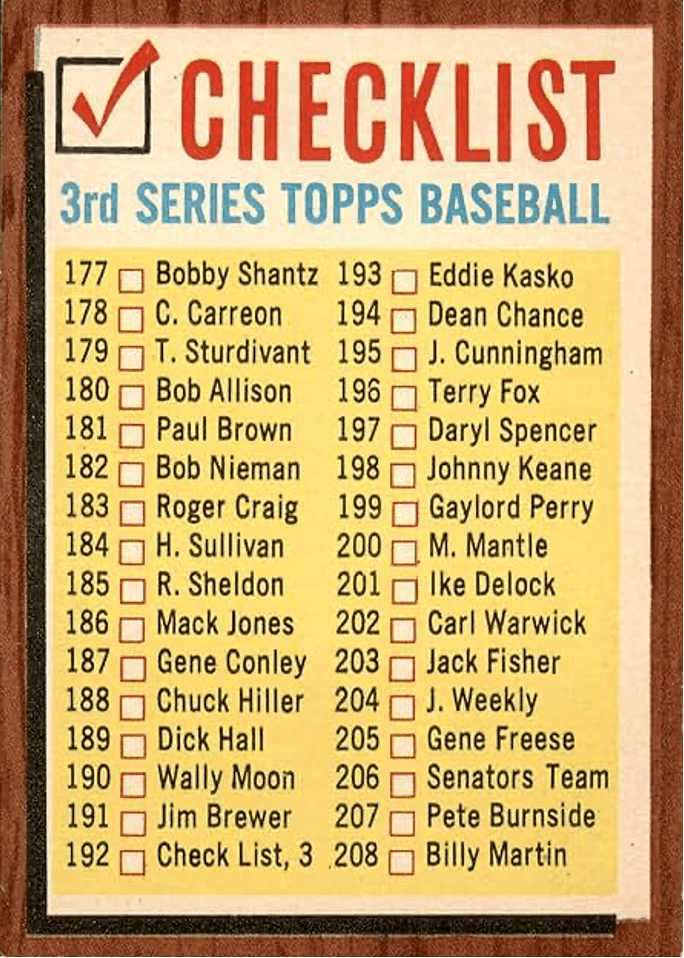
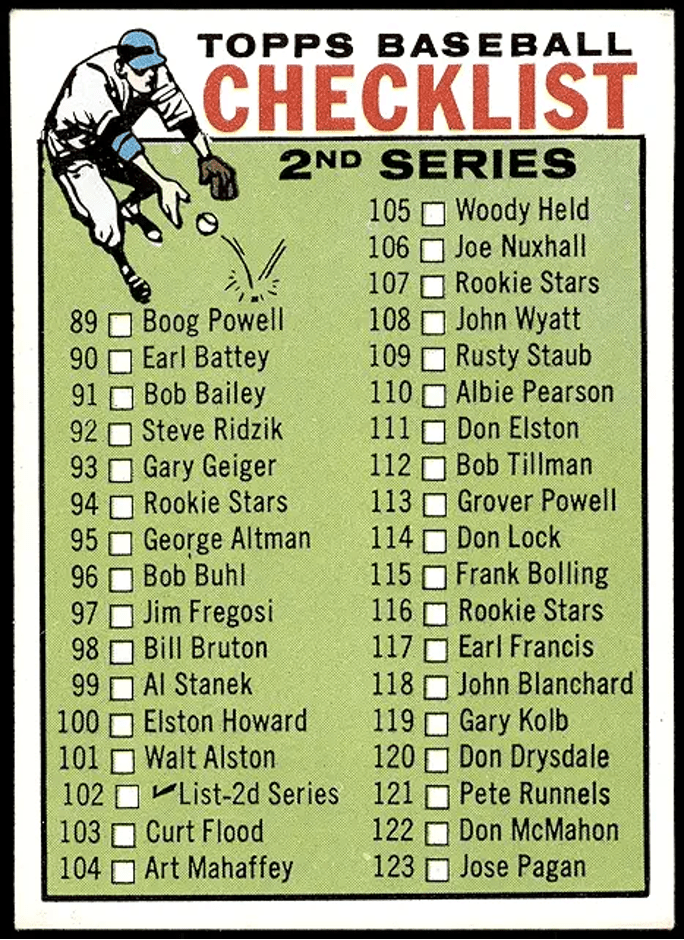
1962 Topps & 1964 Topps
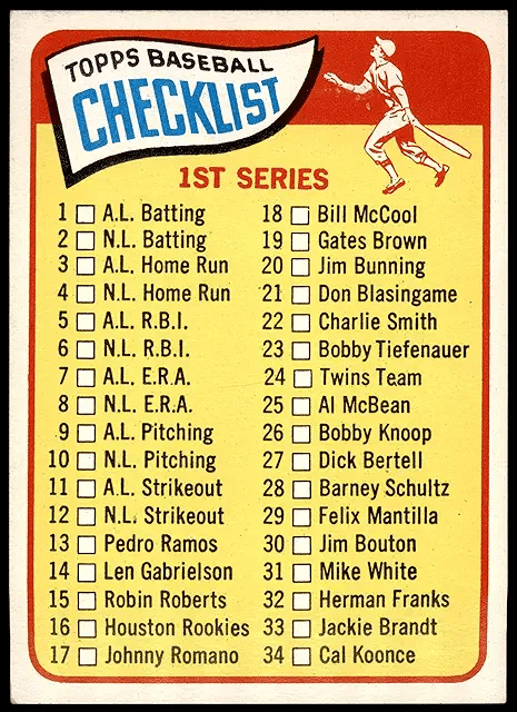
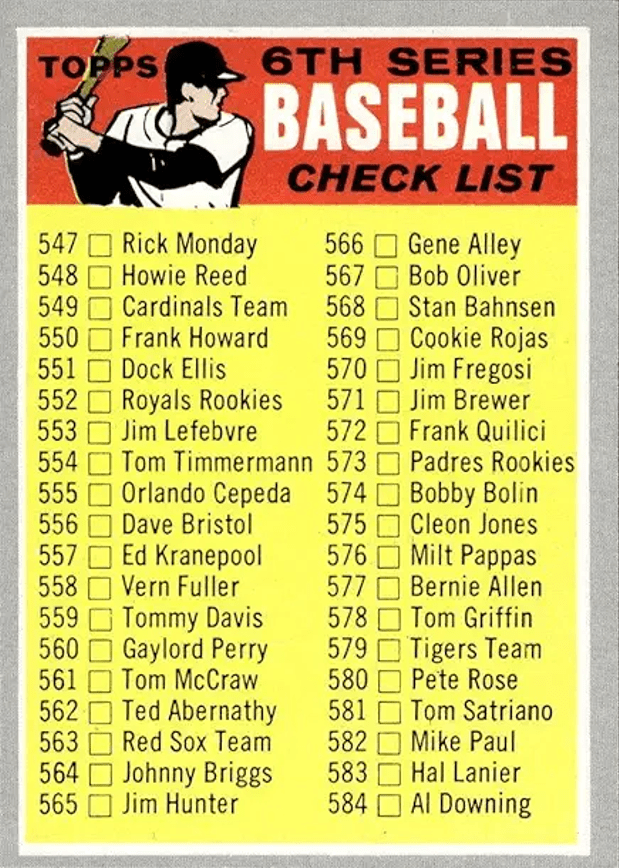
1965 Topps & 1970 Topps
• • • • • •
• Originally Published in Jan. 1992 “Baseball Hobby News” •
THIS ARTICLE FROM “BASEBALL HOBBY NEWS” MAGAZINE IS REPRINTED WITH THE PERMISSION OF BOTH THE EDITOR/PUBLISHER AND THE AUTHOR. IT HAS BEEN RETYPED, BUT NO CONTENT HAS BEEN CHANGED (EXCEPT FOR VERY MINOR ADJUSTMENTS, CORRECTIONS TO TYPOGRAPHICAL ERRORS AND CHANGES TO GRAPHICS). COMMENTS OR INFORMATION IN THE ARTICLE MAY BE OUT-OF-DATE.
See related article on BaseballCardFun.com entitled:
“Checklist Cards That Weren’t Totally BLAH”
Click Link Here
To keep up-to-date on additions to BaseballCardFun.com, subscribe below*
* Your email address will never be shared and is only used to announce new articles

