
The history of Topps baseball card sets
BY MARK A. LARSON
Night and day.
That’s literally the difference between Topps’ pre-1963 baseball sets and their ’63 effort. The 1963 Topps set is like a breath of cool, clean, crisp mountain air compared to the smog of the city. It’s like the contrast between Dorothy in Kansas versus being over the rainbow in the Land of Oz.
The thing that differentiates Topps’ 1963 set from all the previous sets is its bright colors … front and back. Just compare the ’63s with the 1962 or 1961 sets. The photos are bright, not gloomy. Colors used on the front borders are bold, not dull. The two-photos-on-front design is basic, but not boring.
Even the backs of the 1963 cards are different. White cardboard is used along with vivid yellow. This was the first of eight consecutive years of white backs on Topps baseball cards. The ’63 backs are by far the easiest to read of Topps’ first dozen major baseball sets … and they include full year-by-year statistics. Plus, the backs also feature great cartoons.

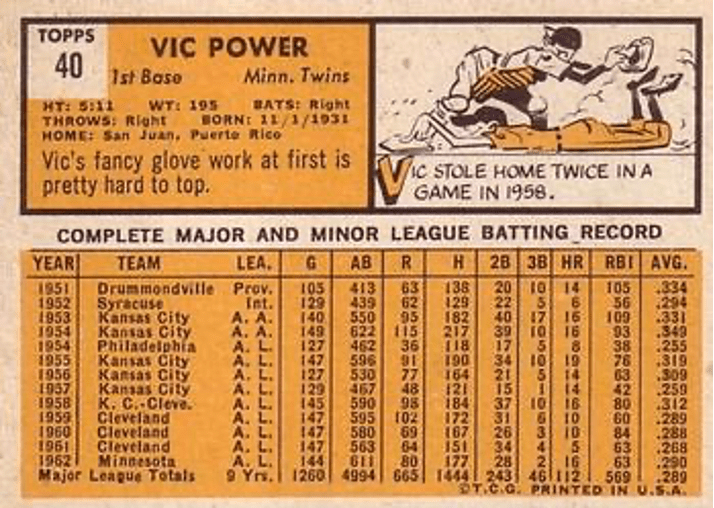
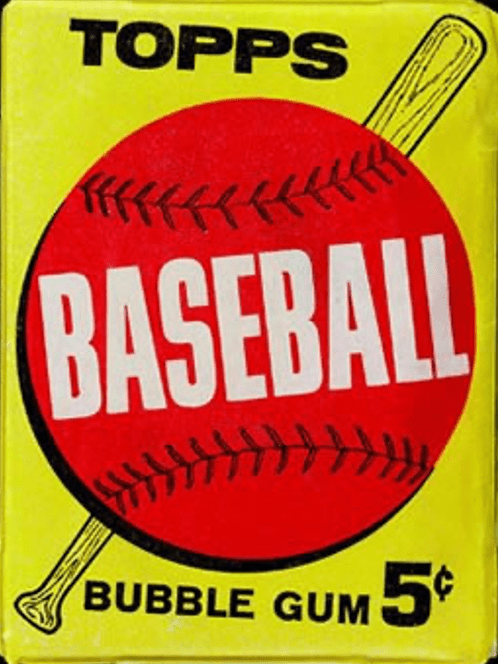

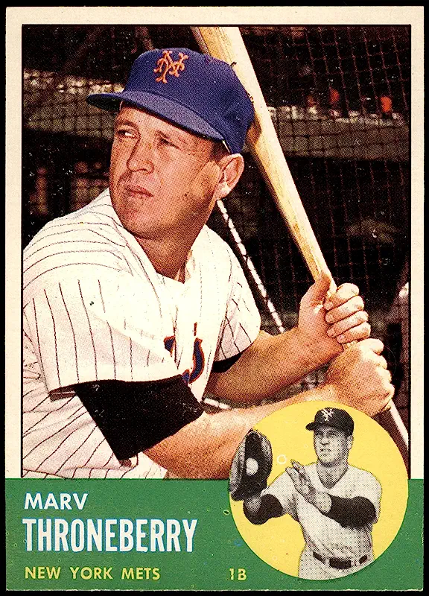
The 1963s are the first in a string of arguably the five best consecutive Topps baseball sets ever produced (1963-67). The impact of the great-looking ’63 set was still being felt 20 years after its issue. The 1983 Topps set is a direct descendent of the ’63s – colorful, clear photos, with an extra photo in a circle on the lower front of the card. Many collectors consider the ’83s to be Topps’ best set design of the 1980s.
The bold brightness of the ’63s has a strong correlation with the mood of the country that summer. It, too, was upbeat and the future looked bright.
The nation had survived a close brush with nuclear Armageddon with the Cuban Missile Crisis the previous October and John F. Kennedy was making plans for his re-election in 1964. For most, Vietnam was a strange place far, far away … that is, if you even knew what Vietnam was. The civil rights movement was heating up and Martin Luther King, Jr. made his famous “I Have a Dream” speech in Washington, D.C. that summer.
On television you would find “Leave It To Beaver” winding down its final season or you could be watching “The Flintstones” or “McHale’s Navy.” “The Great Escape” and “It’s A Mad Mad Mad Mad World” were playing in movie houses across the nation. The Beatles were the hottest item in Great Britain in the summer of ’63, but Americans still only knew the six-legged kind of beetles. Popular American songs were “Walk Like A Man” by the Four Seasons and “Surf City” by Jan and Dean.
In baseball, the Dodgers beat the Cardinals by six games to take the National League pennant, while the Yanks walked away with the American League flag, 10 1/2 games ahead of the White Sox. But the boys from the Bronx choked in the World Series, losing four straight to Los Angeles.
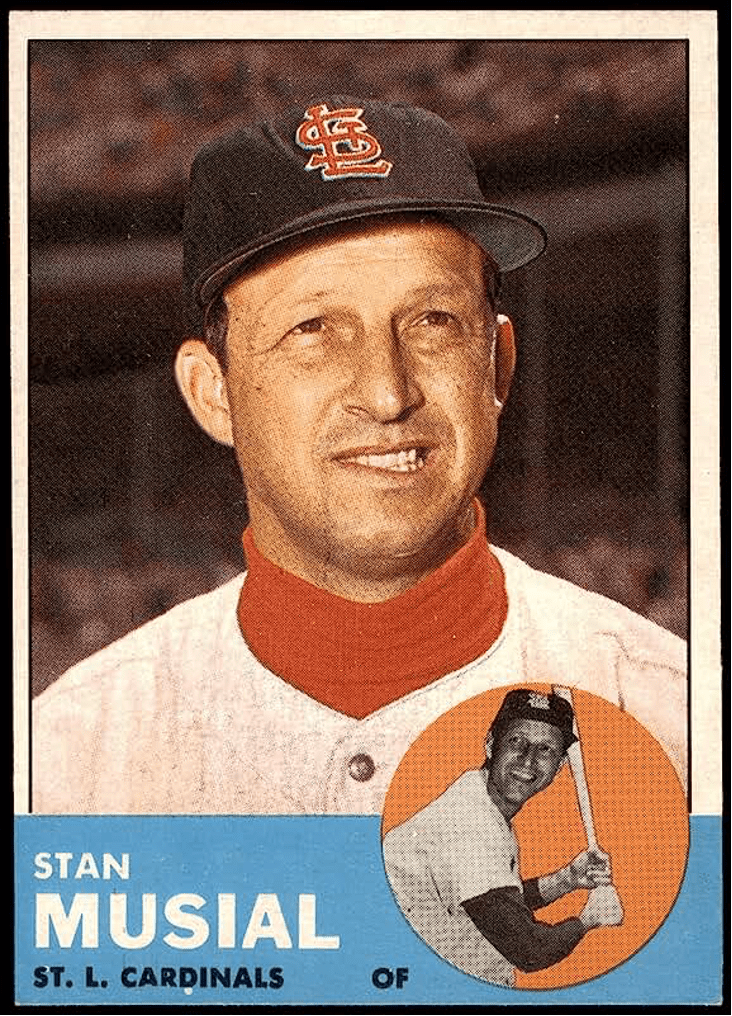

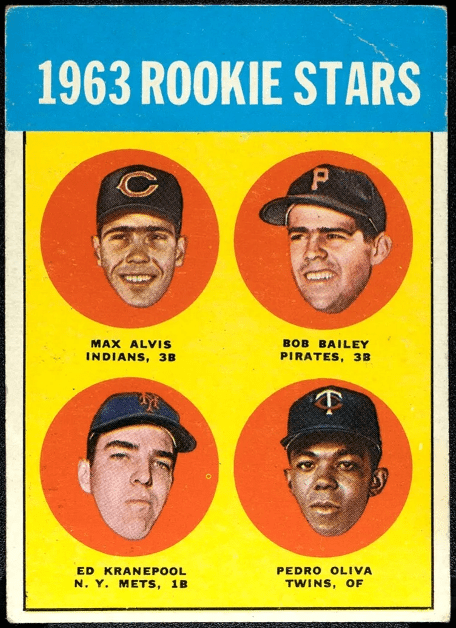
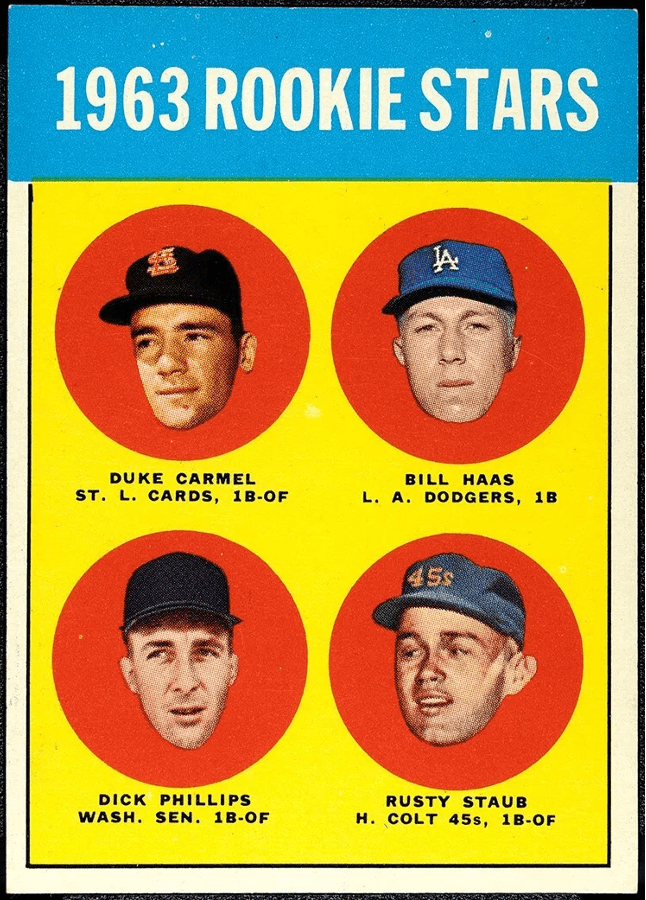
The 1963 set featured the last and first cards of two greats. Stan Musial made his farewell appearance on card #250, while a young second-baseman by the name of Pete Rose first appeared on card #537. Other key rookies in the 1963 set include: Tony Oliva (#228), Rusty Staub (#544) and Willie Stargell (#553).
Each rookie card in the set featured four players. Two of the early rookie cards in the set — #29 and #54 – can be found with either “1962 Rookie Stars” on the front or the correct version that says “1963 Rookie Stars.” The “1962” variations are worth about twice as much as the “1963s.”
Another interesting sidenote involving a 1963 multi-player rookie card was the fact that card #169 included Dick Egan, Julio Navarro, Tommy Sisk and Gaylord Perry. Perry had already appeared on his first card – alone – the previous year. Why Perry would deserve his own card and then be demoted to one including three other young players remains a mystery.
Rose’s first card is noteworthy in that it was the center of attention when rookie-card-mania hit the hobby in the early 1980s. It went up almost every month until he broke Ty Cobb’s all-time hit record. Then it leveled off at about $750 and eventually fell in value when Rose became embroiled in gambling and tax evasion controversies.
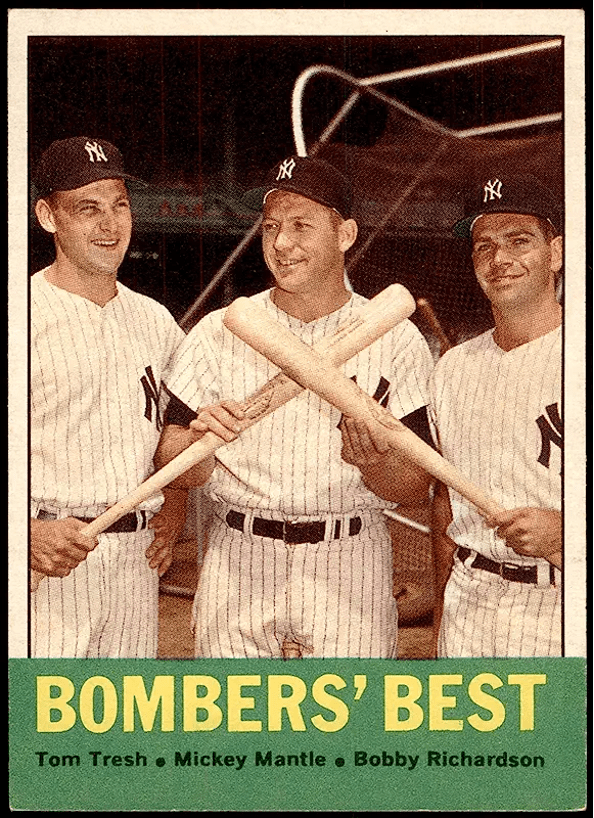
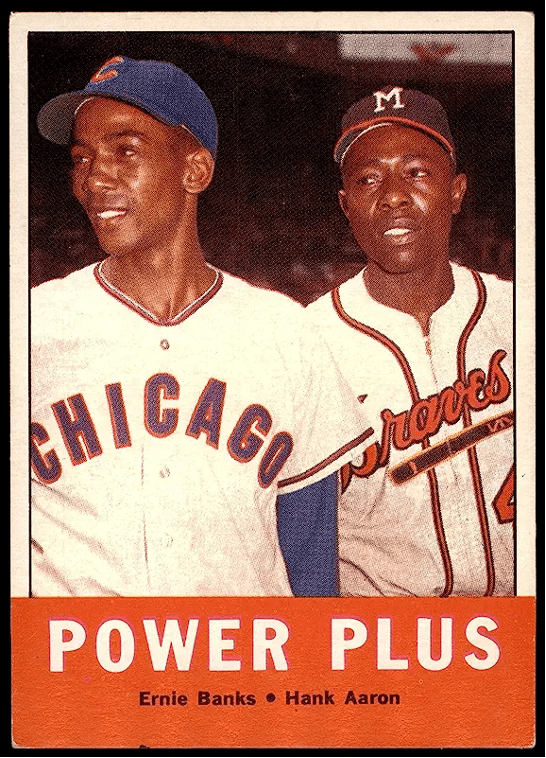

In addition to the usual League Leader cards (#1-10) and World Series subset (#142-148), the ’63 set contains several multi-player cards. Some of the best are: “Friendly Foes” (#68) with Duke Snider and Gil Hodges; “Pride of N.L.” (#138) with Willie Mays and Stan Musial; “Bombers’ Best” (#173) with Tom Tresh, Mickey Mantle and Bobby Richardson; “Power Plus” (#242) with Ernie Banks and Hank Aaron; and “Dodgers’ Big Three” (#412) with Johnny Podres, Don Drysdale and Sandy Koufax.
The value of multi-player cards featuring Hall-of-Famers has been steadily going up. The five cards mentioned have values ranging from $9 (“Friendly Foes”) to $50 (“Bombers’ Best.”)
The 1963 set is also unique in that the most expensive cards are not in the last series, but in the second-to-last. Sixth series commons (#447-522) in top grade now command prices of $12 each. Seventh series cards (#523-576) are a little easier to find, but still expensive at $7 per common. First through fifth series commons range in value from about $1.50-3.50 each.
It’s not clear what prompted Topps to improve the set design in 1963. However, it’s possible competition from Fleer was one factor. In the spring of ’63, Fleer issued a beautiful card set of 66 current players that was advertised as being the first in a series. Did Topps anticipate this new set and therefore put more effort into the design of their own set? We may never know.
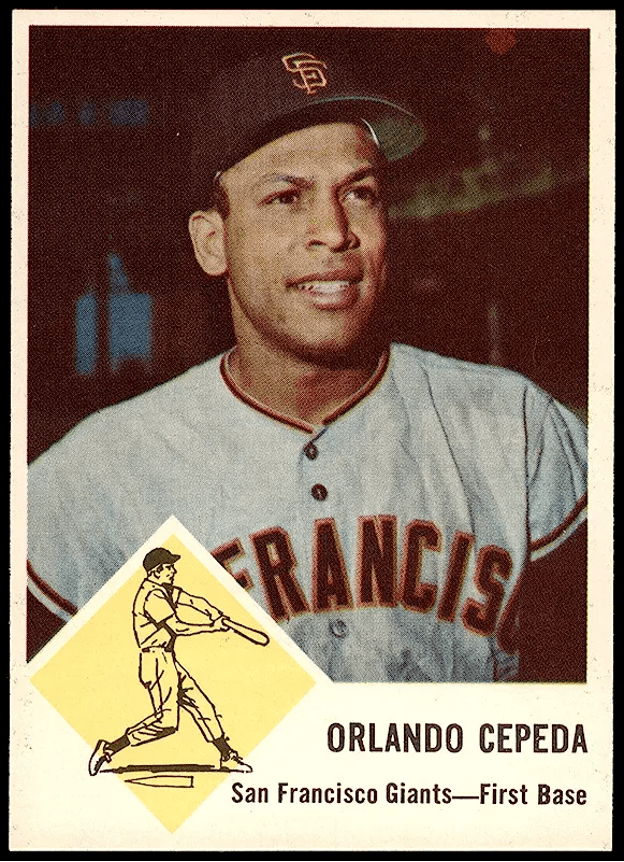
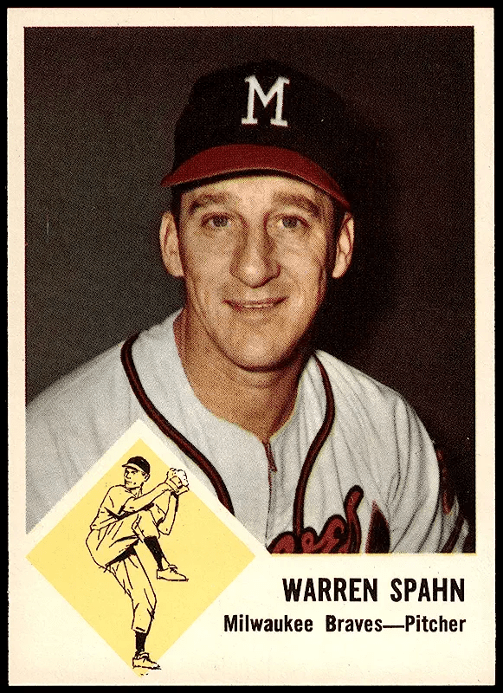
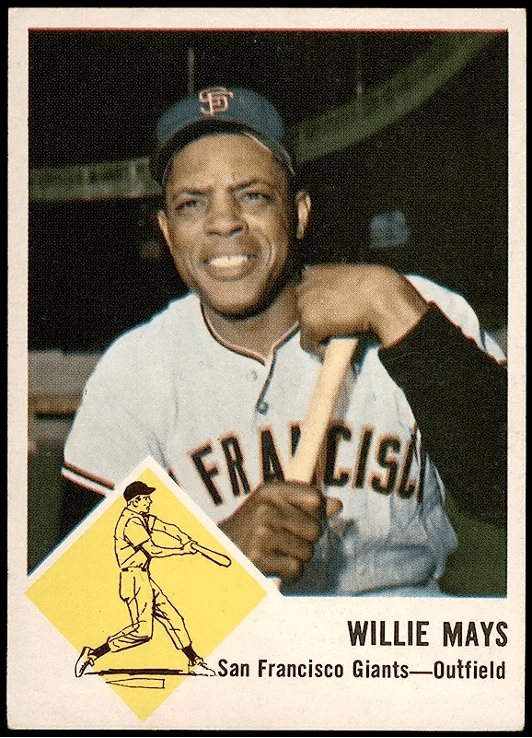
1963 Fleer Baseball
In any case, Topps took Fleer to court and forced the upstart company to stop production at only one series. Fleer wouldn’t return to the current player card market until 1981.
The 1963 Topps set was a landmark with its bright, colorful design on both the front and back. It ushered in a five-year period that saw an emphasis on vivid, attractive baseball cards. It remains one of the most popular Topps sets of the 1960s … and of all-time.
• • • • • •
• Originally Published in Nov. 1991 “Baseball Hobby News” •
THIS ARTICLE FROM “BASEBALL HOBBY NEWS” MAGAZINE IS REPRINTED WITH THE PERMISSION OF BOTH THE EDITOR/PUBLISHER AND THE AUTHOR. IT HAS BEEN RETYPED, BUT NO CONTENT HAS BEEN CHANGED (EXCEPT FOR VERY MINOR ADJUSTMENTS, CORRECTIONS TO TYPOGRAPHICAL ERRORS AND CHANGES TO GRAPHICS). COMMENTS OR INFORMATION IN THE ARTICLE MAY BE OUT-OF-DATE.
To keep up-to-date on additions to BaseballCardFun.com, subscribe below*
* Your email address will never be shared and is only used to announce new articles
 BaseballCardFun.com