
BY MARK A. LARSON
The year 1960 was both the end of an era and the beginning of a new one. … in national politics … in baseball … and in baseball cards.
“Father Knows Best” and “Bonanza” were popular television shows in 1960. The small fictional North Carolina town of Mayberry was featured for the first time on “The Andy Griffith Show.” People across the country were dancing to Chubby Checker’s “Twist,” while “Itsy Bitsy Teenie Weenie Yellow Polkadot Bikini” was topping the pop charts that summer.
Dwight Eisenhower, the nation’s oldest President (up until that time), was spending his last year in the White House. John F. Kennedy would outperform Richard Nixon in the first televised debates to become the nation’s youngest elected President – and first Catholic. A new era was beginning.
Baseball was changing, too. Ted Williams played his final game in September 1960 and appropriately hit a home run in his last at-bat. He belted 29 homers in just 310 at-bats that year. It was the last year of two eight-team leagues and the 154-game schedule. The American League would expand to 10 teams in 1961, with the National League following in 1962.

The “old” Washington Senators announced they were moving to Minnesota. They would be replaced by a new expansion team in the nation’s capital the next year. Charles O. Finley purchased the Kansas City A’s, ushering in an era of wild imagination matched only by the legendary Bill Veeck.
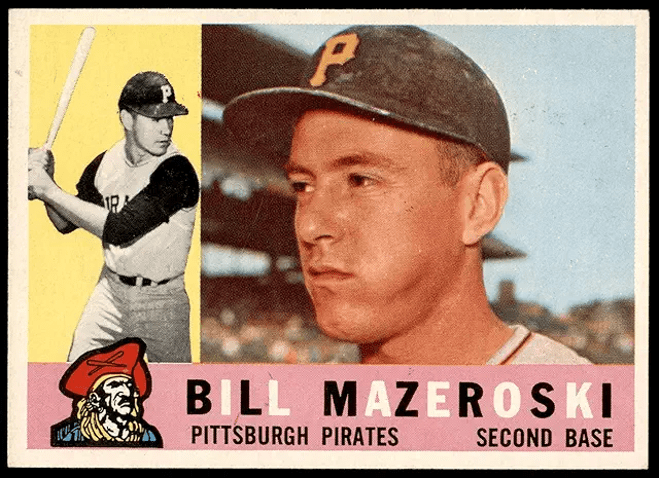
And then there was the World Series. Picture this: Yankees vs. Pirates, seventh and deciding game, score tied 9-9, bottom of the ninth. Pittsburgh second-baseman Bill Mazeroski comes to bat and delivers a dramatic home run to win the Fall Classic for the Bucs.
Mazeroski’s home run led to the end of another era. After 12 years, 10 pennants, seven World Championships and a .623 winning percentage, the Yankees fired colorful manager Casey Stengel. A new era was beginning.
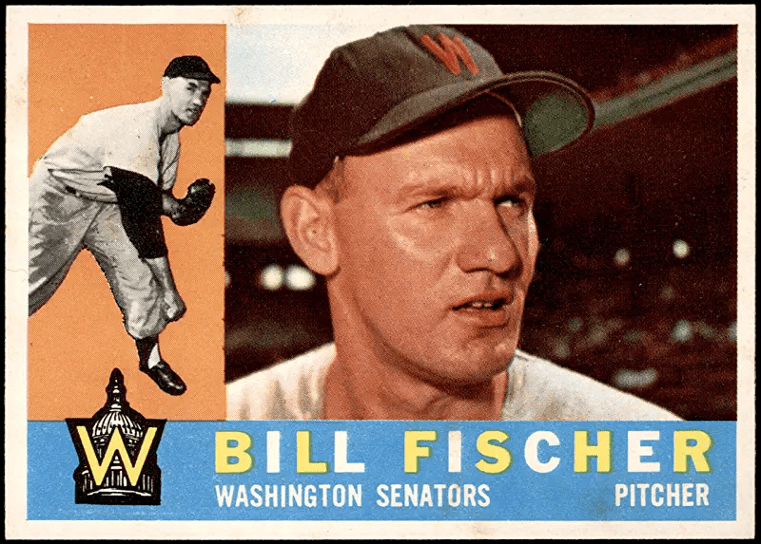
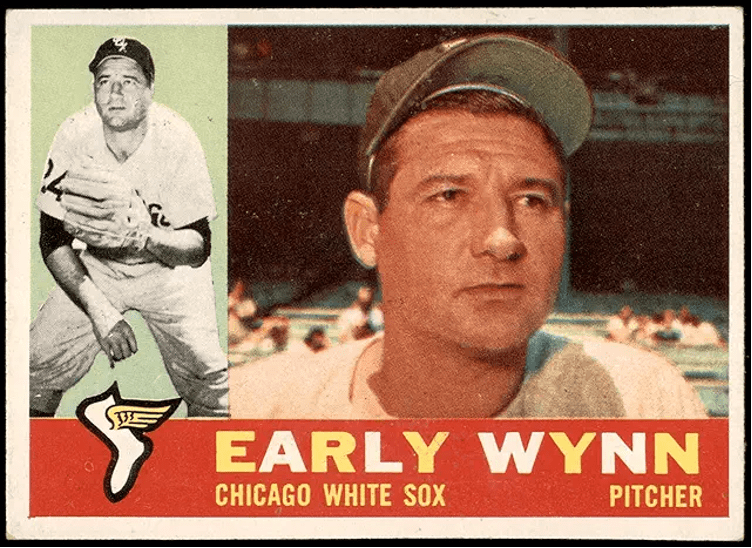
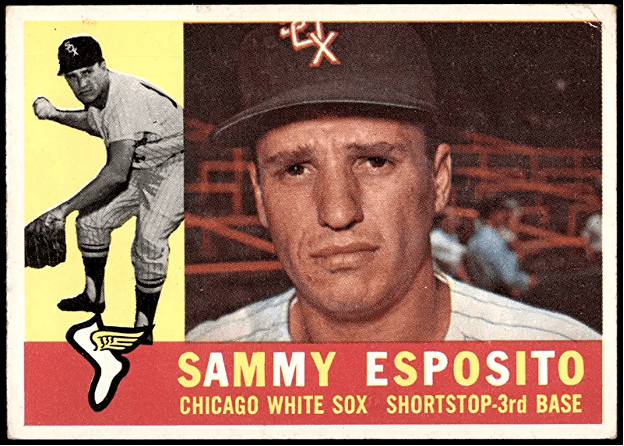
Meanwhile, the 1960 Topps set was the last to feature a horizontal-style front. This general design had been used in 1955 and 1956, but was better suited to the larger size cards issued in those years. The sideways format really only allowed for a close-up shot of the player, plus a small black-and-white action pose off to the side.
The backs were also horizontal and done in a gold color on either white or gray cardboard stock. Only statistics from the previous year and lifetime totals were included. An additional section featured “Season’s Highlights,” listing a half-dozen or so dates from the 1959 season and how the player performed that day.
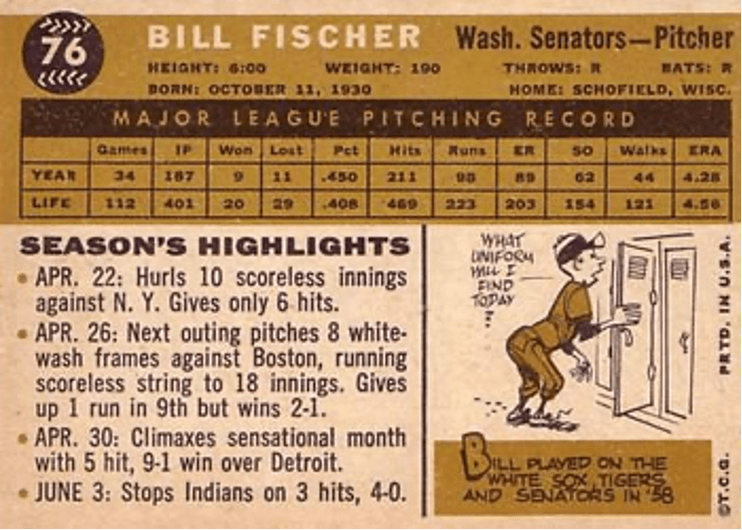
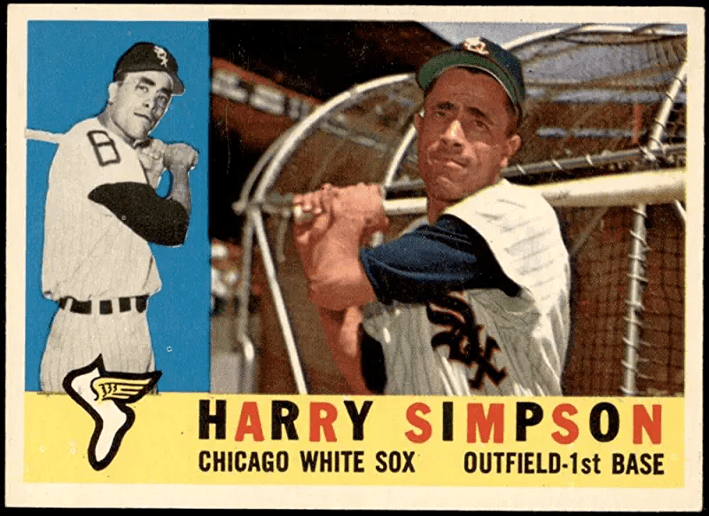

The final component of the 1960 backs was a cartoon. Like most years when Topps used cartoons, some were quite clever. Harry Simpson’s card (#180) shows him reading a road map and states: “Harry started ’59 with the A’s, was traded to Chicago, went to Pittsburgh and came back to Chicago this year.”
On Sammy Esposito’s card (#31) the cartoon caption reads, “Sam can play shortstop, 3rd base, and the outfield.” It shows a hand holding a business card that reads “S. Esposito. Have talent, will travel” … a take-off of the then popular TV western, “Have Gun, Will Travel” starring Richard Boone.
The set itself features 572 cards. Topps usually led off its sets with a star from the previous year. In this case, card number one is White Sox hurler Early Wynn. Wynn went 22-10 in 1959 with a 3.17 ERA and was named the Cy Young Award winner.
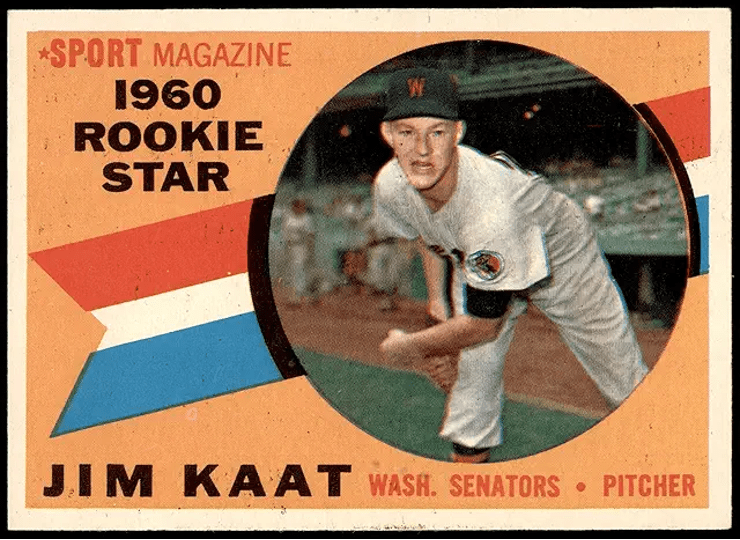
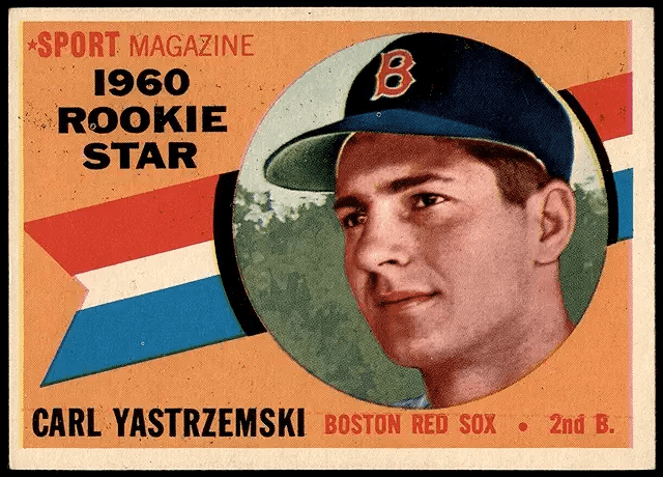
The 1960 set is chock full of subsets. Cards #117-148 feature “Sport Magazine 1960 Rookie Stars.” The card design was slightly different. Topps still utilized the horizontal format, but only included one photo on the front. This subset includes the rookie cards of Jim Kaat (#136) and Carl Yastrzemski (#148). The Yaz card is now worth about $350, while Kaat’s card is $25 in mint condition.
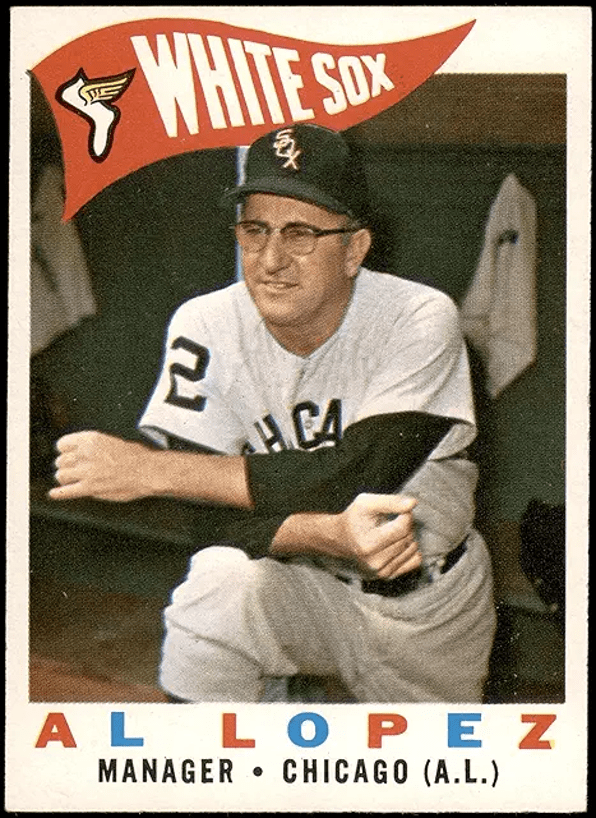
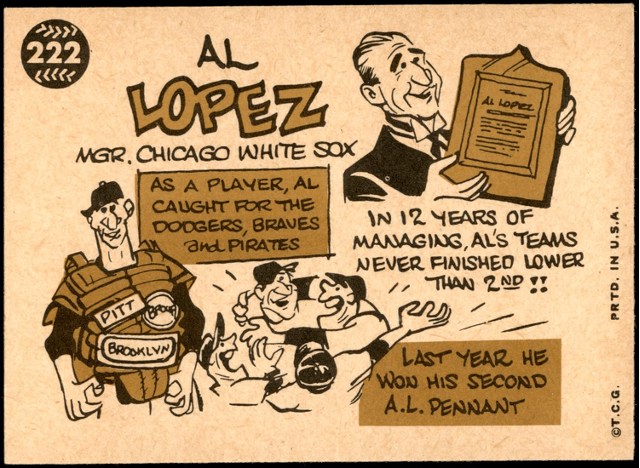
Next up were 16 manager cards (#212-227). For some unknown reason, these have a vertical design on the card fronts. The backs are basically one giant cartoon.
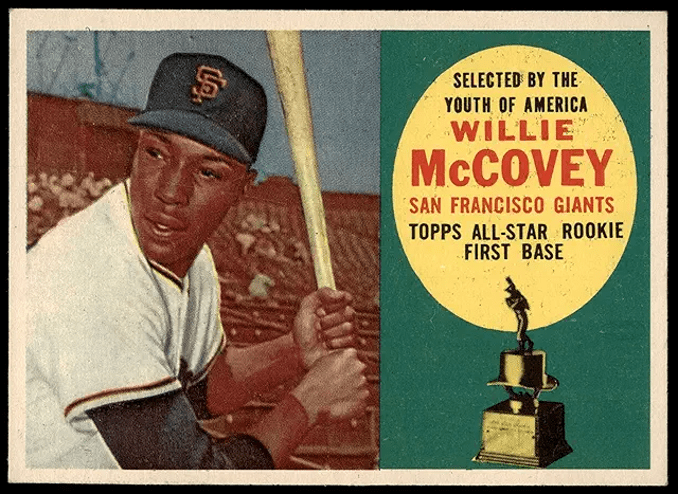
Cards #316-323 include eight Topps All-Star Rookies from the previous year. And, as stated on the front of the cards, they were “Selected by the Youth of America.” One Hall-of-Famer’s rookie card appears in this subset: Giants’ first-baseman Willie McCovey (#316). His card is now valued at $225.
For the first time, the ’60 set included World Series cards. Cards #385-391 featured highlights from the White Sox-Dodgers 1959 Fall match-up. This subset would be included in almost every Topps set for the next 25 years.
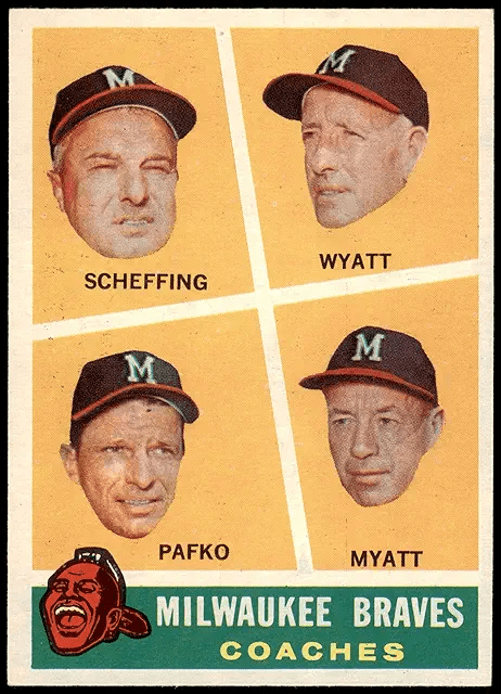
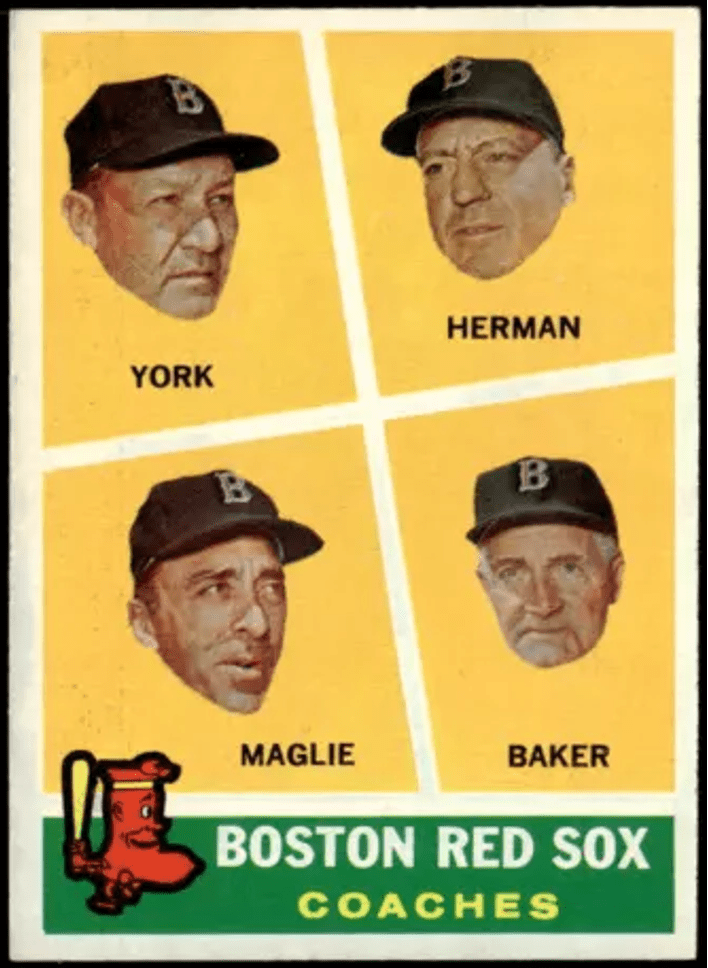
The 16-card coaches subset (#455-470) is one of the strangest-looking batch of cards Topps ever put together. We’re back to a vertical format that features just the heads – no necks or bodies – of four coaches from each team. These floating heads were set against a plain-colored background. It almost looks as if Topps used a guillotine on these poor fellows.
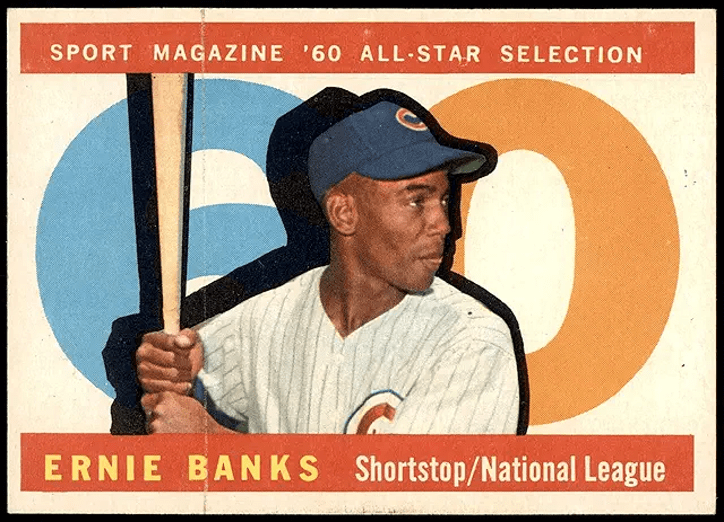
Finally, the last 20 cards in the set (#553-572) are devoted to All-Stars. These include just one front photo with a big “60” in the background.
The set is valued at approximately $3,700 (the least of any major Topps set from 1952-63). Individual cards valued at $100 or more include the already-mentioned Yastrzemski and McCovey rookies, plus Willie Mays, Hank Aaron, Roberto Clemente, Sandy Koufax, Mickey Mantle and Roger Maris. The All-Star cards of Mantle, Mays, Aaron and Maris also top the century mark.
Common cards generally are grouped in three different price categories, based on their scarcity:
• Low numbers (#1-440) go for about $2.00-2.50.
• Semi-high numbers (#441-506) are about $3.50 each.
• High Series (#507-572) commons are $10 each.
As with a couple of other Topps sets, some cards (#375-440) can be found with either gray or white backs.
The following year would bring many changes to national life, baseball and baseball cards. While 1960 marked both the end of an era and the beginning of a new one, the 1960 Topps set can be remembered as being part of this transition.


• • • • • •
• Originally Published in Aug. 1991 “Baseball Hobby News” •
THIS ARTICLE FROM “BASEBALL HOBBY NEWS” MAGAZINE IS REPRINTED WITH THE PERMISSION OF BOTH THE EDITOR/PUBLISHER AND THE AUTHOR. IT HAS BEEN RETYPED, BUT NO CONTENT HAS BEEN CHANGED (EXCEPT FOR VERY MINOR ADJUSTMENTS, CORRECTIONS TO TYPOGRAPHICAL ERRORS AND CHANGES TO GRAPHICS). COMMENTS OR INFORMATION IN THE ARTICLE MAY BE OUT-OF-DATE.
To keep up-to-date on additions to BaseballCardFun.com, subscribe below*
* Your email address will never be shared and is only used to announce new articles
 BaseballCardFun.com