
BY MARK A. LARSON
As usual, Topps’ 1986 baseball set contains a mixture of some old ideas and a few new ones. One of the moldy oldies is the concept of “cards-on-cards.”
Starting a dozen years ago, Topps has produced several subsets using some of their old cards as part of the design of the new cards. The 1986 set contains two such subsets: The Pete Rose series (#2-7) and the Turn Back The Clock cards (#401-405).
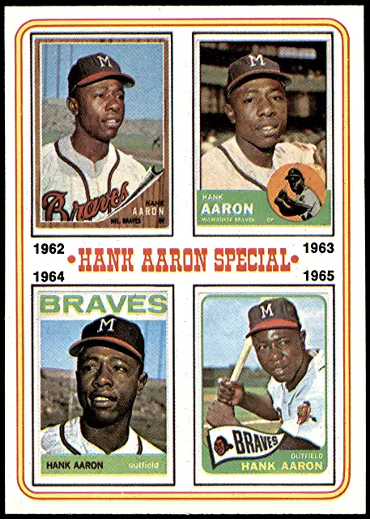
The cards-on-cards idea began with the Hank Aaron Special series in 1974. Aaron was a sure bet to break Babe Ruth’s all-time home run record early in the season and Topps wanted to capitalize on Aaron’s popularity. (Babe Ruth Specials were issued as part of Topps’ 1962 set, but were not cards-on-cards.)


• 1974 Topps “Cards-on-Cards” •
Cards #2-6 in the 1974 set show all of Topps’ regular-issue Aaron cards going back to his rookie card in 1954. Like the 1986 Rose cards, four old Aaron cards appear on each special.
The concept was interesting. Collectors could compare all of the home run king’s Topps cards without bothering to pull them from their own sets – if they had them all. For instance, it is easy to tell that the same photo was used on Aaron’s first three Topps cards. The infamous reversed negative 1957 card, which depicts Aaron batting lefthanded, is also there in all its glory. Then, too, we see that Topps got lazy again in 1969 by repeating his 1968 card photo.
The backs of these first cards-on-cards provide plenty of good information. Included is a listing of Aaron’s major league records up to that point; Aaron’s most memorable homers; the slugger’s “life in the major leagues”; and his milestone homers.
• 1975 Topps “Cards-on-Cards” •
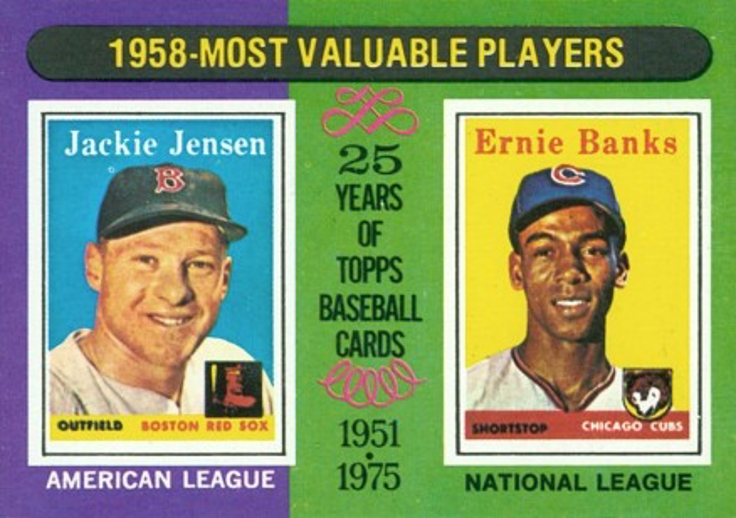
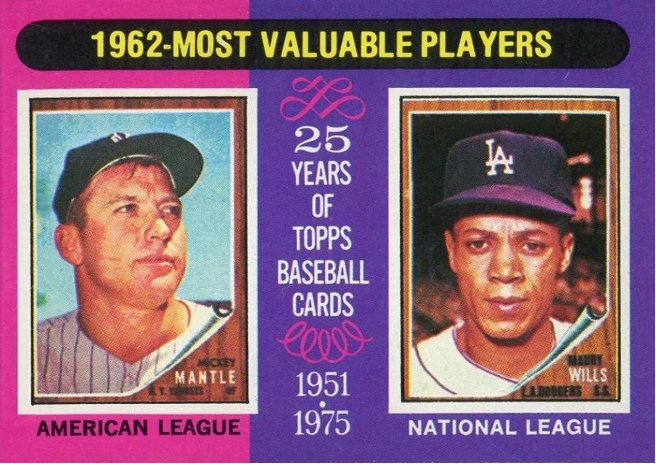
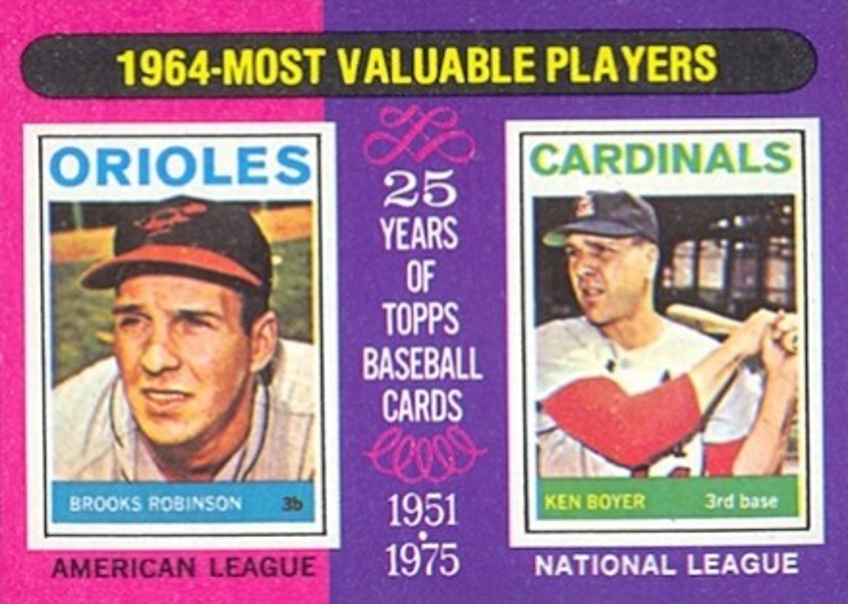
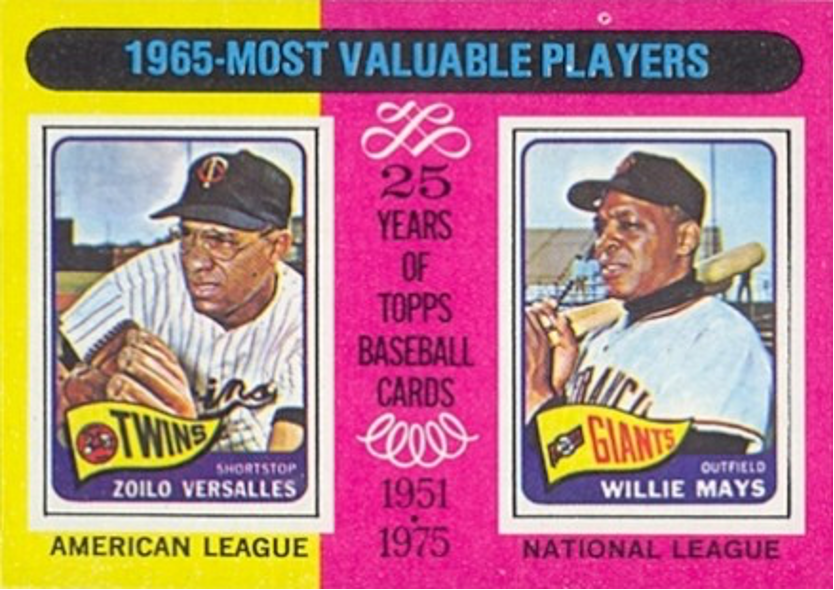
Topps nearly went wild with cards-on-cards in 1975. A 24-card subset (#189-212) was produced to – as it says on the card fronts – “celebrate 25 years of Topps baseball cards.” The cards featured Most Valuable Players from each league beginning in 1951, the “Real One’s” first year. For instance, the first card in the set featured the 1951 Topps cards of Yogi Berra and Roy Campanella – that year’s MVPs.
The cards make for another nice subset. Yet Topps’ idea was a bit flawed this time around. You see, Roy Campanella was the National League MVP in 1951, 1953 and 1955. He did not appear on a Topps card in either 1951 or 1955, so Topps had to “manufacture” one for each year of the subset. Ditto Maury Wills in 1962.
Campanella’s 1951 “phantom” card was okay. The 1962 phantom of Wills seemed pretty good, but the phony 1955 Campanella looks just plain stupid. Campy’s photo is in black and white, while we all know the cards were done in color. Highlights from each player’s MVP season are featured on the backs.
• 1976 Topps “Cards-on-Cards” •
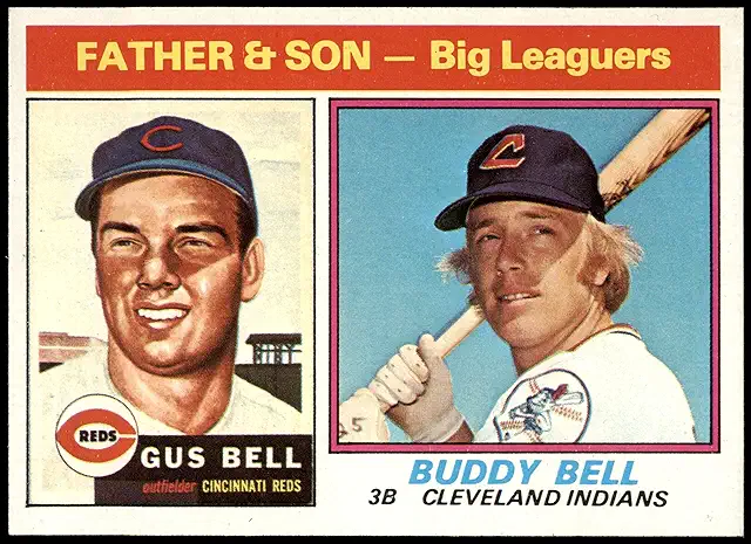
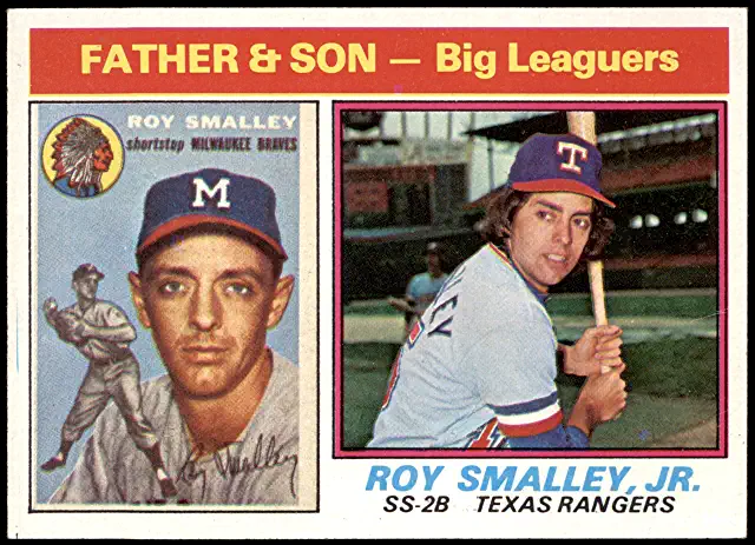
The 1976 set marked the third consecutive year Topps used the cards-on-cards idea. This time around, though, it was used on only the five cards (#66-70) making up the “Father & Son – Big Leaguers” subset. The cards depict an old Topps card of dad on the left and an up-to-date photo of the son (an active player) on the right. As an example, card #66 shows a 1953 Topps card of Gus Bell next to a photo of his son, Buddy.
The backs are kind of corny. The son writes a glowing tribute called “My Dad.” Joe Coleman’s starts out: “Dad was a tremendous influence upon me in my younger years, he didn’t push me but was always there when I needed advice …”

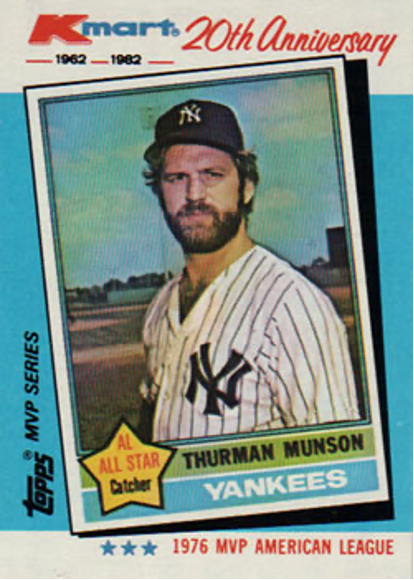
• 1982 K-Mart “Cards-on-Cards” (produced by Topps) •
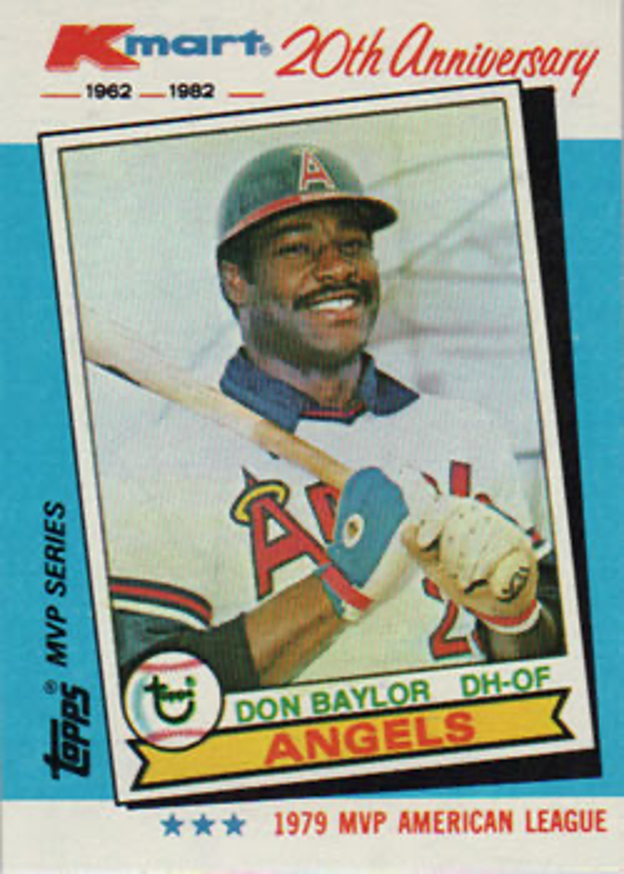
Continuing down the cards-on-cards road, we journey next to 1982 and the infamous K-Mart set produced by Topps. The most unlimited “Limited Edition” set ever issued, commemorates the 20th anniversary of the retail chain.
Like the 1975 subset, this set features Topps cards of Most Valuable Players. Only this time, each MVP has their own individual card and the set begins in 1962 – the year K-Mart was established.
Once again, a manufactured 1962 Maury Wills is used. In addition, Topps doctored up and rearranged a 1975 Fred Lynn rookie card to look like he had his own card that year. (Lynn actually shared his rookie card with Ed Armbrister, Tom Poquette and Terry Whitfield.)
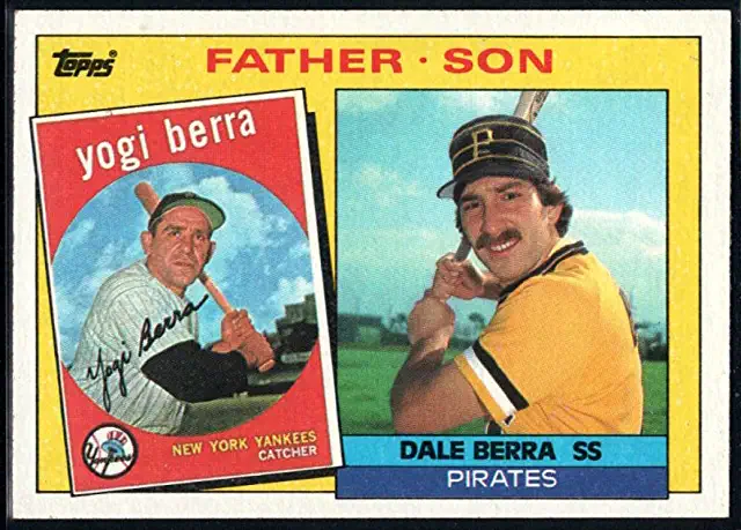
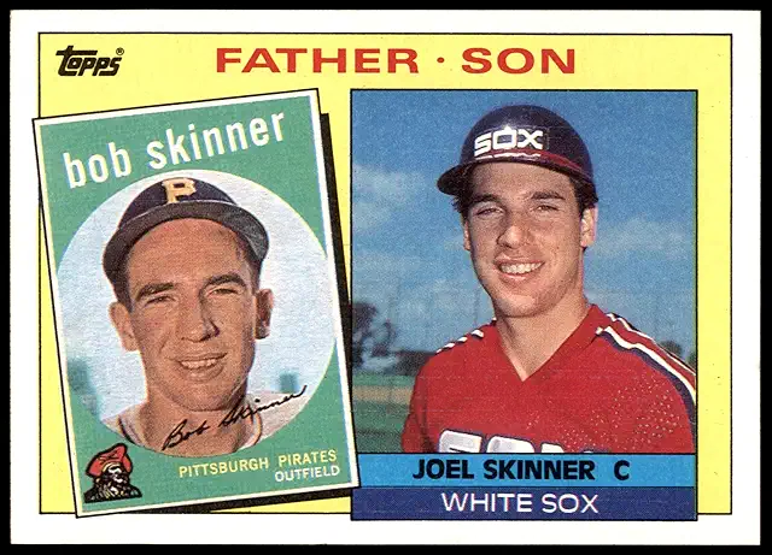
• 1985 Topps “Cards-on-Cards” •
It wasn’t until 1985 that Topps brought cards-on-cards back as a subset to their regular issue. Once again, collectors were subjected to Father-Son cards. Thirteen combinations of fathers and sons were used this time (#131-143). The format was nearly identical to the 1976 cards, except the backs carried basic biographical and career highlight information on both players.
Which brings us to 1986. The Pete Rose series mimics the Hank Aaron Specials of over a decade ago, but are attractive nonetheless. The Turn Back The Clock series, which was used previously in 1977 without card-on-cards, is pretty uninspired.
Five cards are included in the subset which features a look back five, 10, 15, 20 and 25 years. The 1981 card, for instance, shows Fernando Valenzuela – as he was a top rookie that year. The backs recap the bright moments of that particular season. (For reasons unknown, Topps did not use Valenzuela’s regular or Traded card from 1981 … they just made up a new one. The other four cards are “real.”)
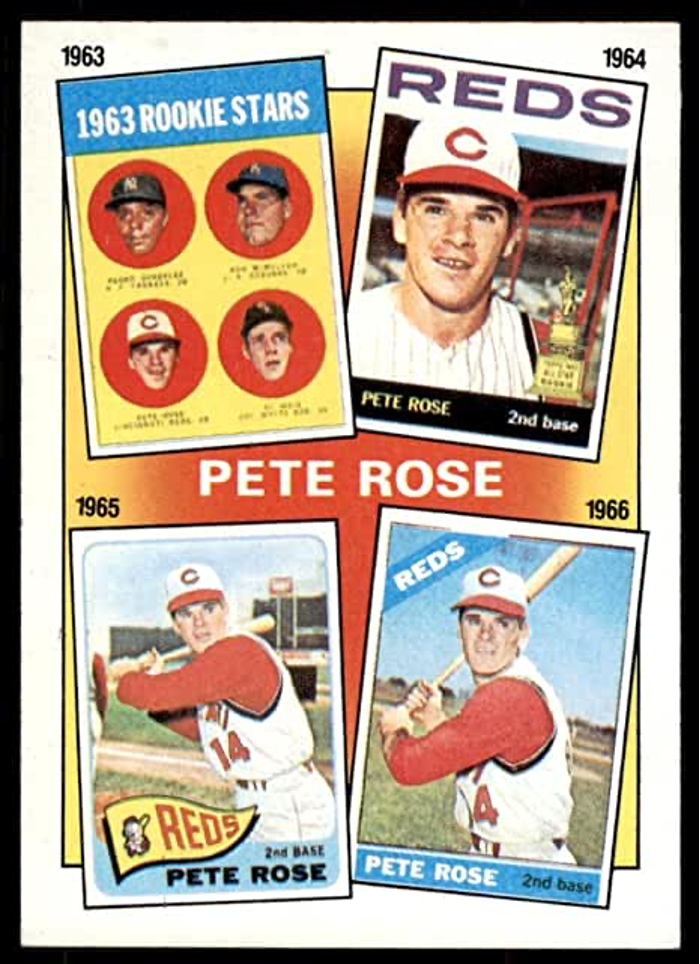
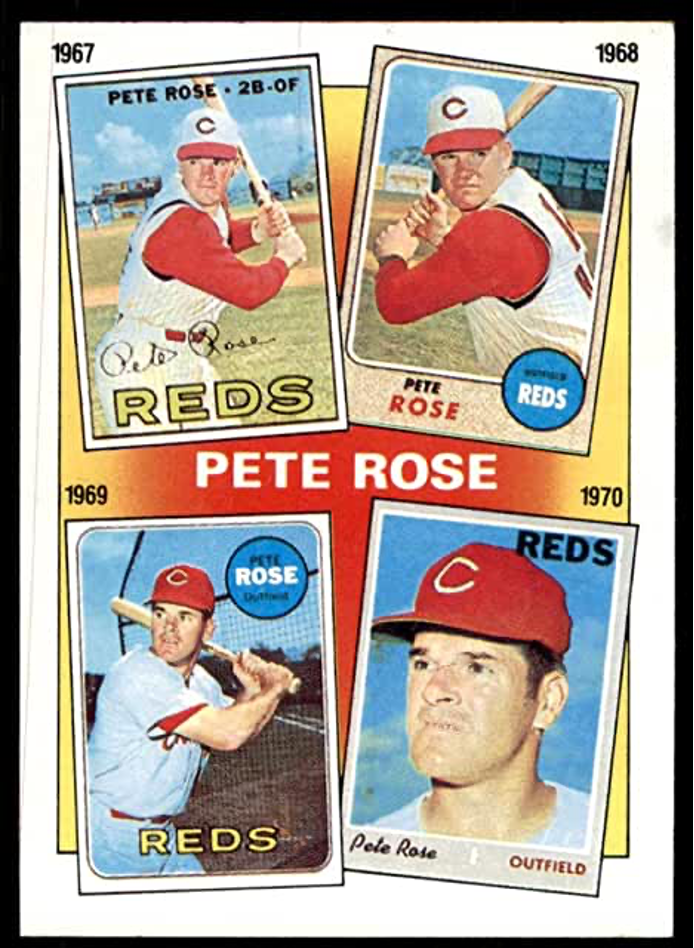
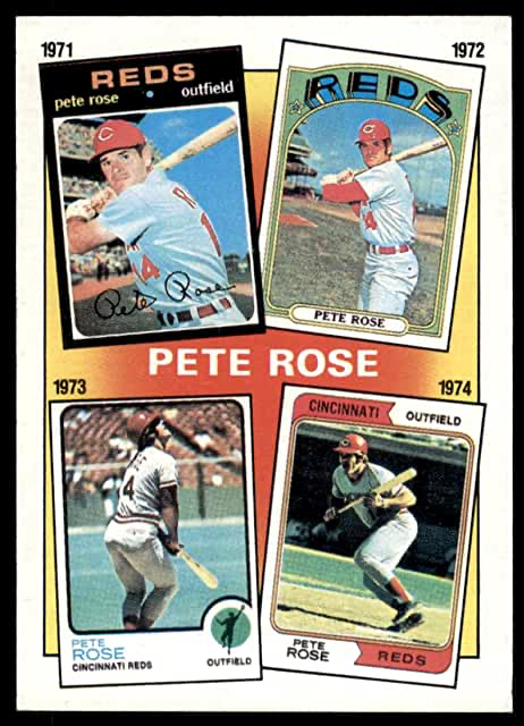
• 1986 Topps “Cards-on-Cards” •
If you don’t think Topps may have finally overdone it with the card-on-cards concept, consider the following: the 1973 Topps Pete Rose card and the 1966 Topps Frank Robinson card have now been used three times each.
Rose’s 1973 card was first used in the 1975 MVP series, again in the K-Mart set, and yet again in this year’s Pete Rose series. Robinson’s 1966 Topps repeat performances also include the 1975 MVP subset and the K-Mart set, plus the 1986 Turn Back The Clock series.
Rose is now king of the cards-on-cards. With his cards in the 1986 set, Rose has appeared on eight cards-on-cards (including K-Mart). The new all-time hits leader edged out Hank Aaron, who appeared on seven cards.
Besides Rose and Aaron which players have appeared on the most cards-on-cards? Four others have been on four cards: Yogi Berra, Frank Robinson, Willie Mays and Mickey Mantle.
Berra appeared as the 1951, 1954 and 1955 MVP in the 1975 Topps set, as well as in the 1985 Father-Son set with son, Dale.
Frank Robinson, as already mentioned, appeared in the 1975 set, K-Mart set and 1986 Turn Back The Clock series. But wait! He was included twice in the 1975 set – once as MVP in 1961 and again in 1966 – making four cards-on-cards.
Willie Mays graced the 1975 set twice as MVP in 1954 and 1965. He also showed up in the K-Mart set and is featured in this year’s Turn Back The Clock subset.
The Mick appeared three times as MVP in the 1975 set: in 1956, 1957 and 1962. He too, unfortunately, was sentenced to life in the K-Mart set. …
• • • • • •
• Originally Published in July 1986 “Baseball Hobby News” •
THIS ARTICLE FROM “BASEBALL HOBBY NEWS” MAGAZINE IS REPRINTED WITH THE PERMISSION OF BOTH THE EDITOR/PUBLISHER AND THE AUTHOR. IT HAS BEEN RETYPED, BUT NO CONTENT HAS BEEN CHANGED (EXCEPT FOR VERY MINOR ADJUSTMENTS, CORRECTIONS TO TYPOGRAPHICAL ERRORS AND CHANGES TO GRAPHICS). COMMENTS OR INFORMATION IN THE ARTICLE MAY BE OUT-OF-DATE.
To keep up-to-date on additions to this
website, subscribe at bottom of this page*
* Your email address will never be shared and is only used to announce new articles
 BaseballCardFun.com