
BY TROY KIRK
In 1976, Fleer released their last set before the big one in 1981. This was a 42-card set, measuring 2 1/2 by 4 inches on gray cardboard. The front design consists of the title “Baseball Firsts” on the top of the vertical-formatted cards, with a brief description of what is first and a cartoon depicting whatever is being described. The backs also have “Baseball Firsts” at the top, followed by a write-up on the event or thing that is a first in baseball. At the bottom is the number out of 42 in the set, a copyright by Fleer and credit to R.G. Laughlin.
The subjects of these cards range from the first slide to the first catcher’s mask to the first .400 hitter to the first baseball cards. Any momentous first is fair game in this set. The write-ups are generally two or three short paragraphs telling a little about the background of the famous first. This is an informative and interesting set.

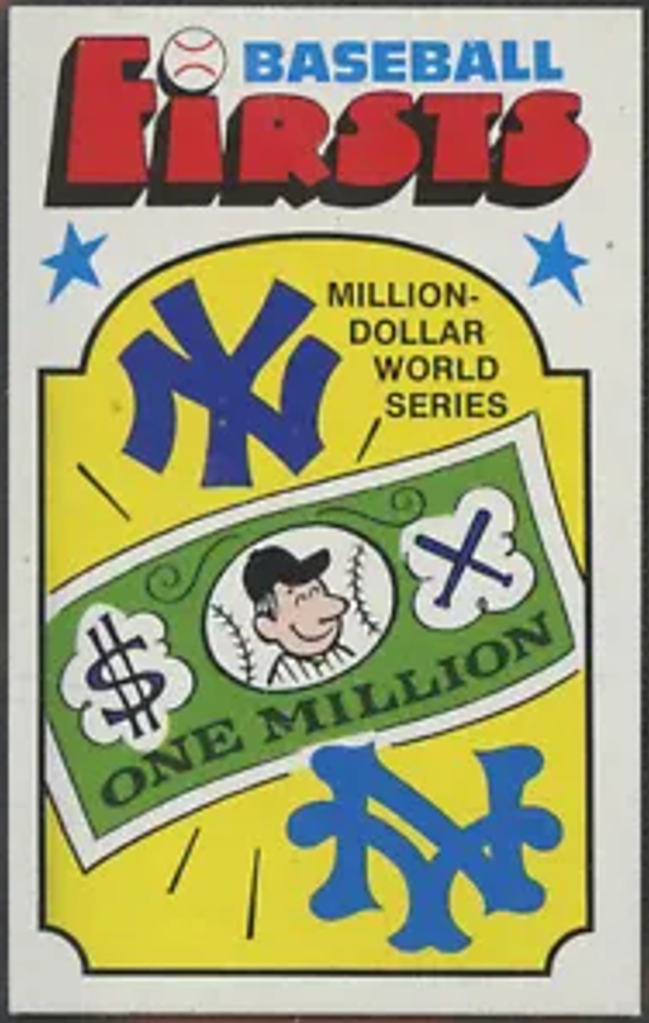
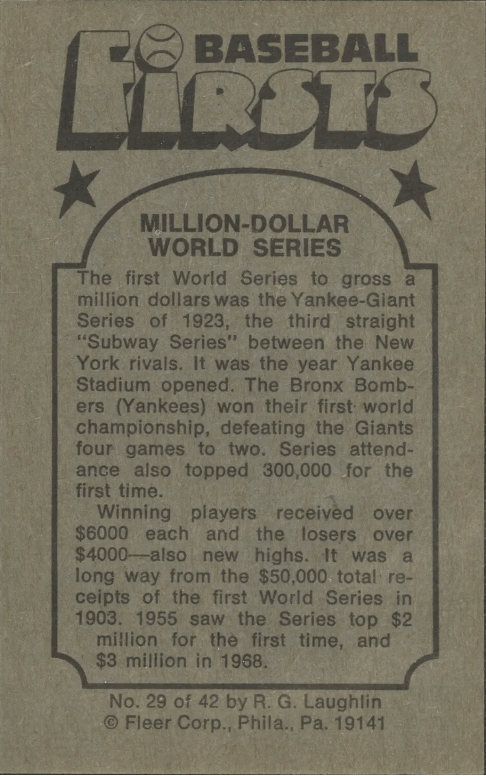

CHECKLIST – 1976 FLEER “BASEBALL FIRSTS”
1. Slide
2. Spring Training
3. Bunt
4. Catcher’s Mask
5. Four Straight Homers
6. Radio Broadcast
7. Numbered Uniforms
8. Shin Guards
9. Players Association
10. Knuckleball
11. Player with Glasses
12. Baseball Cards
13. Standardized Rules
14. Grand Slam
15. Player Fined
16. Presidential Opener
17. Player Transaction
18. All-Star Game
19. Scoreboard
20. Cork Center Ball
21. Scorekeeping
22. Domed Stadium
23. Batting Helmets
24. Fatality
25. Unassisted Triple Play
26. Home Run at Night
27. Black Major Leaguer
28. Pinch Hitter
29. Million Dollar World Series
30. Tarpaulin
31. Team Initials
32. Pennant Playoff
33. Glove
34. Curve Ball
35. Night Game
36. Admission Charge
37. Farm System
38. Telecast
39. Commissioner
40. .400 Hitter
41. World Series
42. Player Into Service
There are two other miscellaneous Fleer baseball card sets I know about – both issued in the late ’60s or early ’70s. I don’t know much about either, but I do have a few samples from each.
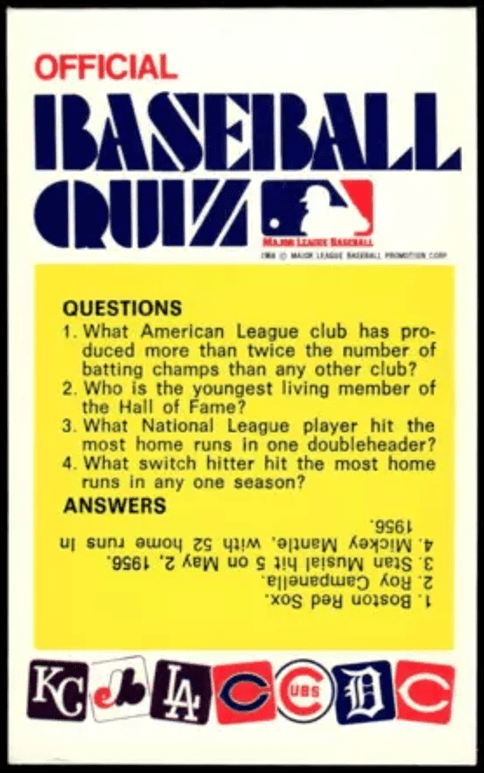
The first I’ll call the Yellow Baseball Quiz set. These cards are 2 1/2 by 4 inches and are titled “Official Baseball Quiz.” The cards have three to five baseball trivia questions, with the answers upside down in a yellow box. There is a 1968 copyright on the card, but there are questions about 1968 events on certain cards. This suggests they were issued in 1969 or later. The bottom of the card has a row of seven team logos. I have cards with three different sets of seven logos. There is probably at least one more, so that all of the teams are covered. I don’t know how many cards are in the set, but I have 13 different. There is no writing on the back and no mention of Fleer anywhere on the card.
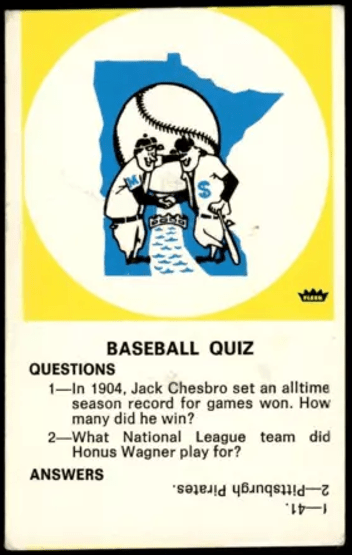
The second unknown set I’ll call the Team Logo Baseball Quiz set. These cards have a team logo taking up slightly more than the top half of the card, with three baseball trivia questions at the bottom of the card – the answers being upside down. The Fleer crown logo is on the card. The backs are blank. There is a reference to the Seattle Pilots in the past tense in one of the questions, so the set had to have come out in 1970 or later. There is also a card for the Washington Senators, so this pinpoints the set to 1970 or 1971. There are probably at least 24 cards in the set (one for each team in the early ’70s), but I only have 17 different. I do have one variation. The Houston Astros team logo comes in two different versions. The quiz questions are the same, but the colors on the logos are different.
FINAL THOUGHTS/OPINIONS:
In all, R.G. Laughlin designed six baseball card sets for Fleer. He gets credit on the backs of all of the cards, too. These sets are not to be confused with several other sets Laughlin put out on his own in the early 1970s. While the sets he issued on his own were nice, they are collector issues. The only way they could be obtained was through Laughlin or baseball card dealers. They could not be purchased in stores like the Fleer cards.
This brings up the whole issue of collector issues vs. legitimate issues. Some collectors felt that since Laughlin had designed Fleer cards, his own sets were therefore legitimate issues. The same can be said now for Topps and Fleer traded/update sets. Some collectors feel that since Topps and Fleer put them out, they are legitimate issues. This is simply not the case.
A legitimate issue of baseball cards is one that anybody can obtain, whether they’ve heard of the organized hobby of baseball card collectors or not. A collector issue is one that is only obtainable through the organized hobby. In theory, anyone could put out a set of baseball cards. Many people do in order to line their own pockets. There is nothing wrong with that. That’s why Topps, Fleer, Donruss and other card companies put out cards too. Still, in order to be a legitimate collectible, the cards have to be available to the general public. How can there be a value to cards made by a private individual who can feel free to print up more any time he wants?
While we can’t be sure Topps will never make reprints of their earlier issues, it would not be in their best interest to do so. Their market is so huge because they sell to everybody. Their power has grown over the last few years because of the values now attributed to some of their older cards. If they were to issue unmarked reprints, their card values would drop to nothing and many serious collectors would abandon them as collectible cards. Their business is too big to allow that to happen. They have released marked reprints, but that doesn’t hurt the value of the original cards. Private individuals have no such worries. They don’t care about the long-range value of their issues because they are probably not going to keep producing sets every year. If there is a demand for their cards a few years down the road, they can print up some more and just say they had a few sets left over from the original printing.
Even though Topps and Fleer will probably not make unmarked reprints of their traded/update sets, these are still collector issues since they are only available through baseball card dealers and cannot be obtained by people not aware of the organized hobby. The whole point I’m getting at is that there are two types of baseball cards – legitimate and collector issues. If you like collector issues, by all means buy them. But if you’re like me and feel you have to get every legitimate issue each year, don’t concern yourself with them. It’s expensive enough just to get the legitimate sets.
LEGITIMATE ISSUES
• Topps 1951-85
• Fleer 1981-85
• Bowman 1948-55
• Kellogg’s 1970-83
• Hostess 1975-79
VS.
COLLECTOR ISSUES
• Topps Traded 1981-85
• Fleer Update 1984-85
• SSPC sets*
• Topps 1952 Reprints
• The Star Co. sets
* Sports Stars Publishing Company
EXAMPLES OF TWO “COLLECTORS ISSUES”
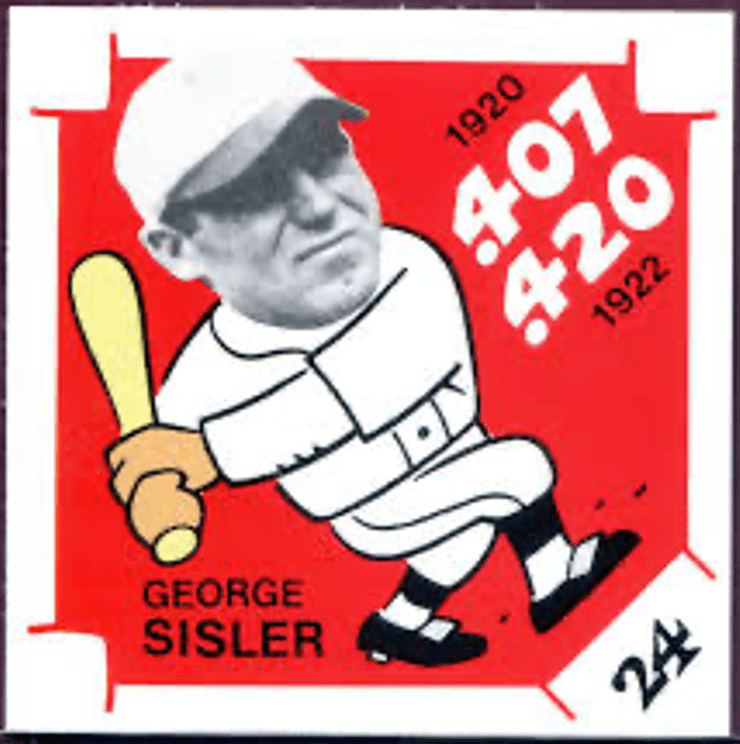
300/400/500 blank-backed set
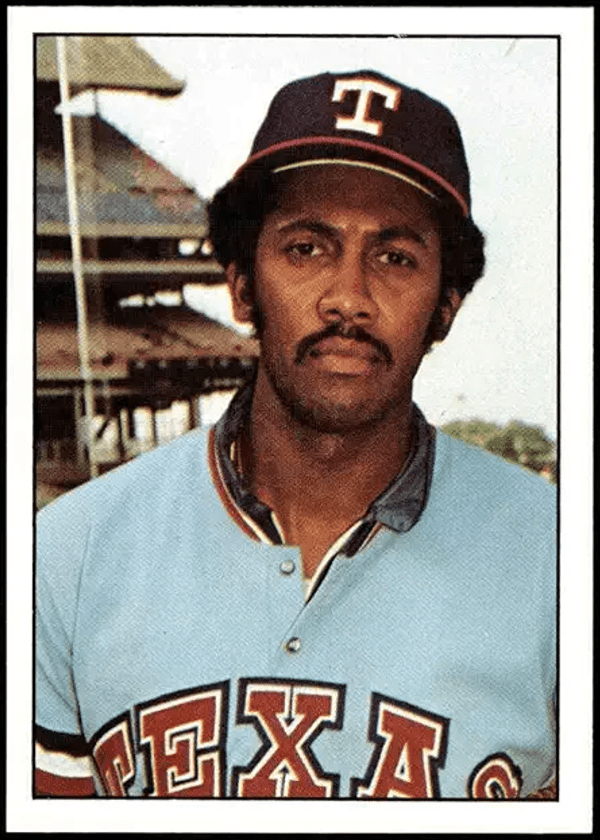
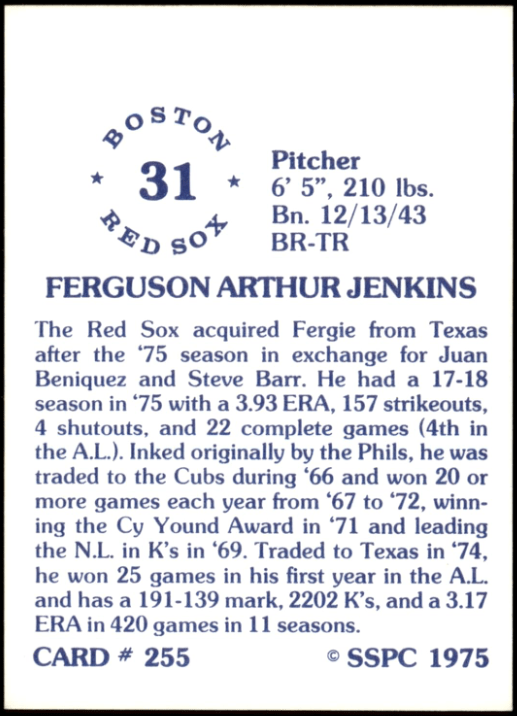
1976 SSPC
• • • • • •
See related articles on BaseballCardFun.com entitled:
“TWIN TIMES – Fleer Oddball Sets, Parts 1” Click Link Here
“TWIN TIMES – Fleer Oddball Sets, Parts 2” Click Link Here
• Originally Published in Oct. 1985 “Twin Times” •
THIS ARTICLE FROM THE “TWIN TIMES” NEWSLETTER – OFFICIAL PUBLICATION OF THE TWIN CITIES SPORTS COLLECTORS CLUB – IS REPRINTED WITH THE PERMISSION OF THE AUTHOR. IT HAS BEEN RETYPED, BUT NO CONTENT HAS BEEN CHANGED (EXCEPT FOR VERY MINOR ADJUSTMENTS, CORRECTIONS TO ANY TYPOGRAPHICAL ERRORS AND THE ADDITION OF GRAPHICS). COMMENTS OR INFORMATION IN THE ARTICLE MAY BE OUT-OF-DATE.
To keep up-to-date on additions to BaseballCardFun.com, subscribe below*
* Your email address will never be shared and is only used to announce new articles
 BaseballCardFun.com